Georgia 3.PAR.3
Georgia Standard (Expectation Cluster)
Use part-whole strategies to solve real-life, mathematical problems involving multiplication and division with whole numbers within 100.
Georgia's K-12 Mathematics Standards
Cluster contents
Expectations in This Standard
3.PAR.3 is a Georgia mathematics standard. These are the expectations under it.
- 3.PAR.3.1
Describe, extend, and create numeric patterns related to multiplication. Make predictions related to the patterns.
- 3.PAR.3.2
Represent single digit multiplication and division facts using a variety of strategies. Explain the relationship between multiplication and division.
- 3.PAR.3.3
Apply properties of operations (i.e., commutative property, associative property, distributive property) to multiply and divide within 100.
- 3.PAR.3.4
Use the meaning of the equal sign to determine whether expressions involving addition, subtraction, and multiplication are equivalent.
- 3.PAR.3.5
Use place value reasoning and properties of operations to multiply one-digit whole numbers by multiples of 10, in the range 10-90.
- 3.PAR.3.6
Solve practical, relevant problems involving multiplication and division within 100 using part-whole strategies, visual representations, and/or concrete models.
- 3.PAR.3.7
Use multiplication and division to solve problems involving whole numbers to 100. Represent these problems using equations with a letter standing for the unknow...
Teacher's field guide
What This Cluster Means
What Students Need to Do
- Students solve story problems by identifying the whole and the known and unknown parts. They use equal groups, arrays, or break-apart facts to multiply or divide within 100.
What Mastery Looks Like
- Students identify the total, group size, number of groups, and unknown in a problem. They use an array, equal groups, or a break-apart strategy and write a matching equation.
Common Misconceptions
- Students may add the number of groups and the group size instead of multiplying. They may confuse finding the number of groups with finding the size of each group. Some students know a fact but cannot connect it to a matching model or division equation.
How to Assess It
- Exit ticket: “A teacher puts 32 markers equally into 4 cups. How many markers go in each cup?” Require a diagram, equation, and answer sentence.
Lesson moves
Ways to Teach It
Give pairs 36 counters and cups, then have them build equal groups, record related equations, and label the whole and parts.
Ask, “How are 6 × 8 and 48 ÷ 6 connected?” Students write two sentences using groups, group size, and total.
Play Fact Family Match with cards showing an array, a total, and related multiplication and division equations within 100.
Pack 24 snacks equally into 3, 4, 6, or 8 bags, then compare how many snacks each bag holds.
Free download
Printable 3.PAR.3 Worksheet
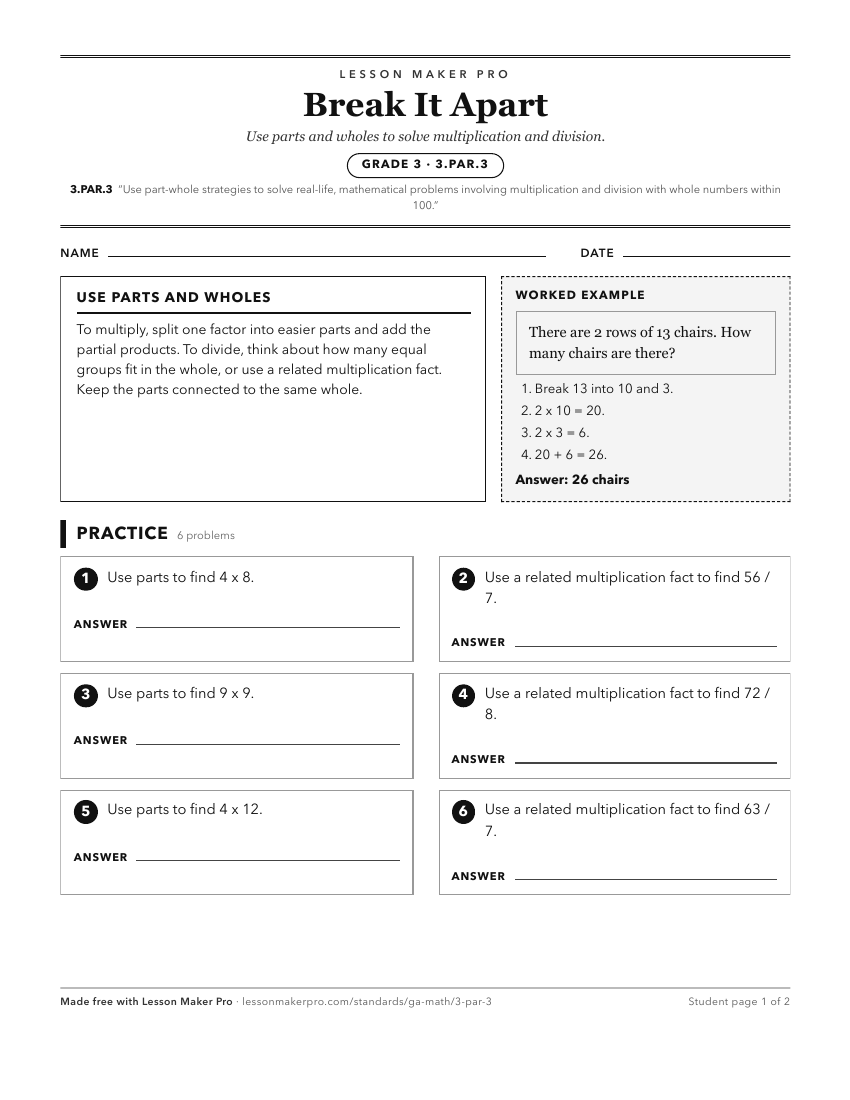
A ready-to-print activity worksheet aligned to 3.PAR.3, with an answer key for the teacher on its own page. No account needed.
PDF, US Letter, prints cleanly in black and white.
Download the worksheetKeep exploring
Related Standards
- 3.PAR.2
Use part-whole strategies to represent and solve real-life problems involving addition and subtraction with whole numbers up to 10,000.
- 2.NR.2.3
Solve problems involving the addition and subtraction of two-digit numbers using part-whole strategies.
- 4.NR.2
Using part-whole strategies, solve problems involving addition and subtraction through the hundred-thousands place, as well as multiplication and division of mu...
Turn this cluster into a lesson
Grade, subject, topic, and the complete cluster are prefilled. Create one free, no account needed.
Also for this cluster:Make a WorksheetMake a QuizMake a Sub Lesson