Georgia 3.PAR.3.1
The Standard
Describe, extend, and create numeric patterns related to multiplication. Make predictions related to the patterns.
Georgia's K-12 Mathematics Standards · Use part-whole strategies to solve real-life, mathematical problems involving multiplication and division with whole numbers within 100.
Teacher's field guide
What This Standard Means
What Students Need to Do
- Students identify, extend, and create number patterns based on multiplication. They describe the rule and use it to predict terms that come later.
What Mastery Looks Like
- Students extend a multiplication pattern and explain the rule using facts such as multiples of 4. They create a matching pattern and use the rule to predict later terms.
Common Misconceptions
- Students may look only at the amount added and miss its connection to a multiplication fact. They may also continue a pattern correctly but give a rule that does not fit every term.
How to Assess It
- Give the pattern 7, 14, 21, 28, __, __. Ask students to fill the blanks, state the multiplication rule, and predict the tenth term.
Lesson moves
Ways to Teach It
Build arrays with counters for 3 × 1 through 3 × 8, then record and extend the product pattern.
Ask students to explain in writing how the patterns for multiples of 2 and multiples of 4 are connected.
Play Pattern Detective with cards showing partial multiplication sequences, and have partners identify missing terms and state each rule.
Track the total wheels on groups of bicycles, then predict totals for larger groups without drawing every bicycle.
Free download
Printable 3.PAR.3.1 Worksheet
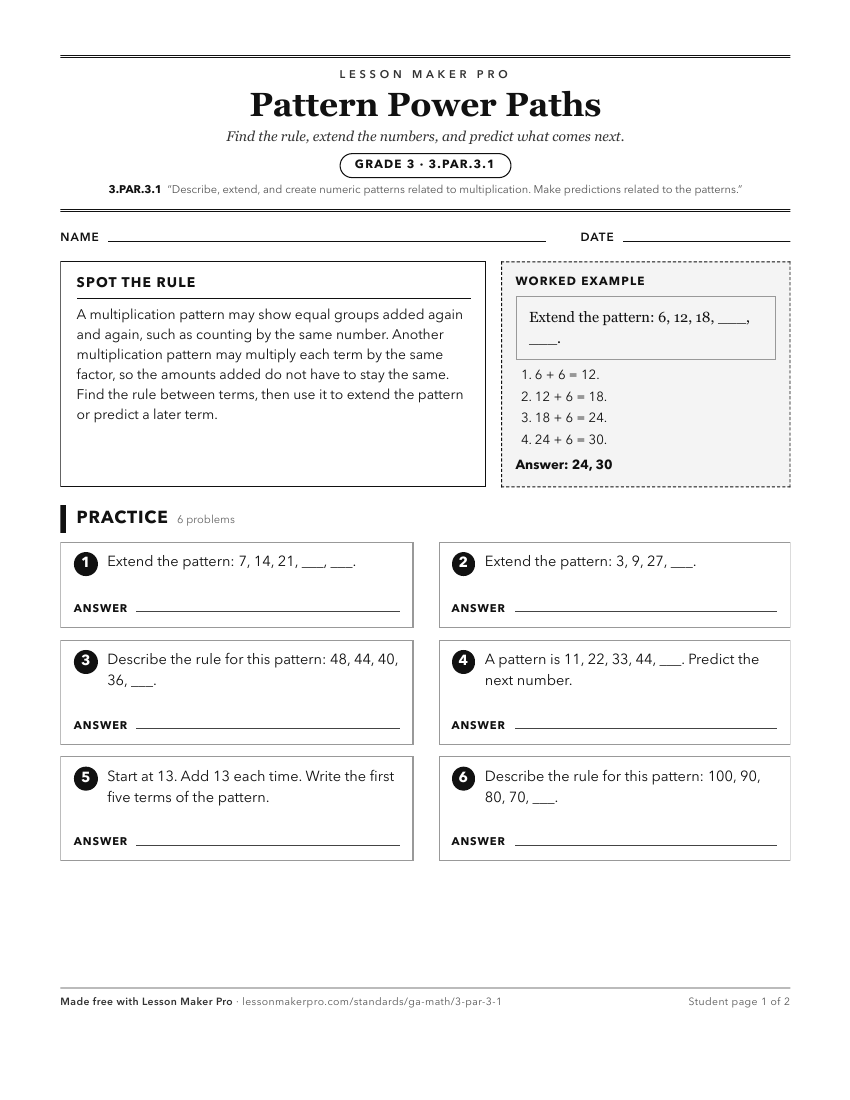
A ready-to-print activity worksheet aligned to 3.PAR.3.1, with an answer key for the teacher on its own page. No account needed.
PDF, US Letter, prints cleanly in black and white.
Download the worksheetKeep exploring
Related Standards
- 2.PAR.4
Identify, describe, extend, and create repeating patterns, growing patterns, and shrinking patterns.
- K.PAR.6.1
Create, extend, and describe repeating patterns with numbers and shapes, and explain the rationale for the pattern.
- 2.PAR.4.1
Identify, describe, and create a numerical pattern resulting from repeating an operation such as addition and subtraction.
- 1.PAR.3.1
Investigate, create, and make predictions about repeating patterns with a core of up to 3 elements resulting from repeating an operation, as a series of shapes,...
Turn this exact standard into a lesson
Grade, subject, topic, and the complete standard are prefilled. Create one free, no account needed.
Also for this standard:Make a WorksheetMake a QuizMake a Sub Lesson