Florida SS.8.G.4
Florida Standard (Benchmark Cluster)
Understand the characteristics, distribution, and migration of human populations.
Florida Next Generation Sunshine State Standards for Social Studies
Cluster contents
Benchmarks in This Standard
SS.8.G.4 is a Florida social studies standard. These are the benchmarks under it.
- SS.8.G.4.1
Interpret population growth and other demographic data for any given place in the United States throughout its history.
- SS.8.G.4.2
Use geographic terms and tools to analyze the effects throughout American history of migration to and within the United States, both on the place of origin and ...
- SS.8.G.4.3
Use geographic terms and tools to explain cultural diffusion throughout the United States as it expanded its territory.
- SS.8.G.4.4
Interpret databases, case studies and maps to describe the role that regions play in influencing trade, migration patterns, and cultural or political interactio...
- SS.8.G.4.5
Use geographic terms and tools to analyze case studies of the development, growth, and changing nature of cities and urban centers in the United States over tim...
- SS.8.G.4.6
Use political maps to describe changes in boundaries and governance throughout American history.
Teacher's field guide
What This Cluster Means
What Students Need to Do
- Students read maps, graphs, and tables to identify where people live and how populations change. They explain migration using push and pull factors, including jobs, conflict, climate, transportation, and available land.
What Mastery Looks Like
- Students can compare population patterns in two places and support their conclusions with map or data evidence. They can trace a migration route and explain why people left one place and chose another.
Common Misconceptions
- Students may confuse total population with population density. They may assume migration is always voluntary or caused by one factor. They may also treat population patterns as fixed rather than changing over time.
How to Assess It
- Give students a population density map and a short migration scenario. Ask them to identify one pattern, one push factor, and one pull factor.
Lesson moves
Ways to Teach It
Give pairs counters and a blank United States map, then have them model population data and describe where clusters form.
Ask students to write which factor most influences migration, jobs, safety, climate, or family, and defend their choice with evidence.
Play a push-or-pull sorting game using cards labeled drought, war, factory jobs, religious freedom, family ties, and affordable land.
Compare local census maps from two decades, then have students explain one population change using housing, jobs, roads, or hazards.
Free download
Printable SS.8.G.4 Worksheet
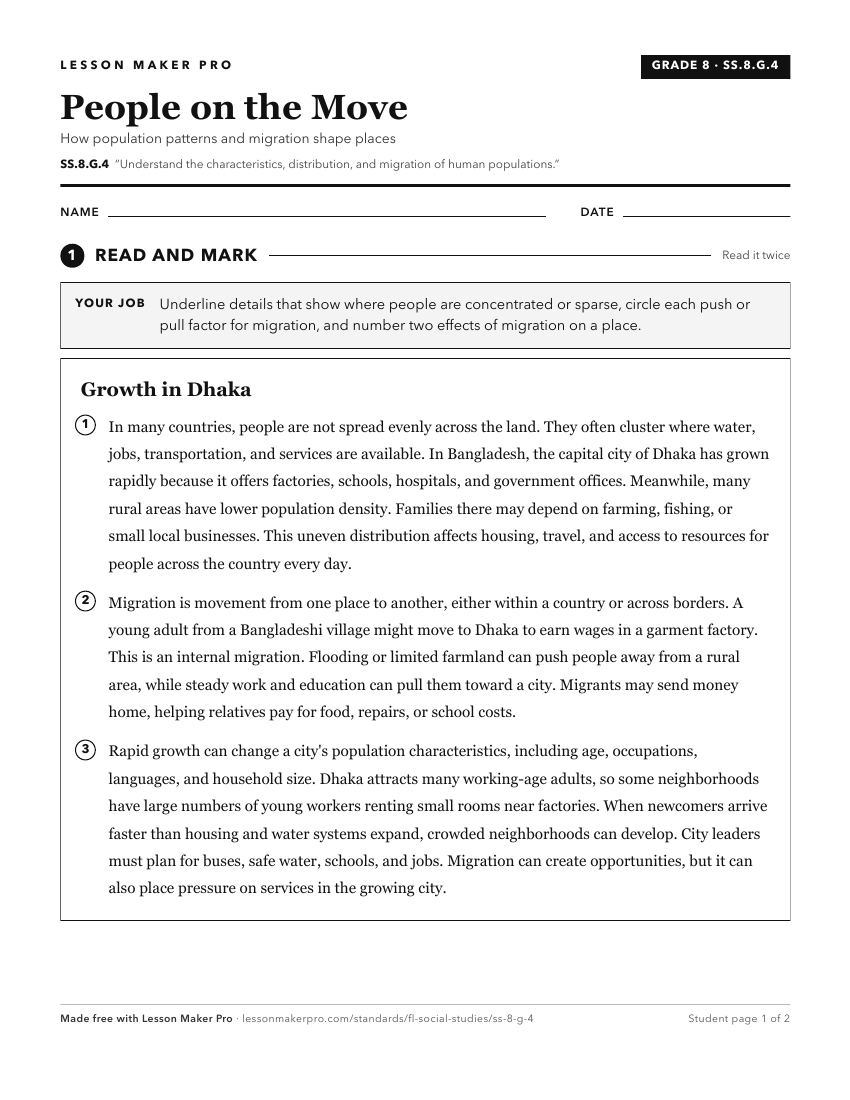
A ready-to-print activity worksheet aligned to SS.8.G.4, with an answer key for the teacher on its own page. No account needed.
PDF, US Letter, prints cleanly in black and white.
Download the worksheetKeep exploring
Related Standards
- SS.6.G.4
The 6th Grade version of this standard.
- SS.6.G.4.2
Use maps to trace significant migrations and analyze their results.
- SS.6.G.4.3
Locate sites in Africa and Asia where archaeologists have found evidence of early human societies and trace their migration patterns to other parts of the world...
- SS.7.G.4
The 7th Grade version of this standard.
Turn this cluster into a lesson
Grade, subject, topic, and the complete cluster are prefilled. Create one free, no account needed.
Also for this cluster:Make a WorksheetMake a QuizMake a Sub Lesson