Florida SS.6.G.4.3
The Standard
- SS.6.G.4
- Understand the characteristics, distribution, and migration of human populations.
Locate sites in Africa and Asia where archaeologists have found evidence of early human societies and trace their migration patterns to other parts of the world.
Florida Next Generation Sunshine State Standards for Social Studies
Teacher's field guide
What This Standard Means
What Students Need to Do
- Students locate early human sites in Africa and Asia on a map, such as Olduvai Gorge and Zhoukoudian. They draw likely routes from Africa into Asia and then to other parts of the world.
What Mastery Looks Like
- A student places both sites in the right regions on a blank map. They use arrows to show movement out of Africa and explain that the routes are based on evidence, not a record of every step people took.
Common Misconceptions
- Students may put Olduvai Gorge in Asia or assume all groups followed one exact route. Some think people reached every continent at the same time or that archaeologists can see the full path in the evidence.
How to Assess It
- Give students a blank world map. Ask them to mark Olduvai Gorge and Zhoukoudian, draw a possible route from Africa to East Asia, and label one piece of evidence archaeologists might find.
Lesson moves
Ways to Teach It
Give pairs a blank map and site cards for Olduvai Gorge and Zhoukoudian, then have them place the cards and draw migration arrows.
Ask students to write two sentences explaining why a stone tool find helps archaeologists map where early humans lived.
Play a map relay: teams place site labels and route arrows, then check each placement against an atlas.
Show a modern world map and ask students to trace a possible land route from East Africa to East Asia.
Free download
Printable SS.6.G.4.3 Worksheet
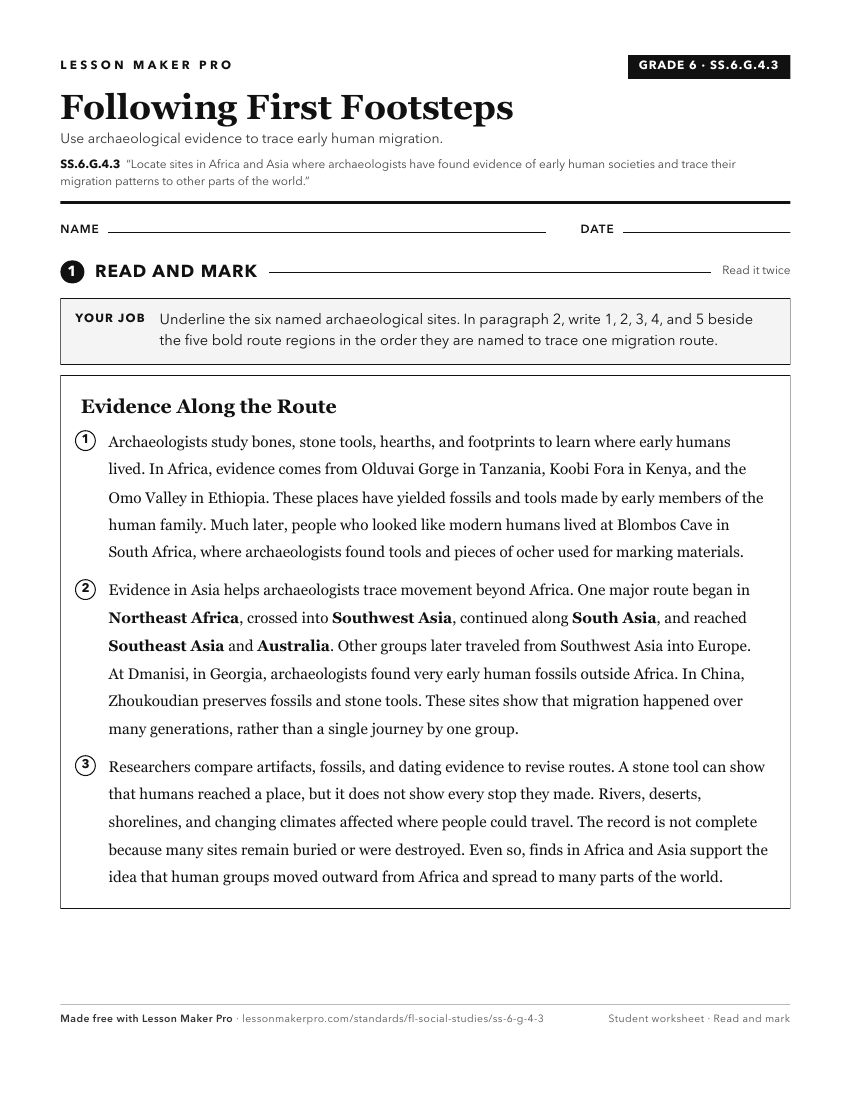
A ready-to-print activity worksheet aligned to SS.6.G.4.3, with an answer key for the teacher on its own page. No account needed.
PDF, US Letter, prints cleanly in black and white.
Download the worksheetKeep exploring
Related Standards
- SS.6.G.4
Understand the characteristics, distribution, and migration of human populations.
- SS.6.G.4.2
Use maps to trace significant migrations and analyze their results.
- SS.7.G.4
Understand the characteristics, distribution, and migration of human populations.
- SS.8.G.4
Understand the characteristics, distribution, and migration of human populations.
Turn this exact standard into a lesson
Grade, subject, topic, and the complete standard are prefilled. Create one free, no account needed.
Also for this standard:Make a WorksheetMake a QuizMake a Sub Lesson