Florida SS.6.W.2
Florida Standard (Benchmark Cluster)
Describe the emergence of early civilizations (e.g., Nile, Tigris-Euphrates, Indus, and Yellow Rivers, Mesoamerican, and South American).
Florida Next Generation Sunshine State Standards for Social Studies
Cluster contents
Benchmarks in This Standard
SS.6.W.2 is a Florida social studies standard. These are the benchmarks under it.
- SS.6.W.2.1
Compare the lifestyles of hunter-gatherers with those of settlers of early agricultural communities.
- SS.6.W.2.2
Describe how the developments of agriculture and metallurgy related to settlement, population growth, and the emergence of civilization.
- SS.6.W.2.3
Identify the characteristics of civilization.
- SS.6.W.2.4
Compare the economic, political, social, and religious institutions of ancient river civilizations.
- SS.6.W.2.5
Summarize important achievements of Egyptian civilization.
- SS.6.W.2.6
Determine the contributions of key figures from ancient Egypt.
- SS.6.W.2.7
Summarize the important achievements of Mesopotamian civilization.
- SS.6.W.2.8
Determine the impact of key figures from ancient Mesopotamian civilizations.
- SS.6.W.2.9
Identify key figures and basic beliefs of the Israelites and determine how these beliefs compare with those of others in the geographic area.
- SS.6.W.2.10
Compare the emergence of advanced civilizations in Mesoamerica and South America with the four early river valley civilizations.
Teacher's field guide
What This Cluster Means
What Students Need to Do
- Students explain how farming, water access, trade, government, and record keeping helped settlements grow into civilizations. They identify similarities and differences across several early civilization regions.
What Mastery Looks Like
- Students can place major early civilizations on a map and describe why each developed in its location. They support explanations with details about food supply, rivers, trade, labor, or leadership.
Common Misconceptions
- Students may assume every early civilization developed beside a major river or emerged at the same time. They may also confuse a civilization’s location with its later territory or empire.
How to Assess It
- Give students a blank world map and ask them to locate two early civilizations. For each, they write one sentence explaining how geography supported its growth.
Lesson moves
Ways to Teach It
Give groups maps, water tokens, crop cards, and settlement pieces to build a civilization, then explain why they chose each location.
Ask students to write: Which mattered most for early civilization, reliable food, trade, government, or writing, and what evidence supports your choice?
Play a matching game where students pair civilization cards with location, geography, farming, trade, and government clues.
Compare an early settlement site with your town, then list how water, food, transportation, and leadership support both communities.
Free download
Printable SS.6.W.2 Worksheet
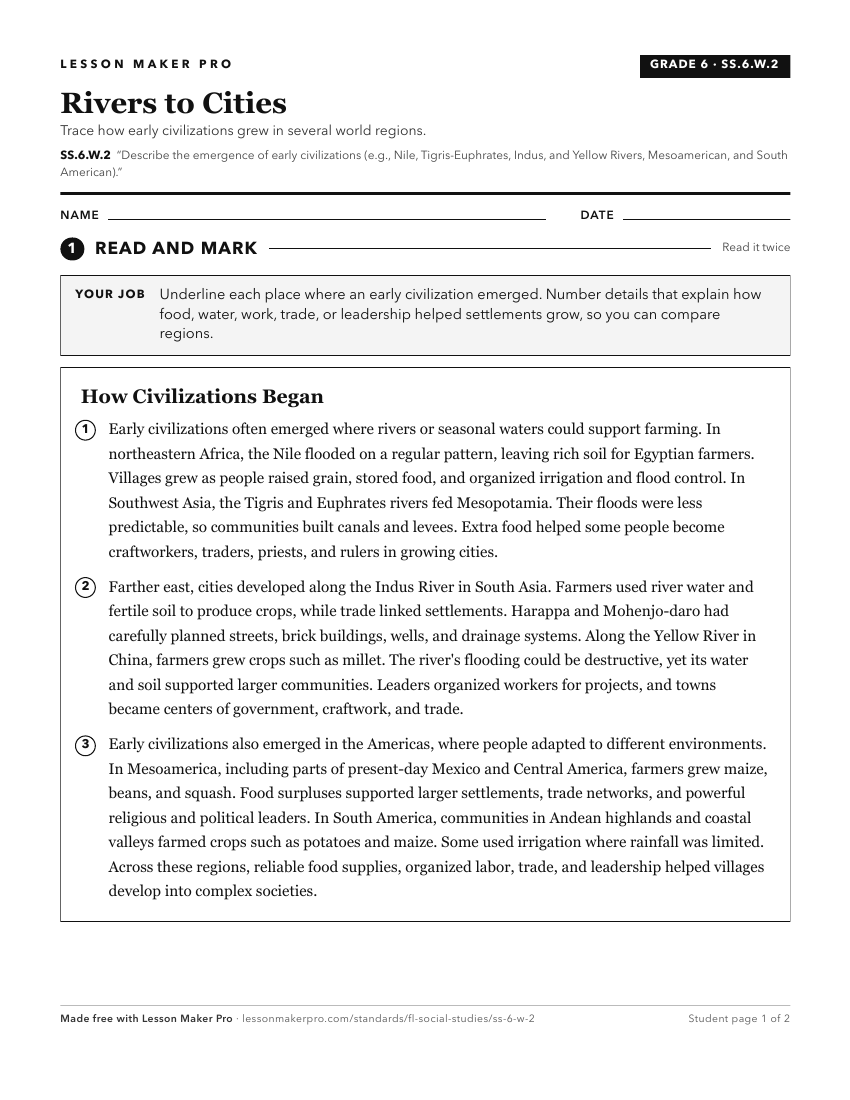
A ready-to-print activity worksheet aligned to SS.6.W.2, with an answer key for the teacher on its own page. No account needed.
PDF, US Letter, prints cleanly in black and white.
Download the worksheetKeep exploring
Related Standards
Turn this cluster into a lesson
Grade, subject, topic, and the complete cluster are prefilled. Create one free, no account needed.
Also for this cluster:Make a WorksheetMake a QuizMake a Sub Lesson