Florida SS.6.W.2.1
The Standard
- SS.6.W.2
- Describe the emergence of early civilizations (e.g., Nile, Tigris-Euphrates, Indus, and Yellow Rivers, Mesoamerican, and South American).
Compare the lifestyles of hunter-gatherers with those of settlers of early agricultural communities.
Florida Next Generation Sunshine State Standards for Social Studies
Teacher's field guide
What This Standard Means
What Students Need to Do
- Students identify how mobile groups found food and how farming communities produced and stored it. They compare movement, homes, work, population, and social organization, then explain how agriculture changed daily life.
What Mastery Looks Like
- A student can sort accurate details into both ways of life and name similarities as well as differences. The student uses specific evidence to explain one benefit and one cost of settling.
Common Misconceptions
- Students may assume farming immediately made life easier, safer, or healthier. They may also think all hunter-gatherers wandered constantly, lacked technology, or disappeared once farming began.
How to Assess It
- On an exit ticket, write two differences and one similarity between mobile food collectors and settled farmers. Then explain one benefit and one cost of settling.
Lesson moves
Ways to Teach It
Give groups picture cards of tools, homes, foods, and jobs to sort onto two floor mats, then defend two placements.
Students answer the prompt “Would you choose a mobile life or a settled village?” using three details about food, work, shelter, or safety.
Play a card game where teams match lifestyle clues to hunter-gatherers, farmers, or both, earning a point only with a correct explanation.
Compare a weekly grocery list with foods available seasonally nearby, then discuss how food supply affects where families live.
Free download
Printable SS.6.W.2.1 Worksheet
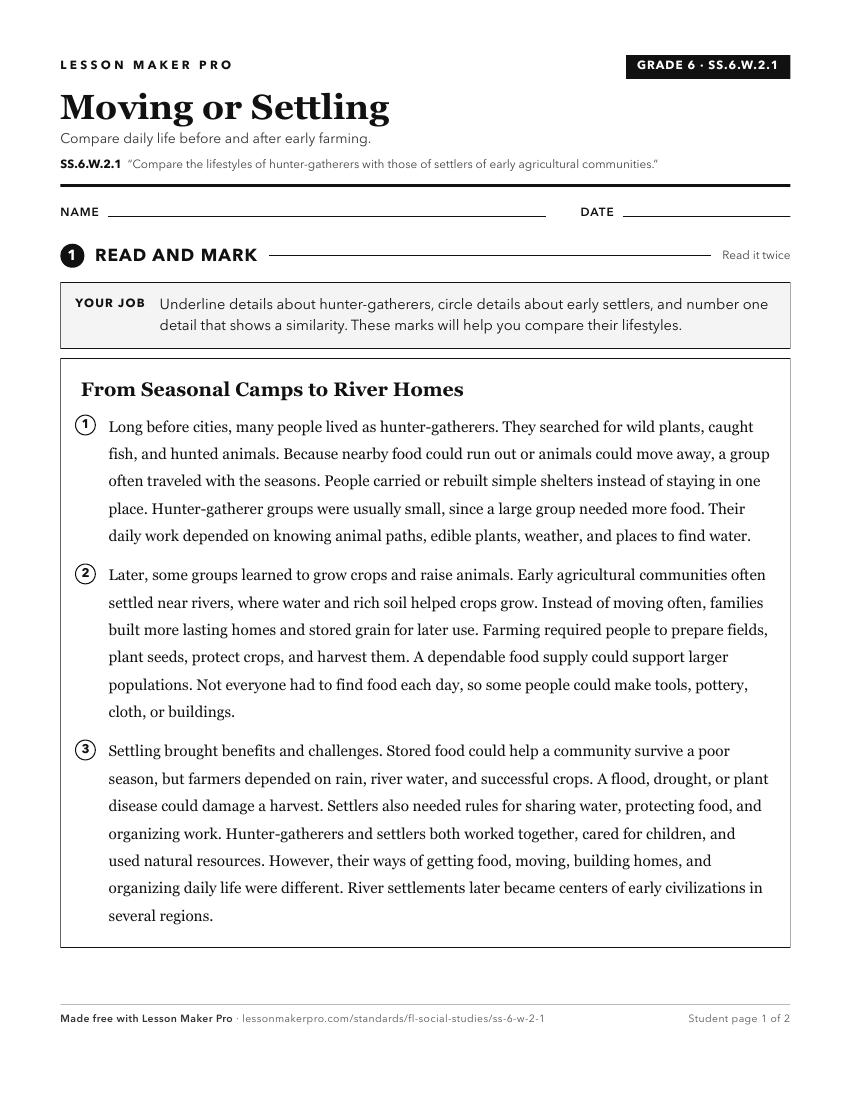
A ready-to-print activity worksheet aligned to SS.6.W.2.1, with an answer key for the teacher on its own page. No account needed.
PDF, US Letter, prints cleanly in black and white.
Download the worksheetKeep exploring
Related Standards
- SS.2.A.2.4
Explore ways the daily life of people living in Colonial America changed over time.
- SS.8.HC.1
Examine early attempts at communal living in American society.
- SS.8.HC.1.1
Examine early attempts at communal living in American society and their effect on economic stability and societal prosperity.
- SS.K.A.2.1
Compare children and families of today with those in the past.
Turn this exact standard into a lesson
Grade, subject, topic, and the complete standard are prefilled. Create one free, no account needed.
Also for this standard:Make a WorksheetMake a QuizMake a Sub Lesson