Florida SS.4.FL.2
Florida Standard (Benchmark Cluster)
Buying Goods and Services
Florida Next Generation Sunshine State Standards for Social Studies
Cluster contents
Benchmarks in This Standard
SS.4.FL.2 is a Florida social studies standard. These are the benchmarks under it.
- SS.4.FL.2.1
Explain that economic wants are desires that can be satisfied by consuming a good, a service, or a leisure activity.
- SS.4.FL.2.2
Explain that people make choices about what goods and services they buy because they can't have everything they want. This requires individuals to prioritize th...
- SS.4.FL.2.3
Identify some of the ways that people spend a portion of their income on goods and services in order to increase their personal satisfaction or happiness.
- SS.4.FL.2.4
Discuss that whenever people buy something, they incur an opportunity cost. Opportunity cost is the value of the next best alternative that is given up when a p...
- SS.4.FL.2.5
Explain that costs are things that a decision maker gives up; benefits are things that a decision maker gains. Make an informed decision by comparing the costs ...
- SS.4.FL.2.6
Predict how people’s spending choices are influenced by prices as well as many other factors, including advertising, the spending choices of others, and peer pr...
- SS.4.FL.2.7
Planning for spending can help people make informed choices. Develop a budget plan for spending, saving, and managing income.
Teacher's field guide
What This Cluster Means
What Students Need to Do
- Students make spending choices within a fixed budget. They compare price, quality, and personal priorities, then explain what they gave up by choosing one option.
What Mastery Looks Like
- A student can select purchases without exceeding a budget and support each choice with clear reasons. The student can identify the next best option and describe the tradeoff.
Common Misconceptions
- Students may think the cheapest option is always the best choice, or that having enough money makes any purchase wise. They may overlook taxes, future costs, advertising, peer pressure, and the option to save.
How to Assess It
- Give students a $20 budget and three choices: a $12 book, a $9 movie ticket, and a $6 snack. Have them choose purchases, total the cost, and explain one tradeoff.
Lesson moves
Ways to Teach It
Set up a classroom store with price cards and play money, then have students plan purchases within a $15 budget.
Ask, “Would you buy one durable backpack or two cheaper backpacks?” Students defend a choice using price, quality, and expected use.
Play Budget Bingo by calling out budgets and item pairs, then have students cover affordable choices and name each tradeoff.
Compare two grocery ads, then create a $25 breakfast list and explain why each item earned a place.
Free download
Printable SS.4.FL.2 Worksheet
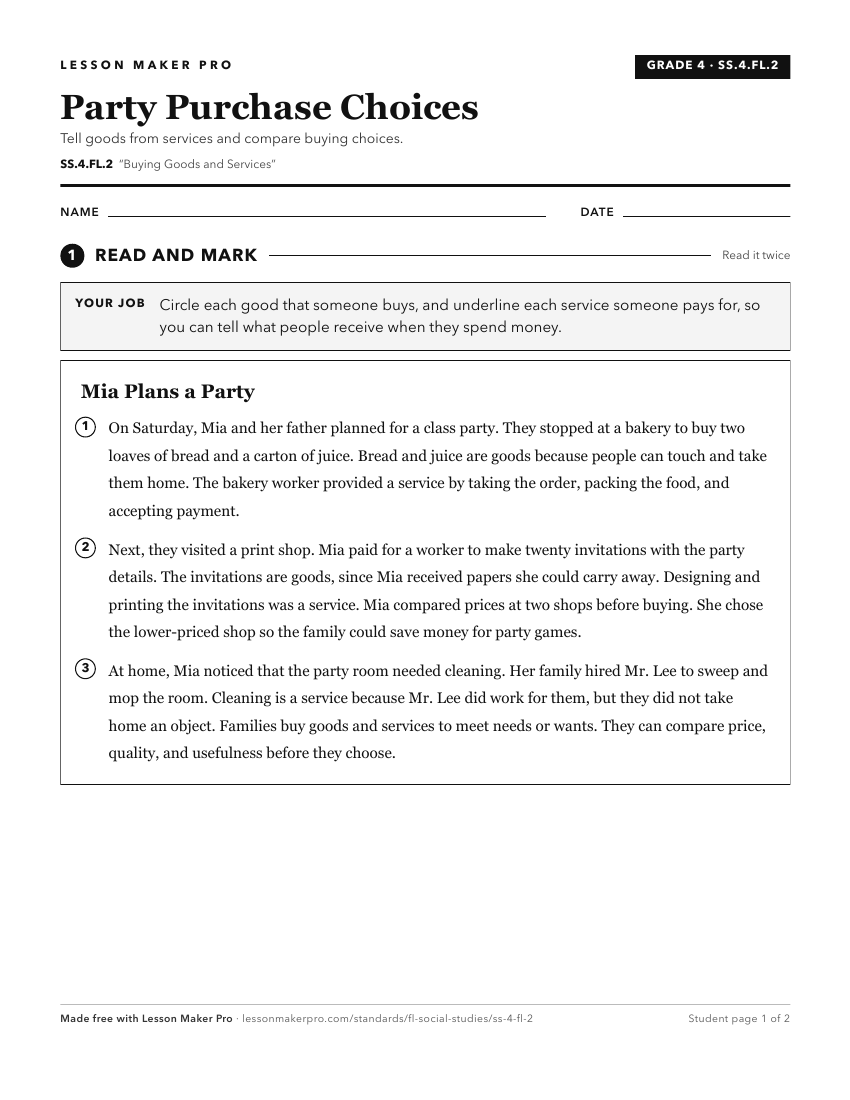
A ready-to-print activity worksheet aligned to SS.4.FL.2, with an answer key for the teacher on its own page. No account needed.
PDF, US Letter, prints cleanly in black and white.
Download the worksheetKeep exploring
Related Standards
Turn this cluster into a lesson
Grade, subject, and topic are prefilled; the lesson picks the standards under this heading. Create one free, no account needed.
Also for this cluster:Make a WorksheetMake a QuizMake a Sub Lesson