Florida SS.4.FL.1
Florida Standard (Benchmark Cluster)
Earning Income
Florida Next Generation Sunshine State Standards for Social Studies
Cluster contents
Benchmarks in This Standard
SS.4.FL.1 is a Florida social studies standard. These are the benchmarks under it.
- SS.4.FL.1.1
People have many different types of jobs from which to choose. Identify different jobs requiring people to have different skills.
- SS.4.FL.1.2
People earn an income when they are hired by an employer to work at a job. Explain why employers are willing to pay people to do their work.
- SS.4.FL.1.3
Workers are paid for their labor in different ways such as wages, salaries, or commissions. Explain the ways in which workers are paid.
- SS.4.FL.1.4
People can earn interest income from letting other people borrow their money. Explain why banks and financial institutions pay people interest when they deposit...
- SS.4.FL.1.5
People can earn income by renting their property to other people. Identify different types of property (such as apartments, automobiles, or tools) that people o...
- SS.4.FL.1.6
Describe ways that people who own a business can earn a profit, which is a source of income.
- SS.4.FL.1.7
Entrepreneurs are people who start new businesses. Entrepreneurs do not know if their new businesses will be successful and earn a profit. Identify ways in whic...
- SS.4.FL.1.8
Income earned from working and most other sources of income are taxed. Describe ways that the revenue from these taxes is used to pay for government provided go...
Teacher's field guide
What This Cluster Means
What Students Need to Do
- Students identify ways people receive money for work, including wages, salaries, tips, commissions, and business profit. They distinguish money earned through work from gifts or allowances.
What Mastery Looks Like
- Students can match workers with likely forms of payment and explain their choices. They can calculate simple earnings using hours, pay rates, sales, or business costs.
Common Misconceptions
- Students may call all money income, including gifts or borrowed money. They may confuse business sales with profit or assume every worker is paid by the hour.
How to Assess It
- Exit ticket: Sam earns $12 mowing lawns, gets a $10 birthday gift, and makes $30 selling lemonade after $18 in costs. Label each amount and find the profit.
Lesson moves
Ways to Teach It
Give pairs job, wage, salary, tip, commission, and profit cards to sort by how each worker gets paid.
Ask students to write which payment method fits a server, teacher, and shop owner, then explain each choice.
Play Income Match, where teams pair worker cards with wage, salary, commission, tip, or profit cards.
Use a fictional pay stub to identify hours worked, pay rate, gross pay, deductions, and take-home pay.
Free download
Printable SS.4.FL.1 Worksheet
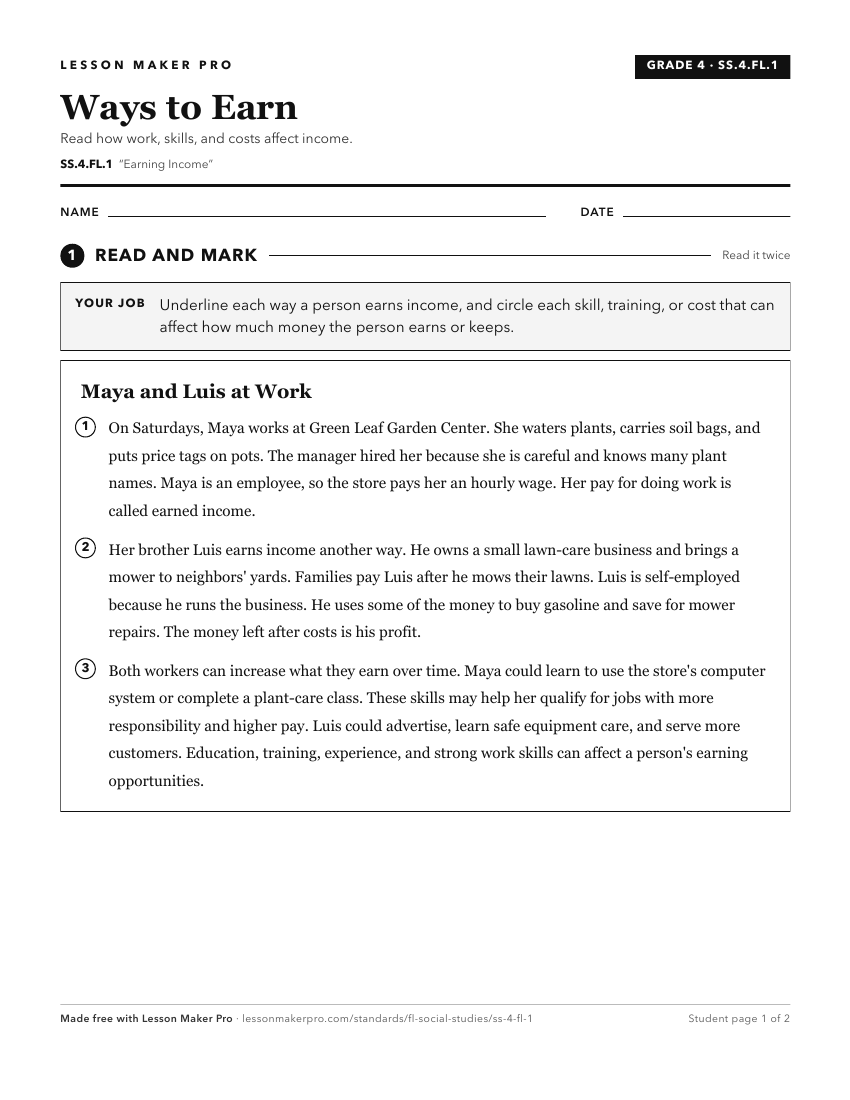
A ready-to-print activity worksheet aligned to SS.4.FL.1, with an answer key for the teacher on its own page. No account needed.
PDF, US Letter, prints cleanly in black and white.
Download the worksheetKeep exploring
Related Standards
Turn this cluster into a lesson
Grade, subject, and topic are prefilled; the lesson picks the standards under this heading. Create one free, no account needed.
Also for this cluster:Make a WorksheetMake a QuizMake a Sub Lesson