Florida B.E.S.T. MA.912.DP.4
B.E.S.T. Standard (Benchmark Cluster)
Use and interpret independence and probability.
Florida B.E.S.T. Standards for Mathematics
Cluster contents
Benchmarks in This Standard
MA.912.DP.4 is a B.E.S.T. standard. These are the benchmarks under it.
- MA.912.DP.4.1
Describe events as subsets of a sample space using characteristics, or categories, of the outcomes, or as unions, intersections or complements of other events.
- MA.912.DP.4.10
Given a mathematical or real-world situation, calculate the appropriate permutation or combination.
- MA.912.DP.4.2
Determine if events A and B are independent by calculating the product of their probabilities.
- MA.912.DP.4.3
Calculate the conditional probability of two events and interpret the result in terms of its context.
- MA.912.DP.4.4
Interpret the independence of two events using conditional probability.
- MA.912.DP.4.5
Given a two-way table containing data from a population, interpret the joint and marginal relative frequencies as empirical probabilities and the conditional re...
- MA.912.DP.4.6
Recognize and explain the concepts of conditional probability and independence in everyday language and everyday situations.
- MA.912.DP.4.7
Apply the addition rule for probability, taking into consideration whether the events are mutually exclusive, and interpret the result in terms of the model and...
- MA.912.DP.4.8
Apply the general multiplication rule for probability, taking into consideration whether the events are independent, and interpret the result in terms of the co...
- MA.912.DP.4.9
Apply the addition and multiplication rules for counting to solve mathematical and real-world problems, including problems involving probability.
Teacher's field guide
What This Cluster Means
What Students Need to Do
- Students decide whether one event changes the probability of another event. They use tables, diagrams, formulas, and context to calculate probabilities and justify whether events are independent.
What Mastery Looks Like
- Students can decide whether two events are independent using data, conditional probabilities, or the multiplication rule. They can calculate a missing probability and explain what the result means in context.
Common Misconceptions
- Students may assume events are independent just because they are different. They may also confuse mutually exclusive events with independent events or multiply probabilities without checking conditions.
How to Assess It
- Give students a two-way table and ask, “Are the two events independent? Show one probability comparison that supports your answer.”
Lesson moves
Ways to Teach It
Have pairs draw colored cubes from a bag with replacement, record 30 trials, and compare observed joint probabilities with products of individual probabilities.
Ask students to explain in writing whether rain and carrying an umbrella are independent, including evidence they would need to decide.
Play an independence sort where teams classify event pairs as independent, dependent, or mutually exclusive, then defend one choice.
Use a medical testing two-way table to compare a positive result among all patients with a positive result among patients who have the condition.
Free download
Printable MA.912.DP.4 Worksheet
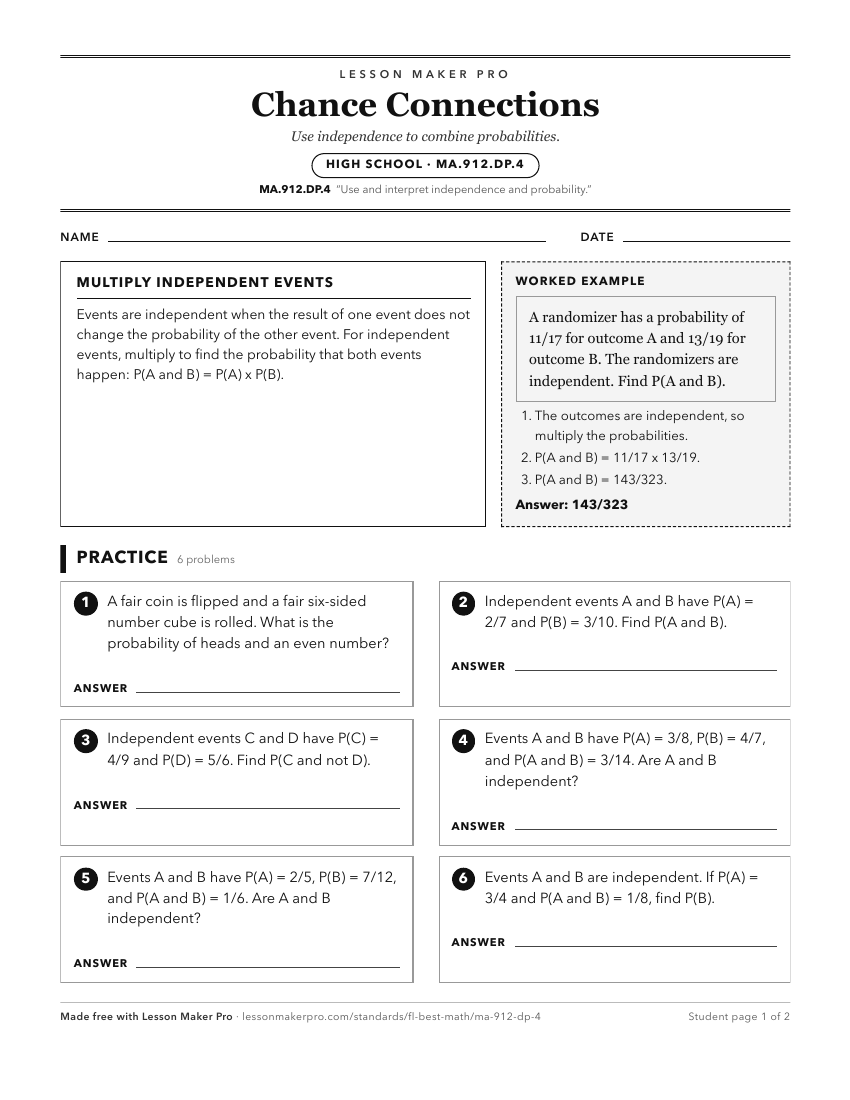
A ready-to-print activity worksheet aligned to MA.912.DP.4, with an answer key for the teacher on its own page. No account needed.
PDF, US Letter, prints cleanly in black and white.
Download the worksheetKeep exploring
Related Standards
Turn this cluster into a lesson
Grade, subject, topic, and the complete cluster are prefilled. Create one free, no account needed.
Also for this cluster:Make a WorksheetMake a QuizMake a Sub Lesson