Florida B.E.S.T. MA.912.DP.4.7
The Standard
Apply the addition rule for probability, taking into consideration whether the events are mutually exclusive, and interpret the result in terms of the model and its context.
Florida B.E.S.T. Standards for Mathematics
Teacher's field guide
What This Standard Means
What Students Need to Do
- Students decide whether two events can happen together. They add the two probabilities, subtract any shared outcomes, and explain the result in the situation described.
What Mastery Looks Like
- A student can find the probability of either event from a table, Venn diagram, or list of counts. The student recognizes when the overlap is zero and explains what the final probability means in the given situation.
Common Misconceptions
- Students often treat “or” as meaning exactly one event, so they leave out outcomes where both occur. They may add both probabilities without subtracting the overlap. Some subtract an overlap even when the events cannot occur together.
How to Assess It
- Give this exit ticket: Of 40 students, 22 play soccer, 18 play basketball, and 8 play both. Find the probability that a randomly chosen student plays soccer or basketball, and explain why 8 is subtracted.
Lesson moves
Ways to Teach It
Give students a deck of cards and have them find the probability of drawing a heart or a face card using sorted cards.
Discuss this prompt: Can a student be both a bus rider and a tenth grader, and how does that overlap change the probability?
Play an error-analysis relay where teams correct probability solutions and label each event pair as overlapping or mutually exclusive.
Use school club survey data to estimate the probability that a randomly chosen student belongs to the art club or robotics club.
Free download
Printable MA.912.DP.4.7 Worksheet
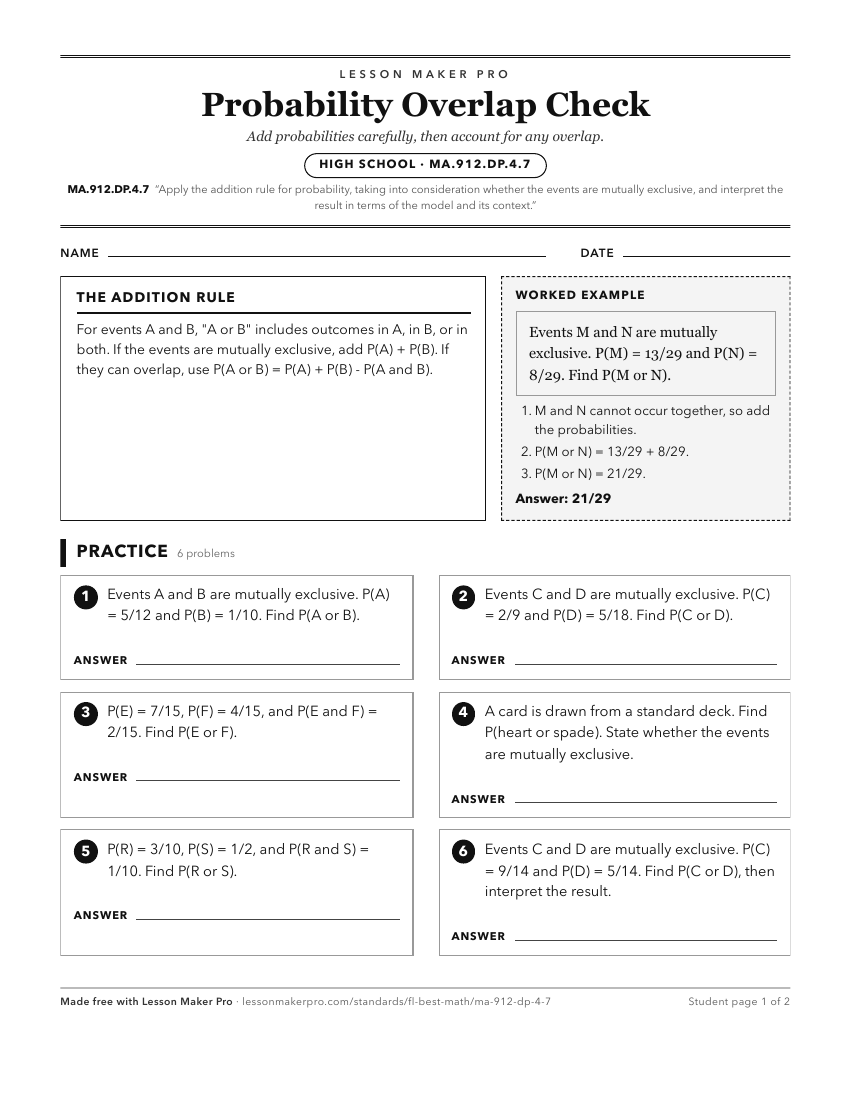
A ready-to-print activity worksheet aligned to MA.912.DP.4.7, with an answer key for the teacher on its own page. No account needed.
PDF, US Letter, prints cleanly in black and white.
Download the worksheetKeep exploring
Related Standards
- MA.912.DP.4.9
Apply the addition and multiplication rules for counting to solve mathematical and real-world problems, including problems involving probability.
- MA.912.DP.4.3
Calculate the conditional probability of two events and interpret the result in terms of its context.
- MA.912.DP.4.8
Apply the general multiplication rule for probability, taking into consideration whether the events are independent, and interpret the result in terms of the co...
- MA.912.DP.4.2
Determine if events A and B are independent by calculating the product of their probabilities.
Turn this exact standard into a lesson
Grade, subject, topic, and the complete standard are prefilled. Create one free, no account needed.
Also for this standard:Make a WorksheetMake a QuizMake a Sub Lesson