Florida B.E.S.T. MA.912.DP.4.3
The Standard
Calculate the conditional probability of two events and interpret the result in terms of its context.
Florida B.E.S.T. Standards for Mathematics
Teacher's field guide
What This Standard Means
What Students Need to Do
- Students find a probability after the sample space has been limited by a given condition. They use tables, tree diagrams, or counts and explain what the result means in context.
What Mastery Looks Like
- Given a two-way table or scenario, a student identifies the restricted group, forms the correct fraction, and computes P(A | B). The student names the condition when explaining the result and can compare it with P(A).
Common Misconceptions
- Students often use the total sample size instead of the size of the restricted group as the denominator. They may reverse the condition or assume P(A | B) equals P(B | A). They also confuse the overlap of two events with a conditional probability.
How to Assess It
- Exit ticket: Of 40 students, 24 play a sport, and 9 of those 24 have jobs. Find the probability that a student has a job given that the student plays a sport, then interpret it.
Lesson moves
Ways to Teach It
Give pairs 30 colored shape cards; students sort by color, then find the fraction of red cards that are triangles.
Students explain why P(rain | cloudy) can differ from P(cloudy | rain), using each condition to name the restricted group.
Run a matching game where students pair conditional probability questions with the correct fraction from four small two-way tables.
Use a week of weather records to find the chance of rain given a cloudy morning, then interpret the result.
Free download
Printable MA.912.DP.4.3 Worksheet
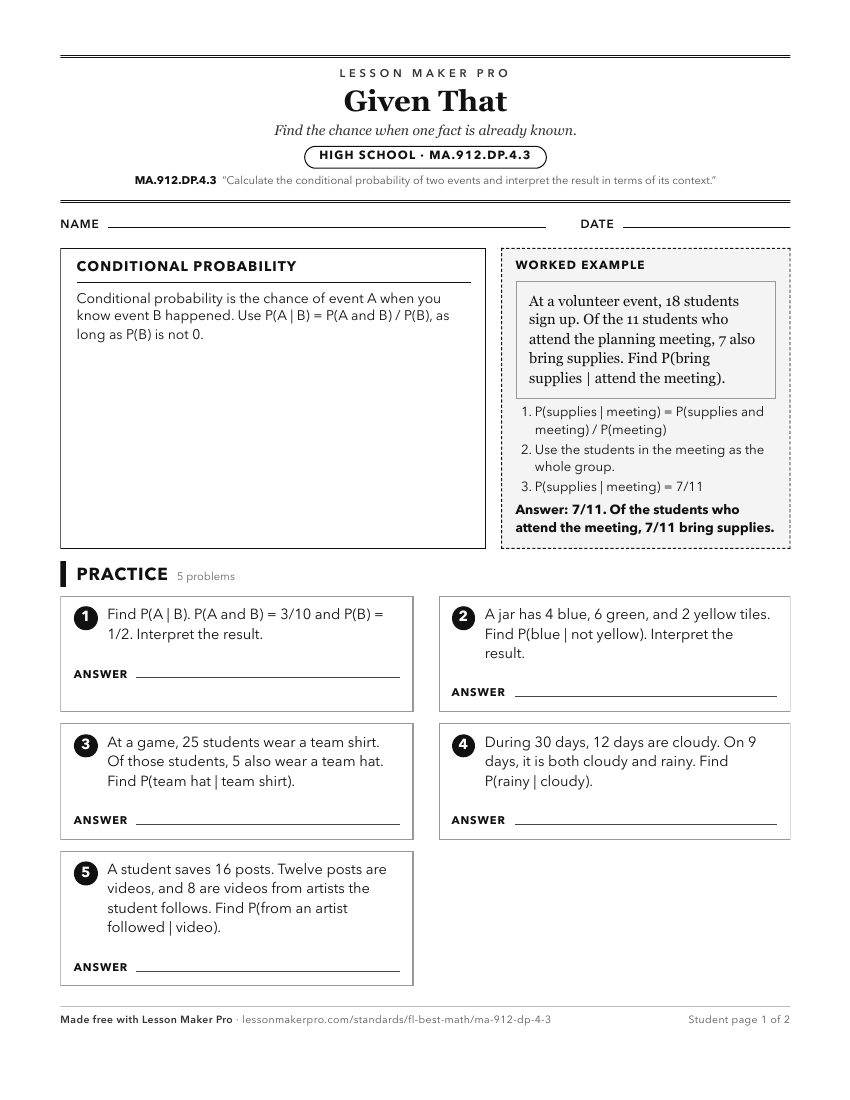
A ready-to-print activity worksheet aligned to MA.912.DP.4.3, with an answer key for the teacher on its own page. No account needed.
PDF, US Letter, prints cleanly in black and white.
Download the worksheetKeep exploring
Related Standards
- MA.7.DP.2.2
Given the probability of a chance event, interpret the likelihood of it occurring. Compare the probabilities of chance events.
- MA.912.DP.4.4
Interpret the independence of two events using conditional probability.
- MA.912.DP.4.7
Apply the addition rule for probability, taking into consideration whether the events are mutually exclusive, and interpret the result in terms of the model and...
- MA.912.DP.4.8
Apply the general multiplication rule for probability, taking into consideration whether the events are independent, and interpret the result in terms of the co...
Turn this exact standard into a lesson
Grade, subject, topic, and the complete standard are prefilled. Create one free, no account needed.
Also for this standard:Make a WorksheetMake a QuizMake a Sub Lesson