Florida B.E.S.T. MA.7.DP.2.2
The Standard
Given the probability of a chance event, interpret the likelihood of it occurring. Compare the probabilities of chance events.
Florida B.E.S.T. Standards for Mathematics
Teacher's field guide
What This Standard Means
What Students Need to Do
- Students interpret a probability as impossible, unlikely, about equally likely, likely, or certain. They compare probabilities written as fractions, decimals, or percentages and explain which event is more likely.
What Mastery Looks Like
- A student can label probabilities near 0 as unlikely, near 0.5 as about equally likely, and near 1 as likely. The student can compare fractions, decimals, and percentages and justify which event has the greater chance.
Common Misconceptions
- Students may think a larger denominator means a greater chance, so they rank 1/8 above 1/4. They may also treat 0.5 as unlikely instead of an even chance, or assume any nonzero probability guarantees an event will occur.
How to Assess It
- Exit ticket: Event A has probability 0.35 and Event B has probability 3/5. Identify which is more likely, describe each likelihood, and explain using 0, 0.5, and 1.
Lesson moves
Ways to Teach It
Give groups bags of colored cubes with assigned probabilities, then have them predict which color is unlikely, equally likely, or likely before drawing.
Ask students to explain whether a 70 percent rain forecast means rain is guaranteed, using a number line from 0 to 1.
Play a card sort where students match fractions, decimals, percentages, likelihood words, and event comparisons, then check matches with a partner.
Compare weather, sports, or medical probabilities from sample headlines and have students rewrite each claim using accurate likelihood language.
Free download
Printable MA.7.DP.2.2 Worksheet
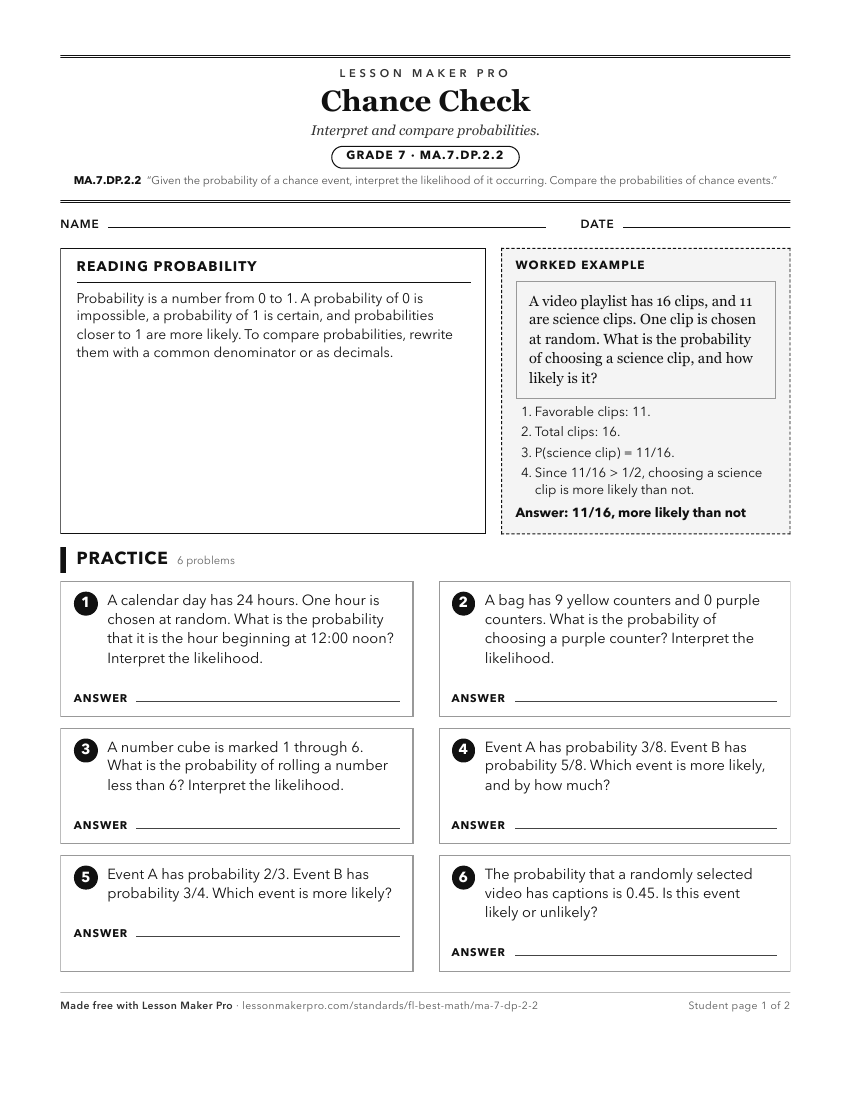
A ready-to-print activity worksheet aligned to MA.7.DP.2.2, with an answer key for the teacher on its own page. No account needed.
PDF, US Letter, prints cleanly in black and white.
Download the worksheetKeep exploring
Related Standards
- MA.7.DP.2.3
Find the theoretical probability of an event related to a simple experiment.
- MA.912.DP.4
Use and interpret independence and probability.
- MA.912.DP.4.3
Calculate the conditional probability of two events and interpret the result in terms of its context.
- MA.7.DP.2
Develop an understanding of probability. Find and compare experimental and theoretical probabilities.
Turn this exact standard into a lesson
Grade, subject, topic, and the complete standard are prefilled. Create one free, no account needed.
Also for this standard:Make a WorksheetMake a QuizMake a Sub Lesson