Florida B.E.S.T. MA.912.DP.4.1
The Standard
Describe events as subsets of a sample space using characteristics, or categories, of the outcomes, or as unions, intersections or complements of other events.
Florida B.E.S.T. Standards for Mathematics
Teacher's field guide
What This Standard Means
What Students Need to Do
- Students define a sample space and identify events as groups of outcomes that meet stated conditions. They also represent events using unions, intersections, and complements.
What Mastery Looks Like
- Given an experiment, a student lists possible outcomes and describes an event with words, sets, or a Venn diagram. The student correctly interprets “or,” “and,” and “not.”
Common Misconceptions
- Students often treat an event as one outcome rather than a set of outcomes. They may confuse union with intersection, read “or” as exclusive, or omit outcomes from a complement.
How to Assess It
- Exit ticket: For one roll of a six-sided die, let A be even outcomes and B be outcomes greater than 3. List A, B, A ∪ B, A ∩ B, and Aᶜ.
Lesson moves
Ways to Teach It
Have students sort outcome cards for two coin tosses into labeled hoops, then identify each event, union, intersection, and complement.
Ask, “When rolling a die, how do ‘even or greater than 4’ and ‘even and greater than 4’ differ?”
Play Event Match: students pair experiment cards with sample spaces and event cards showing unions, intersections, or complements.
Use an anonymous class survey on bus riders and club members, then describe each group, overlap, union, and complement.
Free download
Printable MA.912.DP.4.1 Worksheet
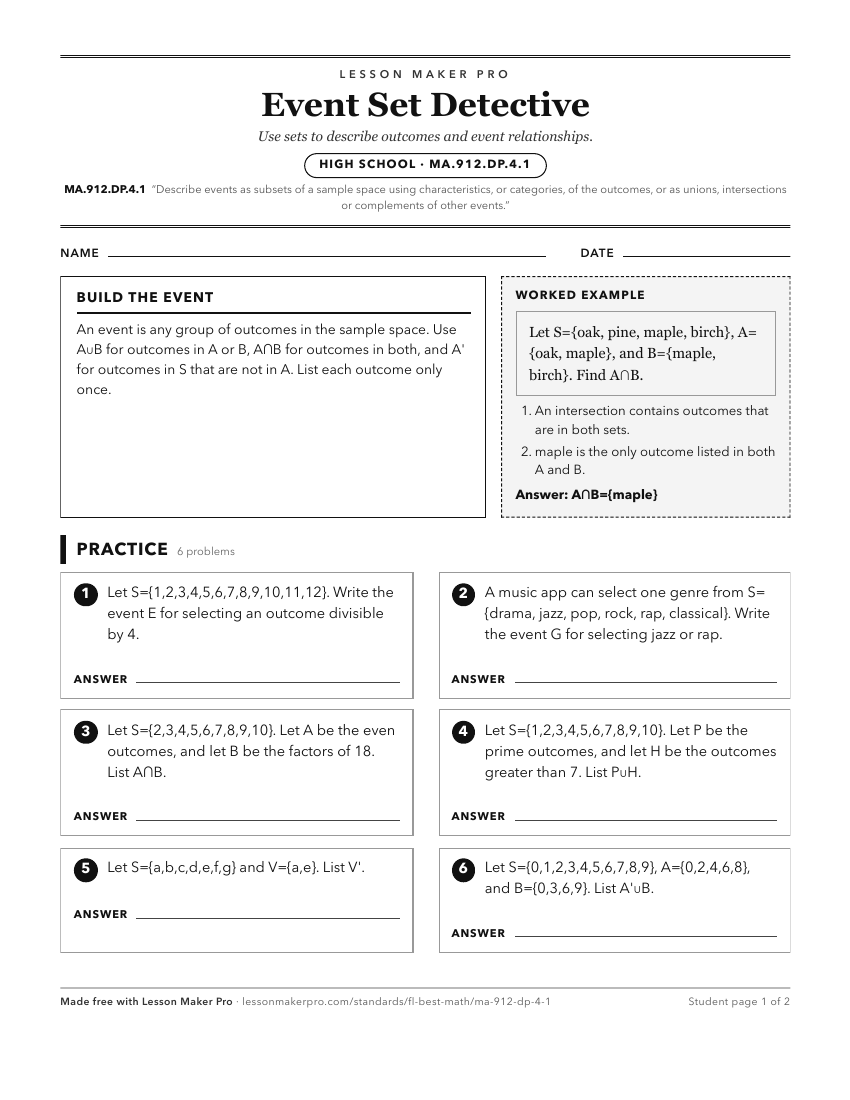
A ready-to-print activity worksheet aligned to MA.912.DP.4.1, with an answer key for the teacher on its own page. No account needed.
PDF, US Letter, prints cleanly in black and white.
Download the worksheetKeep exploring
Related Standards
- MA.K.DP.1.1
Collect and sort objects into categories and compare the categories by counting the objects in each category. Report the results verbally, with a written numera...
- MA.912.DP.6.1
Define a random variable for a quantity of interest by assigning a numerical value to each individual outcome in a sample space; graph the corresponding probabi...
- MA.7.DP.2.1
Determine the sample space for a simple experiment.
- MA.8.DP.2.1
Determine the sample space for a repeated experiment.
Turn this exact standard into a lesson
Grade, subject, topic, and the complete standard are prefilled. Create one free, no account needed.
Also for this standard:Make a WorksheetMake a QuizMake a Sub Lesson