Florida B.E.S.T. MA.K.DP.1.1
The Standard
Collect and sort objects into categories and compare the categories by counting the objects in each category. Report the results verbally, with a written numeral or with drawings.
Florida B.E.S.T. Standards for Mathematics
Teacher's field guide
What This Standard Means
What Students Need to Do
- Students group items by a shared feature, such as color, shape, or type. They count each group, compare the totals, and share their results using words, numerals, or pictures.
What Mastery Looks Like
- A student sorts a mixed set using one clear rule and counts each group accurately. The student identifies which group has more, fewer, or the same and records the totals.
Common Misconceptions
- Students may count an item twice or skip an item. They may change the sorting rule halfway through, compare object size instead of quantity, or confuse more and fewer.
How to Assess It
- Give each student four red counters and six blue counters. Ask them to sort, count, write each total, and circle the group with more counters.
Lesson moves
Ways to Teach It
Give pairs a basket of buttons to sort by color, count each group, and label each group with a numeral.
Show two pictured groups and ask, “How do you know which group has more?” Students explain with words or drawings.
Play Sort and Count: students draw animal cards, group them by type, count each group, and name the largest group.
Survey how classmates travel to school, draw one mark per answer, then count and compare the groups.
Free download
Printable MA.K.DP.1.1 Worksheet
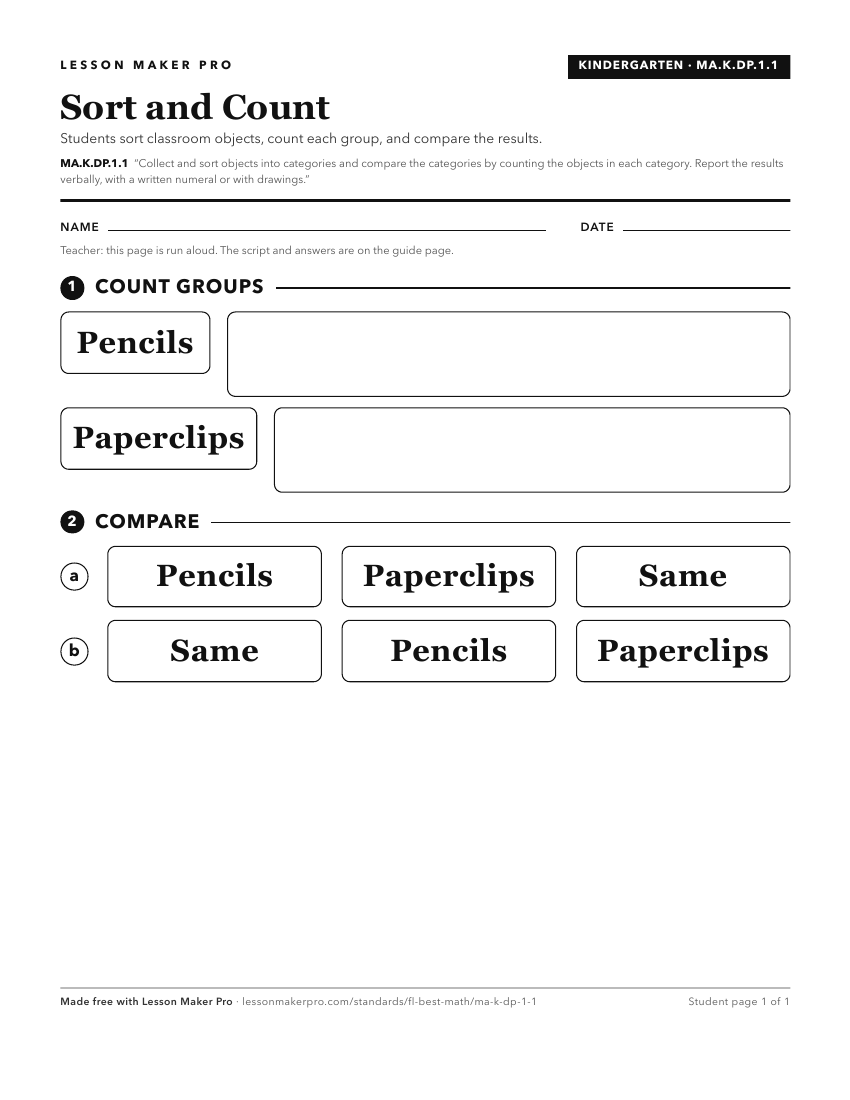
A ready-to-print activity worksheet aligned to MA.K.DP.1.1, with an answer key for the teacher on its own page. No account needed.
PDF, US Letter, prints cleanly in black and white.
Download the worksheetKeep exploring
Related Standards
- MA.1.DP.1.1
Collect data into categories and represent the results using tally marks or pictographs.
- MA.2.DP.1.1
Collect, categorize and represent data using tally marks, tables, pictographs or bar graphs. Use appropriate titles, labels and units.
- MA.3.DP.1.1
Collect and represent numerical and categorical data with whole-number values using tables, scaled pictographs, scaled bar graphs or line plots. Use appropriate...
- MA.3.DP.1
Collect, represent and interpret numerical and categorical data.
Turn this exact standard into a lesson
Grade, subject, topic, and the complete standard are prefilled. Create one free, no account needed.
Also for this standard:Make a WorksheetMake a QuizMake a Sub Lesson