Virginia SOL USII.8
SOL Standard (Skills Cluster)
The student will apply history and social science skills to analyze the key changing patterns of society during the second half of the 20th and early 21st centuries by examining the contributions of key leaders and events during the Civil Rights Era including, but not limited to Robert Kennedy, Dr. Martin Luther King, Jr., Malcolm X, Medgar Evers, John Lewis, Rosa Parks, Ruby Bridges, Jonathan Daniels, Dorothy Height, the Selma march, sit-ins, and boycotts; explaining the significance of urban renewal plans including, but not limited to Jackson Ward in Richmond and Vinegar Hill in Charlottesville; examining key events of the 1960s and 1970s including, but not limited to the Apollo missions, the moon landing, assassinations, the women’s movement, the creation of public sector labor unions, the Watergate scandal and Nixon’s resignation, and the passing of the Clean Air Act and the Clean Water Act; describing the impact of the baby boom, the changing demographics of the United States, and the ending of the military draft; and describing the protections and provisions of the Americans with Disabilities Act (ADA); describing the similarities and differences between the objectives of the women’s movement of the early and mid-20th century; describing expanded educational and economic opportunities for military veterans, women, and minorities; and describing how the terrorist attacks of September 11, 2001, including the heroic sacrifices of Flight 93 passengers, significantly impacted domestic policies, American society, and global perspectives on the war on terror.
Virginia Standards of Learning for History and Social Science
Cluster contents
Skills in This Standard
USII.8 is a Standards of Learning history and social science standard. These are the skills expectations under it.
- USII.8.a
examining the contributions of key leaders and events during the Civil Rights Era including, but not limited to Robert Kennedy, Dr. Martin Luther King, Jr., Mal...
- USII.8.b
explaining the significance of urban renewal plans including, but not limited to Jackson Ward in Richmond and Vinegar Hill in Charlottesville
- USII.8.c
examining key events of the 1960s and 1970s including, but not limited to the Apollo missions, the moon landing, assassinations, the women’s movement, the creat...
- USII.8.d
describing the impact of the baby boom, the changing demographics of the United States, and the ending of the military draft
- USII.8.e
describing the protections and provisions of the Americans with Disabilities Act (ADA)
- USII.8.f
describing the similarities and differences between the objectives of the women’s movement of the early and mid-20th century
- USII.8.g
describing expanded educational and economic opportunities for military veterans, women, and minorities
- USII.8.h
describing how the terrorist attacks of September 11, 2001, including the heroic sacrifices of Flight 93 passengers, significantly impacted domestic policies, A...
Teacher's field guide
What This Cluster Means
What Students Need to Do
- Students place major leaders, events, laws, and social changes in context from the Civil Rights Era through the aftermath of September 11. They compare goals and methods, trace causes and effects, and use evidence to explain changes in rights and opportunities. They also examine local urban renewal, population shifts, military service, disability access, science, environmental policy, and trust in government.
What Mastery Looks Like
- A student can connect a person or event to a specific strategy, policy change, or social impact. The student can compare two movements, explain intended and unintended effects, and support claims with source details. The student can apply this reasoning to Virginia examples such as Jackson Ward and Vinegar Hill.
Common Misconceptions
- Students may treat the Civil Rights Era as the work of one leader or assume all activists used the same methods. They may view urban renewal as only neighborhood improvement, missing displacement and the loss of homes and businesses. They may also confuse Watergate, environmental laws, the ADA, and policies adopted after September 11.
How to Assess It
- Give students three short source cards: a civil rights protest, an urban renewal map, and an ADA provision. Ask, “Choose one card. Explain the change shown, who was affected, and one consequence, using two details.”
Lesson moves
Ways to Teach It
Build a tabletop timeline with event cards, then add yarn links showing cause, effect, and change across civil rights, politics, science, and law.
Write a paragraph comparing the goals and methods of the early suffrage movement and the later women’s movement, using two specific examples.
Play a card sort relay matching leaders, events, laws, and impacts, then require teams to defend one disputed match with evidence.
Use an ADA checklist to inspect the school entrance, restroom, and website, then propose one change that would improve access.
Free download
Printable USII.8 Worksheet
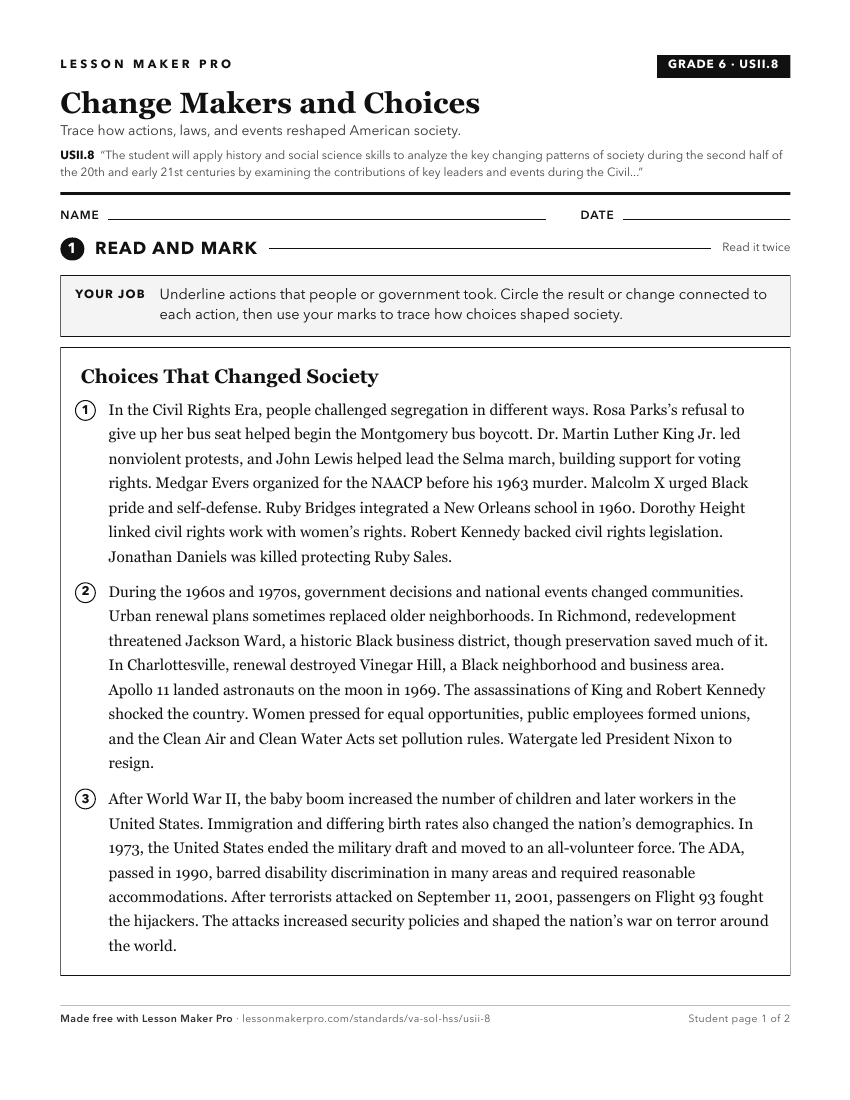
A ready-to-print activity worksheet aligned to USII.8, with an answer key for the teacher on its own page. No account needed.
PDF, US Letter, prints cleanly in black and white.
Download the worksheetKeep exploring
Related Standards
- WG.14
The student will apply history and social science skills to determine cultural patterns and interactions across time and place by
- USII.7
The student will apply history and social science skills to understand the transformation of U.S. foreign policy between the end of World War II and the new mil...
- USII.5
The student will apply history and social science skills to understand the social, political, economic, and technological changes of the early 20th century by
- USII.9
The student will apply history and social science skills by
Turn this cluster into a lesson
Grade, subject, topic, and the complete cluster are prefilled. Create one free, no account needed.
Also for this cluster:Make a WorksheetMake a QuizMake a Sub Lesson