Virginia SOL USII.7
SOL Standard (Skills Cluster)
The student will apply history and social science skills to understand the transformation of U.S. foreign policy between the end of World War II and the new millennium by explaining how key decisions and agreements including, but not limited to the Atlantic Charter, formation of the United Nations, and the North Atlantic Treaty Organization (NATO) established international allies; describing the Marshall Plan’s objectives for rebuilding Europe, the occupation and reconstruction of Japan, and the emergence of the United States and the Soviet Union as superpowers; describing the differences between a communist nation and a democratic nation including, but not limited to self-governance and economic philosophy; examining the role of the United States in fighting communism and defending freedom during the Cold War including, but not limited to the Berlin Airlift, conflicts in Korea and Vietnam, the roles of John F. Kennedy and Nikita Khrushchev during the Cuban missile crisis, the fall of the Berlin Wall, and the collapse of communism in Eastern Europe; and explaining the collapse of communism in the Soviet Union and Eastern Europe and the end of the Cold War, including the actions of Ronald Reagan and Mikhail Gorbachev.
Virginia Standards of Learning for History and Social Science
Cluster contents
Skills in This Standard
USII.7 is a Standards of Learning history and social science standard. These are the skills expectations under it.
- USII.7.a
explaining how key decisions and agreements including, but not limited to the Atlantic Charter, formation of the United Nations, and the North Atlantic Treaty O...
- USII.7.b
describing the Marshall Plan’s objectives for rebuilding Europe, the occupation and reconstruction of Japan, and the emergence of the United States and the Sovi...
- USII.7.c
describing the differences between a communist nation and a democratic nation including, but not limited to self-governance and economic philosophy
- USII.7.d
examining the role of the United States in fighting communism and defending freedom during the Cold War including, but not limited to the Berlin Airlift, confli...
- USII.7.e
explaining the collapse of communism in the Soviet Union and Eastern Europe and the end of the Cold War, including the actions of Ronald Reagan and Mikhail Gorb...
Teacher's field guide
What This Cluster Means
What Students Need to Do
- Students explain why the United States built alliances, funded European recovery, and helped reconstruct Japan after World War II. They compare democratic and communist systems, then connect Cold War conflicts, leaders, and policies to containment and the Cold War's end.
What Mastery Looks Like
- A student can distinguish the purposes of the United Nations, NATO, and the Marshall Plan. The student can place major Cold War events in order and explain their causes, U.S. goals, and results. They can compare political and economic systems using specific examples.
Common Misconceptions
- Students often treat the United Nations, NATO, and the Marshall Plan as the same kind of program. They may think the United States and Soviet Union fought each other directly, or that every communist country followed identical policies. They also confuse the fall of the Berlin Wall with the later breakup of the Soviet Union.
How to Assess It
- Exit ticket: Choose the Berlin Airlift, Cuban missile crisis, or Marshall Plan. In three sentences, state the U.S. goal, one action, and one result.
Lesson moves
Ways to Teach It
Give pairs event, goal, and outcome cards to match and place on a floor timeline from 1945 to 1991.
Ask students to write: Which Cold War action best contained communism, and what evidence supports your choice?
Play alliance sort: teams classify cards as United Nations, NATO, Marshall Plan, or Japan reconstruction, then explain each choice.
Show a current NATO map and headline, then have students identify how Cold War alliances still shape security decisions.
Free download
Printable USII.7 Worksheet
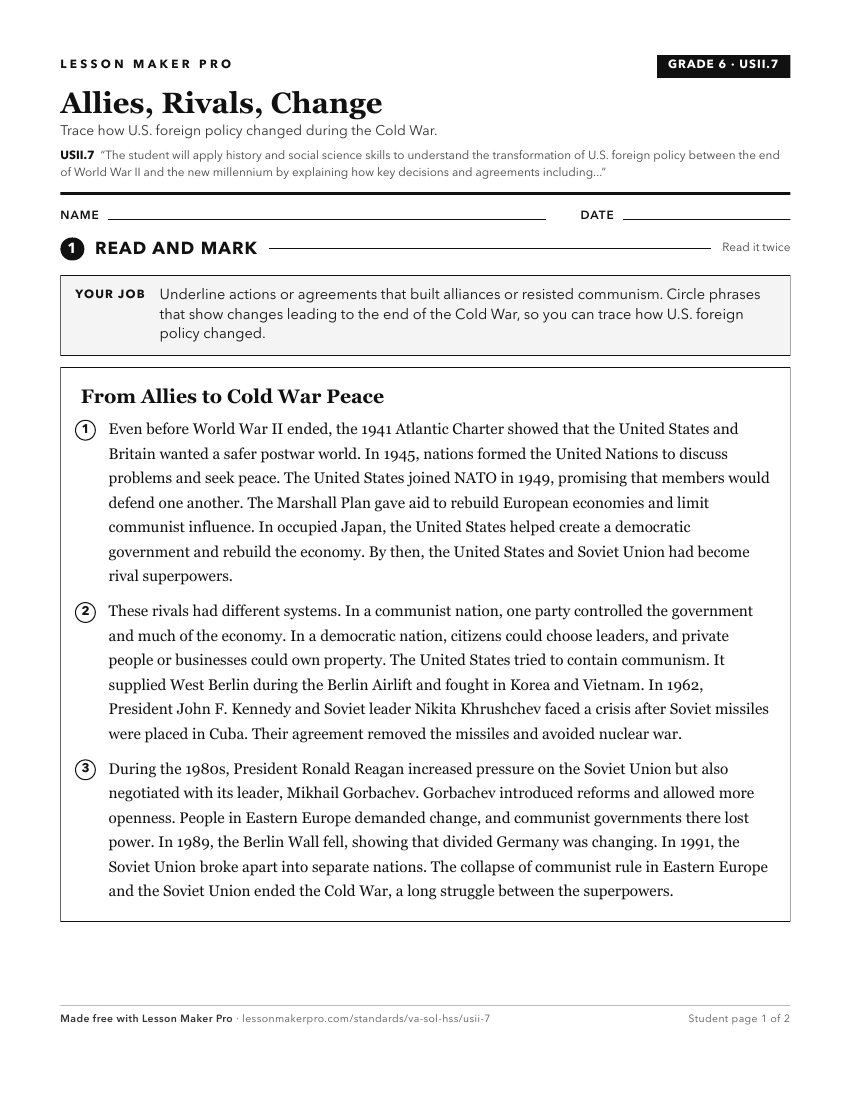
A ready-to-print activity worksheet aligned to USII.7, with an answer key for the teacher on its own page. No account needed.
PDF, US Letter, prints cleanly in black and white.
Download the worksheetKeep exploring
Related Standards
- USII.8
The student will apply history and social science skills to analyze the key changing patterns of society during the second half of the 20th and early 21st centu...
- WG.16
The student will apply history and social science skills to understand the impact of the growing interdependence of the world by
- USII.4
The student will apply history and social science skills to explain the changing role of the United States from the late 19th century through World War I by
- USII.6
The student will apply history and social science skills to understand the major causes and events of World War II and the effects of America’s role by
Turn this cluster into a lesson
Grade, subject, topic, and the complete cluster are prefilled. Create one free, no account needed.
Also for this cluster:Make a WorksheetMake a QuizMake a Sub Lesson