Virginia SOL USII.7.a
The Standard
- USII.7
- The student will apply history and social science skills to understand the transformation of U.S. foreign policy between the end of World War II and the new millennium by
explaining how key decisions and agreements including, but not limited to the Atlantic Charter, formation of the United Nations, and the North Atlantic Treaty Organization (NATO) established international allies
Virginia Standards of Learning for History and Social Science
Teacher's field guide
What This Standard Means
What Students Need to Do
- Students explain how the Atlantic Charter set shared goals for the United States and Britain. They compare that cooperation with the United Nations and NATO, including each group’s purpose and members.
What Mastery Looks Like
- Students correctly match each agreement or organization to its purpose. They explain that the United Nations supported broad international cooperation, while NATO created a military alliance for collective defense.
Common Misconceptions
- Students may treat the Atlantic Charter, United Nations, and NATO as identical military alliances. They may also assume NATO included every United Nations member or began before World War II.
How to Assess It
- Give students three boxes labeled Atlantic Charter, United Nations, and NATO. Ask them to write each one’s purpose and how it connected nations.
Lesson moves
Ways to Teach It
Give groups country cards and event cards, then have them build a timeline showing when and why nations began working together.
Ask students to write: Which created the strongest commitment between nations, the Atlantic Charter, United Nations, or NATO, and why?
Play a matching game with cards for names, dates, members, purposes, and examples of cooperation or collective defense.
Present a fictional threat to one NATO member and ask students how NATO and the United Nations might respond differently.
Free download
Printable USII.7.a Worksheet
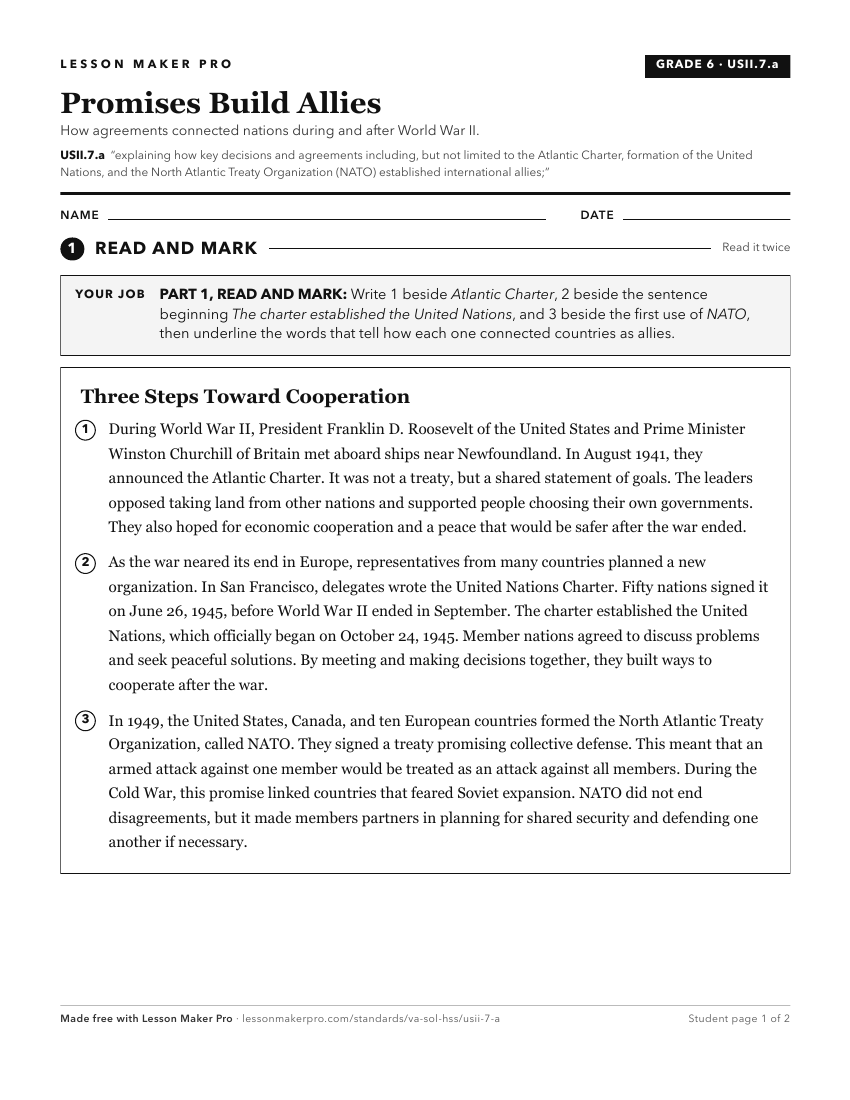
A ready-to-print activity worksheet aligned to USII.7.a, with an answer key for the teacher on its own page. No account needed.
PDF, US Letter, prints cleanly in black and white.
Download the worksheetKeep exploring
Related Standards
- USII.7.b
describing the Marshall Plan’s objectives for rebuilding Europe, the occupation and reconstruction of Japan, and the emergence of the United States and the Sovi...
- USII.4.e
explaining how the war was a catalyst for the United States gaining international power and expanding its sphere of international influence
- USII.6.e
explaining and evaluating the role of key political and military leaders of the Allies and Axis powers including, but not limited to the United States, Germany,...
- USII.6.i
describing the events that led to the surrender of the Axis powers and America’s role in the Allied victory including, but not limited to the Manhattan Project,...
Turn this exact standard into a lesson
Grade, subject, topic, and the complete standard are prefilled. Create one free, no account needed.
Also for this standard:Make a WorksheetMake a QuizMake a Sub Lesson