Virginia SOL USII.6.i
The Standard
- USII.6
- The student will apply history and social science skills to understand the major causes and events of World War II and the effects of America’s role by
describing the events that led to the surrender of the Axis powers and America’s role in the Allied victory including, but not limited to the Manhattan Project, as well as events that shaped post-war peace.
Virginia Standards of Learning for History and Social Science
Teacher's field guide
What This Standard Means
What Students Need to Do
- Students trace cause and effect across Europe and the Pacific, showing why Germany and Japan surrendered at different times. They explain how U.S. forces, production, diplomacy, and the Manhattan Project contributed, then link wartime decisions to peace efforts after 1945.
What Mastery Looks Like
- A student can sequence D-Day, Soviet advances, Germany’s surrender, Pacific island battles, the atomic bombings, Soviet entry against Japan, and Japan’s surrender. They can connect the United Nations, war crimes trials, and occupation policies to efforts to prevent future wars.
Common Misconceptions
- Students may think the atomic bombs caused both Axis powers to surrender, or that Germany and Japan surrendered together. They may confuse the Manhattan Project with a battle and overlook Soviet entry against Japan. Some assume Allied cooperation continued unchanged after 1945.
How to Assess It
- Exit ticket: Put D-Day, Germany’s surrender, the United Nations Charter, the atomic bombings, and Japan’s surrender in order. Explain one U.S. contribution to victory and one effort to build peace.
Lesson moves
Ways to Teach It
Sort labeled event cards onto European and Pacific floor timelines, then add arrows showing how each event pressured an Axis power to surrender.
Read short Truman and Japanese cabinet excerpts, then write: Which factors most influenced Japan’s surrender, and what evidence supports your answer?
Play a matching game linking D-Day, the Battle of the Bulge, island hopping, the Manhattan Project, and the United Nations to outcomes.
Use a current United Nations peacekeeping map to choose one mission and explain how its goal reflects lessons leaders drew from World War II.
Free download
Printable USII.6.i Worksheet
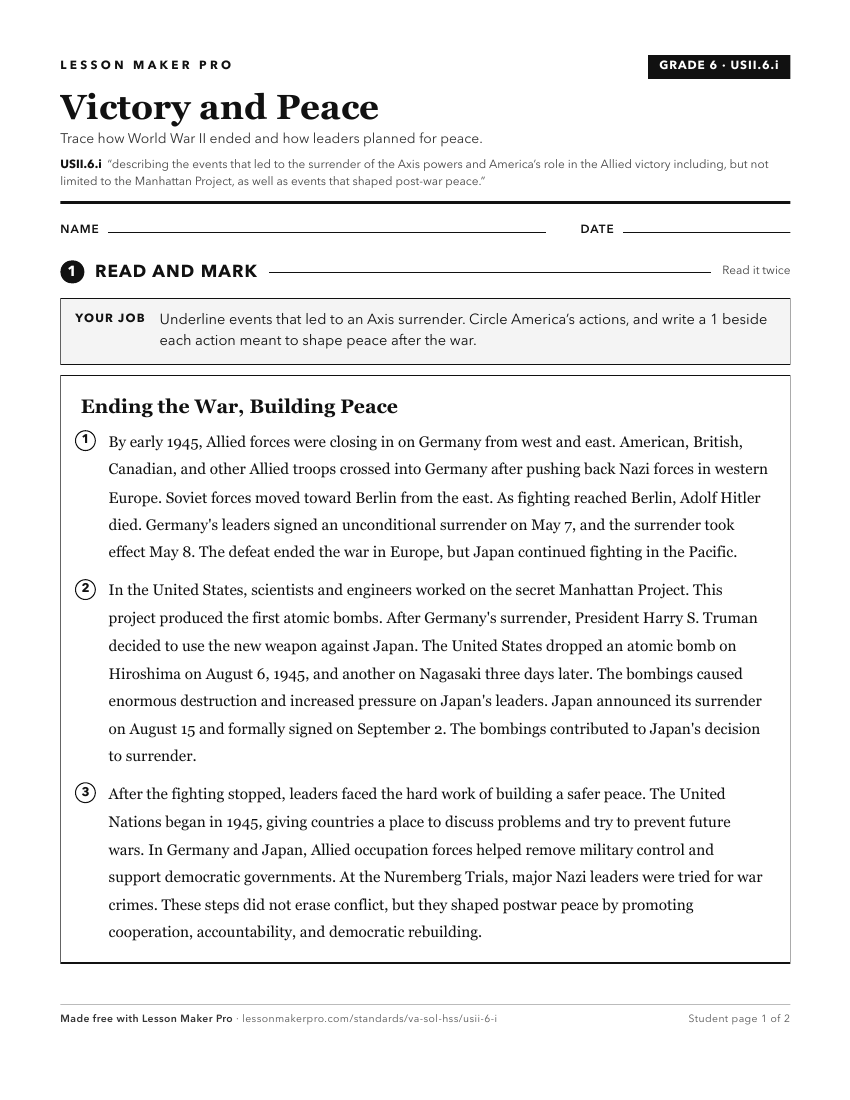
A ready-to-print activity worksheet aligned to USII.6.i, with an answer key for the teacher on its own page. No account needed.
PDF, US Letter, prints cleanly in black and white.
Download the worksheetKeep exploring
Related Standards
- USII.7.b
describing the Marshall Plan’s objectives for rebuilding Europe, the occupation and reconstruction of Japan, and the emergence of the United States and the Sovi...
- USII.6.c
locating and describing the major events and turning points of the war in Europe including, but not limited to the allied invasion of Italy, the invasion of Nor...
- USII.6.e
explaining and evaluating the role of key political and military leaders of the Allies and Axis powers including, but not limited to the United States, Germany,...
- USII.6.b
explaining the causes and events that led to American involvement in the war, including the attack on Pearl Harbor
Turn this exact standard into a lesson
Grade, subject, topic, and the complete standard are prefilled. Create one free, no account needed.
Also for this standard:Make a WorksheetMake a QuizMake a Sub Lesson