Virginia SOL USII.6.b
The Standard
- USII.6
- The student will apply history and social science skills to understand the major causes and events of World War II and the effects of America’s role by
explaining the causes and events that led to American involvement in the war, including the attack on Pearl Harbor
Virginia Standards of Learning for History and Social Science
Teacher's field guide
What This Standard Means
What Students Need to Do
- Students trace how Axis expansion, threats to U.S. interests, and aid to Allied nations moved the country away from neutrality. They explain why Pearl Harbor prompted Congress to declare war.
What Mastery Looks Like
- Students place major events in order and connect each event to a change in U.S. policy or public opinion. They distinguish long-term pressures from the immediate trigger for war.
Common Misconceptions
- Students may think the United States entered the war as soon as fighting began in Europe. They may also confuse Pearl Harbor with D-Day or assume Germany carried out the attack.
How to Assess It
- Give students four event cards: war begins in Europe, Lend-Lease, Pearl Harbor, and the declaration of war. Ask them to order the cards and explain which event directly triggered the declaration.
Lesson moves
Ways to Teach It
Students arrange dated event cards on a string timeline, then attach cause-and-effect labels between related events.
Ask students to write: Why did the United States move from neutrality to war between 1939 and 1941?
Play a matching game using cards labeled event, U.S. response, and consequence, including Lend-Lease and Pearl Harbor.
Students compare December 1941 newspaper front pages and identify words or images meant to shape public reaction.
Free download
Printable USII.6.b Worksheet
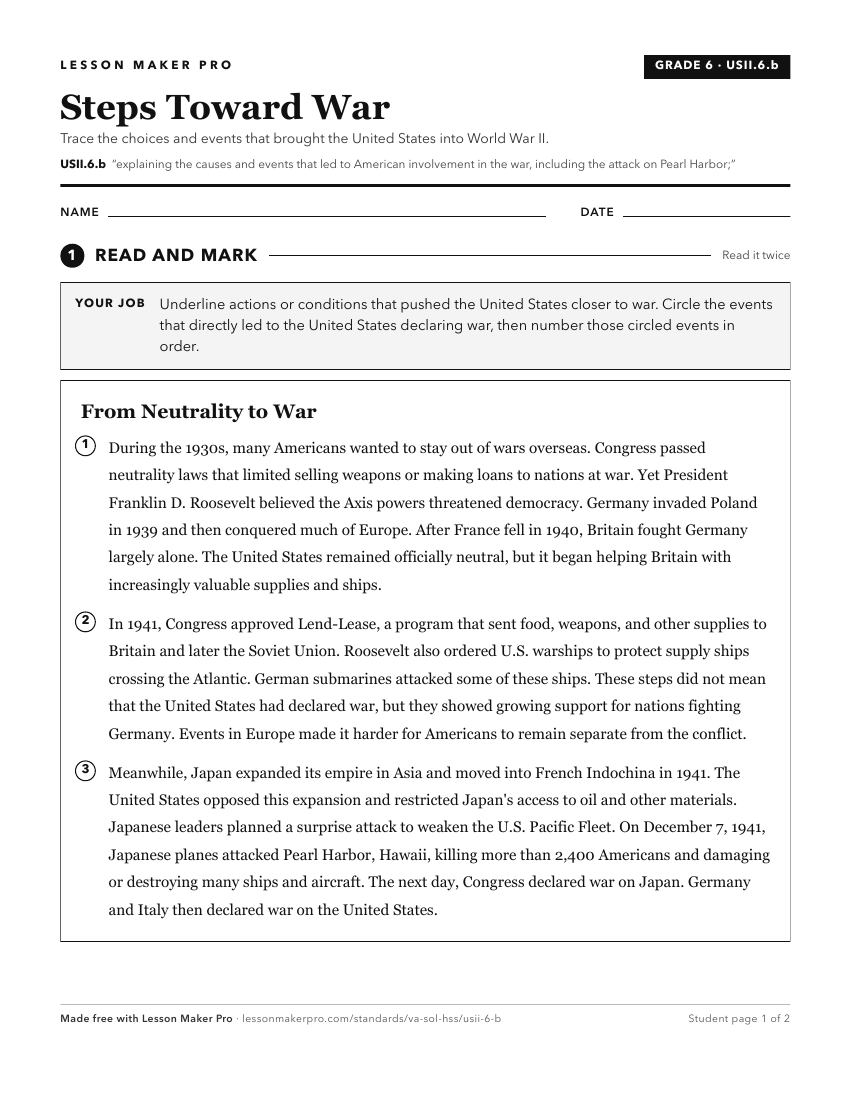
A ready-to-print activity worksheet aligned to USII.6.b, with an answer key for the teacher on its own page. No account needed.
PDF, US Letter, prints cleanly in black and white.
Download the worksheetKeep exploring
Related Standards
- USII.4.e
explaining how the war was a catalyst for the United States gaining international power and expanding its sphere of international influence
- USI.8.b
describing the causes, course of events, and effects of the War of 1812, the role of Andrew Jackson, and the development of the Monroe Doctrine
- USII.6
The student will apply history and social science skills to understand the major causes and events of World War II and the effects of America’s role by
- USII.6.i
describing the events that led to the surrender of the Axis powers and America’s role in the Allied victory including, but not limited to the Manhattan Project,...
Turn this exact standard into a lesson
Grade, subject, topic, and the complete standard are prefilled. Create one free, no account needed.
Also for this standard:Make a WorksheetMake a QuizMake a Sub Lesson