Virginia SOL USII.6
SOL Standard (Skills Cluster)
The student will apply history and social science skills to understand the major causes and events of World War II and the effects of America’s role by explaining the rise and spread of fascism and totalitarianism internationally and the policy of appeasement towards Nazi Germany; explaining the causes and events that led to American involvement in the war, including the attack on Pearl Harbor; locating and describing the major events and turning points of the war in Europe including, but not limited to the allied invasion of Italy, the invasion of Normandy (D-Day), the Battle of the Bulge, and the Battle of Berlin; locating and describing the major events and turning points of the war in the Pacific including, but not limited to the Battle of Iwo Jima, the Battle of Midway, and the Battle of Okinawa; explaining and evaluating the role of key political and military leaders of the Allies and Axis powers including, but not limited to the United States, Germany, Japan, the Soviet Union, Italy, and Great Britain; identifying the roles and sacrifices of U.S. armed forces, including prisoners of war (POWs), women, and segregated units, as well as other notable heroics including, but not limited to the contributions of the Tuskegee Airmen, the 442nd Regimental Combat Team, the Women's Army Auxiliary Corps, the Women Airforce Service Pilots, the Navajo Code Talkers, and the Bedford Boys; evaluating the effects of the war on the home front including, but not limited to women in the workforce, the incarceration of Japanese Americans, rationing, conservation, and war bonds; examining the causes and consequences of the Holocaust including, but not limited to Jewish life before the Holocaust, antisemitism, the rise of the Nazi Party, Nuremberg Laws, persecution of Jews and other targeted groups, resistance efforts, the United States’ response, and the Nuremberg Trials; and describing the events that led to the surrender of the Axis powers and America’s role in the Allied victory including, but not limited to the Manhattan Project, as well as events that shaped post-war peace.
Virginia Standards of Learning for History and Social Science
Cluster contents
Skills in This Standard
USII.6 is a Standards of Learning history and social science standard. These are the skills expectations under it.
- USII.6.a
explaining the rise and spread of fascism and totalitarianism internationally and the policy of appeasement towards Nazi Germany
- USII.6.b
explaining the causes and events that led to American involvement in the war, including the attack on Pearl Harbor
- USII.6.c
locating and describing the major events and turning points of the war in Europe including, but not limited to the allied invasion of Italy, the invasion of Nor...
- USII.6.d
locating and describing the major events and turning points of the war in the Pacific including, but not limited to the Battle of Iwo Jima, the Battle of Midway...
- USII.6.e
explaining and evaluating the role of key political and military leaders of the Allies and Axis powers including, but not limited to the United States, Germany,...
- USII.6.f
identifying the roles and sacrifices of U.S. armed forces, including prisoners of war (POWs), women, and segregated units, as well as other notable heroics incl...
- USII.6.g
evaluating the effects of the war on the home front including, but not limited to women in the workforce, the incarceration of Japanese Americans, rationing, co...
- USII.6.h
examining the causes and consequences of the Holocaust including, but not limited to Jewish life before the Holocaust, antisemitism, the rise of the Nazi Party,...
- USII.6.i
describing the events that led to the surrender of the Axis powers and America’s role in the Allied victory including, but not limited to the Manhattan Project,...
Teacher's field guide
What This Cluster Means
What Students Need to Do
- Students explain how dictatorships expanded, why appeasement failed, and why the United States entered the war. They locate and sequence major battles in Europe and the Pacific, then explain why each changed the war. They assess leaders, military service, the home front, the Holocaust, Axis surrender, and plans for peace.
What Mastery Looks Like
- Students can build an accurate cause-and-effect timeline and use maps to compare the two theaters. They support claims about turning points, leaders, military groups, home-front policies, the Holocaust, and Allied victory with specific evidence.
Common Misconceptions
- Students often treat every authoritarian government as identical and assume appeasement meant support for Hitler. They may think Pearl Harbor began the whole war, D-Day ended it, or the atomic bombs caused Germany's surrender. They also confuse Japanese American incarceration with prisoner-of-war camps and overlook resistance, segregated units, and women's military service.
How to Assess It
- Give students a blank two-theater map and six event labels: D-Day, Battle of the Bulge, Berlin, Midway, Iwo Jima, and Okinawa. Have them place each, circle one turning point, and write two sentences explaining its effect on Allied victory.
Lesson moves
Ways to Teach It
Give pairs event, leader, and home-front cards to sort by cause, theater, group, or effect, then build a class timeline.
Ask students to write: Was appeasement a defensible choice in 1938? Use two facts and address one counterargument.
Run a map relay where teams place battle cards, identify the theater, and state why each battle mattered.
Compare a ration book, war bond poster, and incarceration order, then ask how wartime policy changed daily life and civil rights.
Free download
Printable USII.6 Worksheet
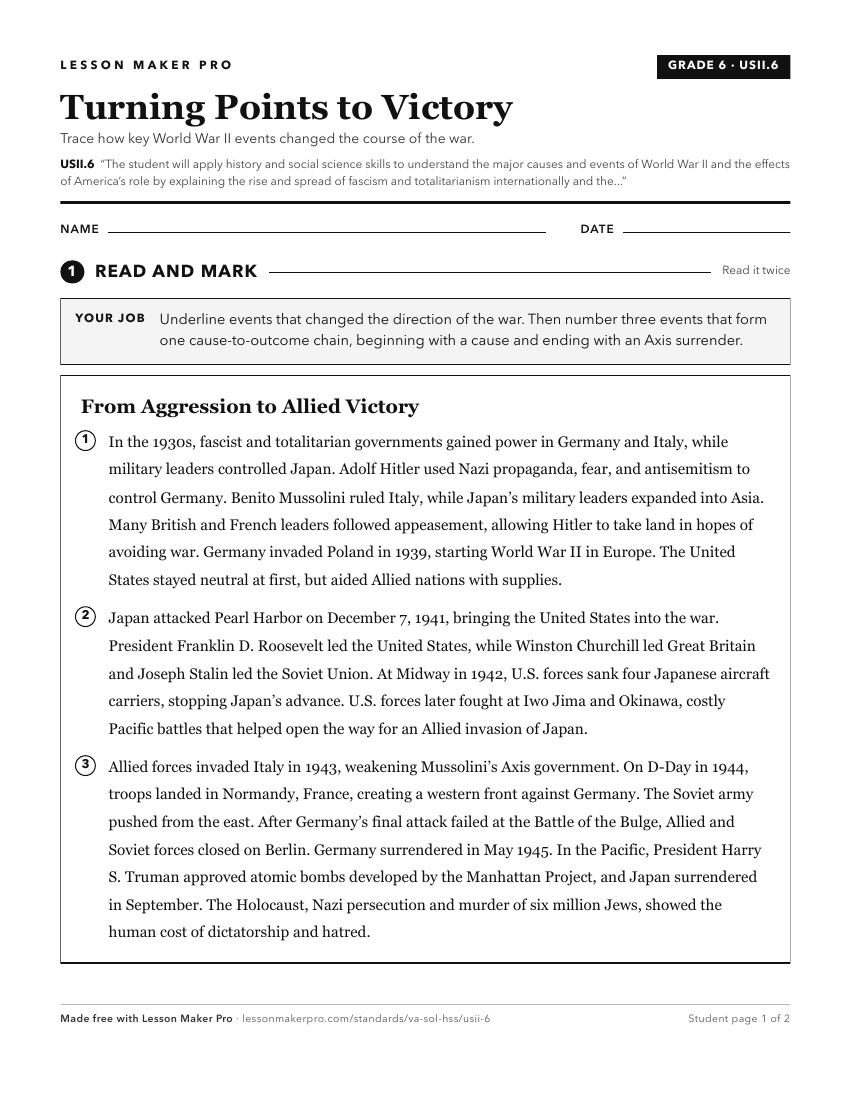
A ready-to-print activity worksheet aligned to USII.6, with an answer key for the teacher on its own page. No account needed.
PDF, US Letter, prints cleanly in black and white.
Download the worksheetKeep exploring
Related Standards
- USI.9
The student will apply history and social science skills to understand the cause, major events, and effects of the Civil War by
- USII.7
The student will apply history and social science skills to understand the transformation of U.S. foreign policy between the end of World War II and the new mil...
- 2.9
The student will apply history and social science skills to understand key events in United States history including, but not limited to
- USII.4
The student will apply history and social science skills to explain the changing role of the United States from the late 19th century through World War I by
Turn this cluster into a lesson
Grade, subject, topic, and the complete cluster are prefilled. Create one free, no account needed.
Also for this cluster:Make a WorksheetMake a QuizMake a Sub Lesson