Virginia SOL USII.6.a
The Standard
- USII.6
- The student will apply history and social science skills to understand the major causes and events of World War II and the effects of America’s role by
explaining the rise and spread of fascism and totalitarianism internationally and the policy of appeasement towards Nazi Germany
Virginia Standards of Learning for History and Social Science
Teacher's field guide
What This Standard Means
What Students Need to Do
- Students identify the economic, political, and social conditions that helped dictators gain power in Germany, Italy, the Soviet Union, and Japan. They distinguish fascism from the broader system of totalitarian rule. They explain why Britain and France made concessions to Hitler and how those choices affected German expansion.
What Mastery Looks Like
- A student can connect depression, nationalism, fear of communism, and weak democratic governments to particular regimes. The student can use the Munich Agreement to explain the goals, short-term appeal, and failure of appeasement.
Common Misconceptions
- Students often treat fascism, communism, militarism, and totalitarianism as identical labels. They may think appeasement meant agreement with Nazi beliefs, or that the Munich Agreement prevented war. Some assume Hitler took power in one sudden coup rather than through elections, appointment, and the removal of democratic limits.
How to Assess It
- Exit ticket: Name two conditions that helped one dictatorship rise, then explain why Britain and France accepted the Munich Agreement and what Hitler did next.
Lesson moves
Ways to Teach It
Give groups country, leader, and event cards to place on a 1919 to 1939 wall timeline, then require one cause-and-effect link.
Ask students to write: Was appeasement a reasonable choice in 1938, given memories of World War I and limited military readiness?
Play a card sort matching conditions, government controls, leaders, and expansionist actions to Germany, Italy, the Soviet Union, or Japan.
Read a teacher-selected news article about diplomatic concessions, then name one similarity to appeasement and one limit to the comparison.
Free download
Printable USII.6.a Worksheet
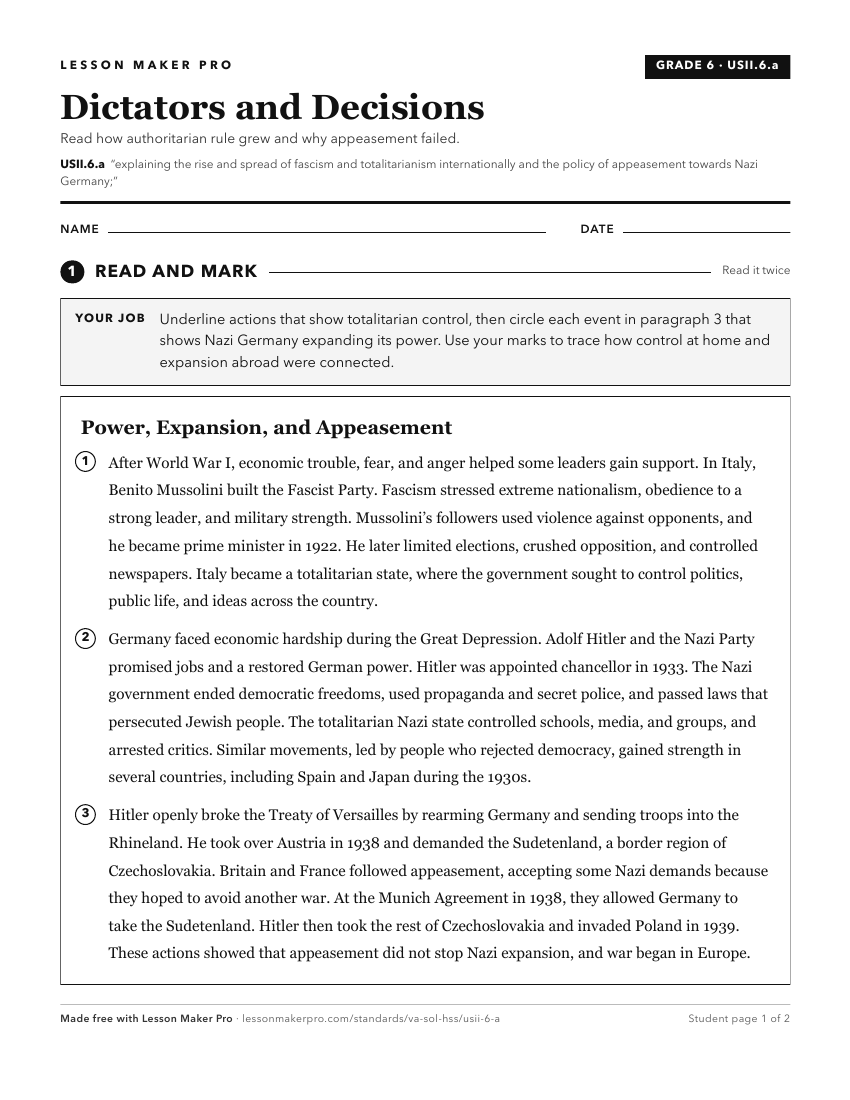
A ready-to-print activity worksheet aligned to USII.6.a, with an answer key for the teacher on its own page. No account needed.
PDF, US Letter, prints cleanly in black and white.
Download the worksheetKeep exploring
Related Standards
- USII.7.a
explaining how key decisions and agreements including, but not limited to the Atlantic Charter, formation of the United Nations, and the North Atlantic Treaty O...
- USII.6.e
explaining and evaluating the role of key political and military leaders of the Allies and Axis powers including, but not limited to the United States, Germany,...
- USII.6.h
examining the causes and consequences of the Holocaust including, but not limited to Jewish life before the Holocaust, antisemitism, the rise of the Nazi Party,...
- USII.4.f
examining how post-war sanctions and the failure of the League of Nations set the stage for World War II
Turn this exact standard into a lesson
Grade, subject, topic, and the complete standard are prefilled. Create one free, no account needed.
Also for this standard:Make a WorksheetMake a QuizMake a Sub Lesson