Virginia SOL USII.8.c
The Standard
- USII.8
- The student will apply history and social science skills to analyze the key changing patterns of society during the second half of the 20th and early 21st centuries by
examining key events of the 1960s and 1970s including, but not limited to the Apollo missions, the moon landing, assassinations, the women’s movement, the creation of public sector labor unions, the Watergate scandal and Nixon’s resignation, and the passing of the Clean Air Act and the Clean Water Act
Virginia Standards of Learning for History and Social Science
Teacher's field guide
What This Standard Means
What Students Need to Do
- Students identify major events of the 1960s and 1970s and place them in time. They explain how each event changed science, government, rights, labor, or environmental policy.
What Mastery Looks Like
- Students can sequence major events and match each one to an accurate result. They can explain links such as Watergate weakening public trust or environmental laws increasing federal pollution controls.
Common Misconceptions
- Students may think Nixon was removed through impeachment, rather than resigning during the Watergate investigation. They may also think the moon landing ended space exploration, or that new rights and environmental laws solved every problem immediately.
How to Assess It
- Use this exit ticket: Choose three events from the lesson, place them in order, and write one lasting effect of each event.
Lesson moves
Ways to Teach It
Give groups dated event cards and photographs to build a classroom timeline, then add one impact label beneath each event.
Ask students to write which event most changed Americans’ view of government, using two facts from class sources.
Play an event-and-impact matching game with cards for Apollo, assassinations, women’s rights, labor unions, Watergate, and environmental laws.
Check the local AirNow reading, then discuss how federal clean air rules affect students’ daily lives.
Free download
Printable USII.8.c Worksheet
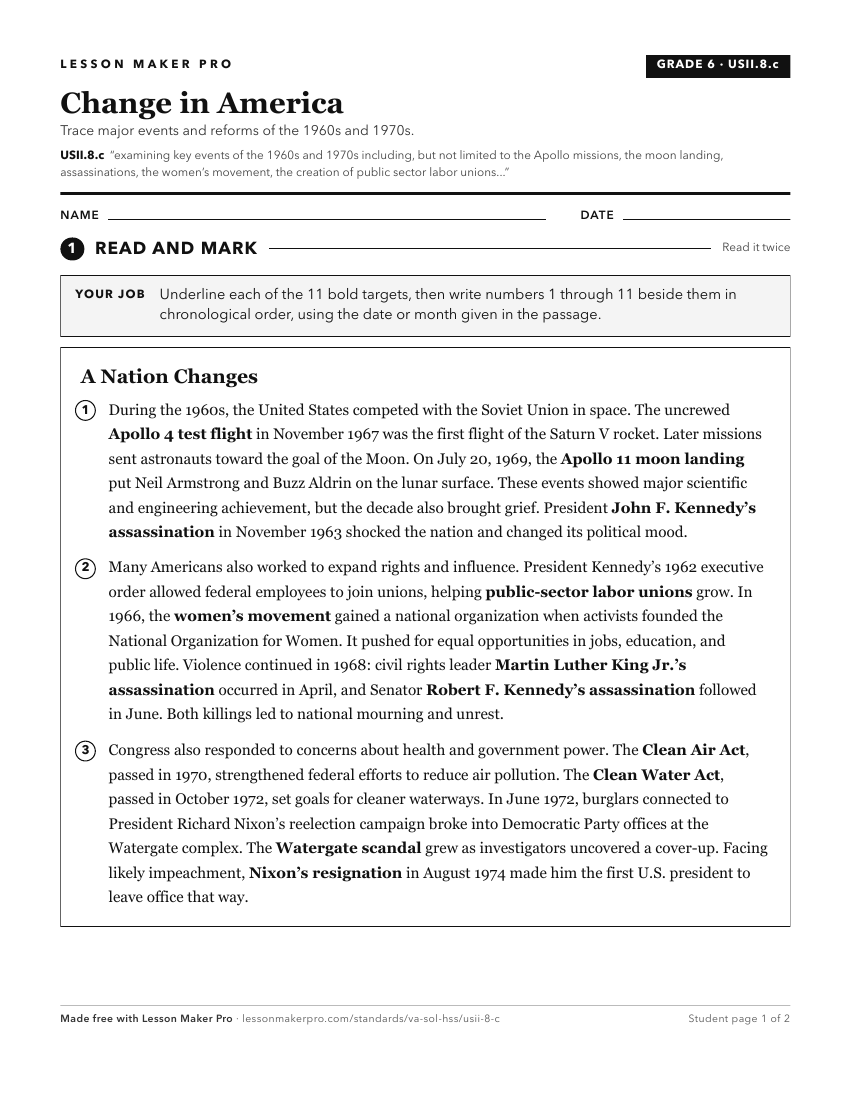
A ready-to-print activity worksheet aligned to USII.8.c, with an answer key for the teacher on its own page. No account needed.
PDF, US Letter, prints cleanly in black and white.
Download the worksheetKeep exploring
Related Standards
- USII.8.a
examining the contributions of key leaders and events during the Civil Rights Era including, but not limited to Robert Kennedy, Dr. Martin Luther King, Jr., Mal...
- USII.1.c
examining the impact of policies, legislation, and treaties associated with the growth of the nation
- 2.9
The student will apply history and social science skills to understand key events in United States history including, but not limited to
- USII.7.d
examining the role of the United States in fighting communism and defending freedom during the Cold War including, but not limited to the Berlin Airlift, confli...
Turn this exact standard into a lesson
Grade, subject, topic, and the complete standard are prefilled. Create one free, no account needed.
Also for this standard:Make a WorksheetMake a QuizMake a Sub Lesson