Virginia SOL USII.8.a
The Standard
- USII.8
- The student will apply history and social science skills to analyze the key changing patterns of society during the second half of the 20th and early 21st centuries by
examining the contributions of key leaders and events during the Civil Rights Era including, but not limited to Robert Kennedy, Dr. Martin Luther King, Jr., Malcolm X, Medgar Evers, John Lewis, Rosa Parks, Ruby Bridges, Jonathan Daniels, Dorothy Height, the Selma march, sit-ins, and boycotts
Virginia Standards of Learning for History and Social Science
Teacher's field guide
What This Standard Means
What Students Need to Do
- Students identify major leaders and events from the Civil Rights Era. They explain each person’s contribution, describe protest strategies, and connect actions to changes in laws or public life.
What Mastery Looks Like
- Students accurately match leaders and events with specific actions and results. They compare strategies such as sit-ins, boycotts, marches, speeches, and legal action using clear evidence.
Common Misconceptions
- Students may treat Martin Luther King Jr. as the movement’s only leader or assume all leaders used the same methods. They may also confuse the Selma march with the Montgomery bus boycott or view Rosa Parks’s protest as unplanned.
How to Assess It
- Give an exit ticket: Choose one leader or event, name one specific action, and explain one result of that action.
Lesson moves
Ways to Teach It
Sort leader and event cards onto a floor timeline, then attach action and impact labels to each card.
Write: Which protest strategy created the clearest change, and what evidence supports your choice?
Play a three-card matching game using leader, action, and result cards from the Civil Rights Era.
Use a local news article to identify a march, boycott, or speech, then compare its strategy with one historical example.
Free download
Printable USII.8.a Worksheet
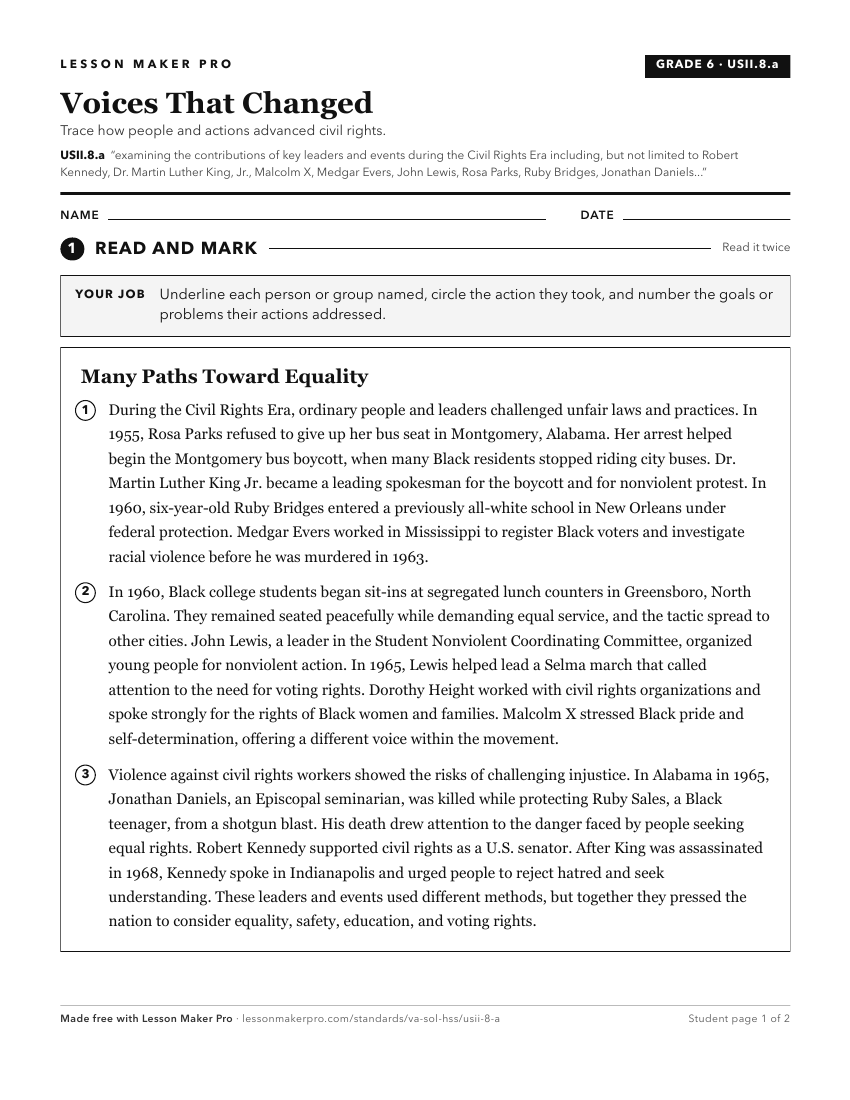
A ready-to-print activity worksheet aligned to USII.8.a, with an answer key for the teacher on its own page. No account needed.
PDF, US Letter, prints cleanly in black and white.
Download the worksheetKeep exploring
Related Standards
- 2.10.c
Reformers and Champions: Abraham Lincoln, Theodore Roosevelt, Helen Keller, Thurgood Marshall, Rosa Parks, Jackie Robinson, Cesar Chavez, Dr. Martin Luther King...
- USII.5.i
analyzing events and impacts of African American leaders in response to “Jim Crow” including, but not limited to the formation of the National Association for t...
- VS.11.b
investigating the political, social, and economic effects of choices made during the Civil Rights Era by Virginians including, but not limited to Maggie Walker,...
- USII.8.c
examining key events of the 1960s and 1970s including, but not limited to the Apollo missions, the moon landing, assassinations, the women’s movement, the creat...
Turn this exact standard into a lesson
Grade, subject, topic, and the complete standard are prefilled. Create one free, no account needed.
Also for this standard:Make a WorksheetMake a QuizMake a Sub Lesson