Virginia SOL USII.5.i
The Standard
- USII.5
- The student will apply history and social science skills to understand the social, political, economic, and technological changes of the early 20th century by
analyzing events and impacts of African American leaders in response to “Jim Crow” including, but not limited to the formation of the National Association for the Advancement of Colored People (NAACP), strikes, protests, the role of historically black colleges and universities (HBCUs), and the work of leaders like Booker T. Washington, W.E.B. DuBois, Mary White Ovington, and Ida B. Wells-Barnett.
Virginia Standards of Learning for History and Social Science
Teacher's field guide
What This Standard Means
What Students Need to Do
- Students compare how individuals and organizations resisted segregation and racial violence. They explain how education, journalism, legal action, strikes, and protests affected rights, opportunities, and public awareness.
What Mastery Looks Like
- A student can connect Washington to vocational education, Du Bois to immediate civil rights, Wells-Barnett to anti-lynching journalism, and Ovington to NAACP organizing. The student distinguishes different strategies and explains one impact of an HBCU or the NAACP with evidence.
Common Misconceptions
- Students may assume every named reformer was African American, although Mary White Ovington was a white cofounder of the NAACP. They often treat Washington and Du Bois as complete opposites and miss their shared goals. They may reduce Jim Crow to separate facilities, overlooking voting restrictions, unequal schools, and racial violence.
How to Assess It
- Exit ticket: Choose one leader and one organization or institution. For each, name a strategy used against Jim Crow and explain one impact.
Lesson moves
Ways to Teach It
Give pairs person, group, strategy, and impact cards; students build accurate sets and defend two matches using a short source packet.
Ask students to write: Which strategy produced the clearest immediate impact, and what evidence supports your claim?
Play a clue-card game where teams identify Washington, Du Bois, Wells-Barnett, Ovington, the NAACP, or an HBCU, then name the strategy.
Compare one current HBCU mission statement with its founding purpose, then list one way the institution still expands opportunity.
Free download
Printable USII.5.i Worksheet
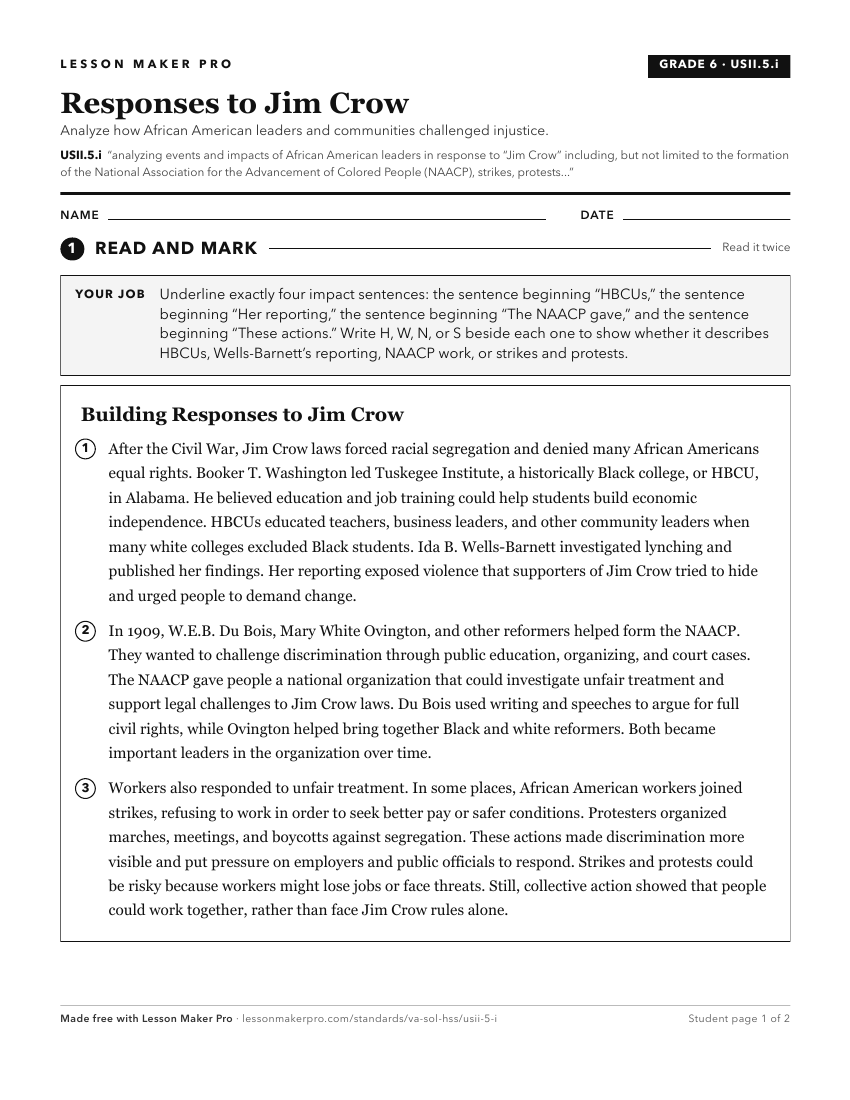
A ready-to-print activity worksheet aligned to USII.5.i, with an answer key for the teacher on its own page. No account needed.
PDF, US Letter, prints cleanly in black and white.
Download the worksheetKeep exploring
Related Standards
- USII.8.a
examining the contributions of key leaders and events during the Civil Rights Era including, but not limited to Robert Kennedy, Dr. Martin Luther King, Jr., Mal...
- USII.5.h
describing racial segregation, housing discrimination via redlining, the rise of “Jim Crow” laws, Black Codes, and threats of violence including, but not limite...
- VS.11.a
explaining the social and political events connected to disenfranchisement of African American voters in Virginia in the early 20th century, desegregation, cour...
- VS.11.b
investigating the political, social, and economic effects of choices made during the Civil Rights Era by Virginians including, but not limited to Maggie Walker,...
Turn this exact standard into a lesson
Grade, subject, topic, and the complete standard are prefilled. Create one free, no account needed.
Also for this standard:Make a WorksheetMake a QuizMake a Sub Lesson