Virginia SOL VS.11.b
The Standard
- VS.11
- The student will apply history and social science skills to understand the Civil Rights Movement in Virginia by
investigating the political, social, and economic effects of choices made during the Civil Rights Era by Virginians including, but not limited to Maggie Walker, Robert Russa Moton, Barbara Johns, Samuel Wilbert Tucker, Oliver W. Hill, Sr., Irene Morgan, Arthur R. Ashe, A. Linwood Holton, Jr., and L. Douglas Wilder.
Virginia Standards of Learning for History and Social Science
Teacher's field guide
What This Standard Means
What Students Need to Do
- Students identify choices Virginia leaders made to challenge segregation, expand opportunity, or change public policy. They connect each choice to political, social, and economic effects. They use dates and evidence to explain immediate and lasting change.
What Mastery Looks Like
- A student can explain how Barbara Johns's student strike helped lead to a school desegregation case. The student can compare her action with Irene Morgan's court challenge or Maggie Walker's business leadership and classify the effects.
Common Misconceptions
- Students may treat every person as a politician or assume each worked at the same time. They often confuse an action with its effect or think one protest ended segregation immediately. They may force an effect into one category when it fits more than one.
How to Assess It
- Exit ticket: Choose Barbara Johns, Irene Morgan, or Oliver Hill. Name one choice the person made, one effect, and whether it was political, social, economic, or overlapping.
Lesson moves
Ways to Teach It
Give groups person, action, date, and effect cards to match, then place each completed set on a classroom timeline.
Write: Which Virginian's choice created the widest change, and what evidence supports your claim?
Play Cause and Effect Relay: teams draw a leader card, state the choice, then earn a point for an accurate effect.
Read a recent local news story about a policy change, then compare its decision and effects with Holton's leadership on school integration.
Free download
Printable VS.11.b Worksheet
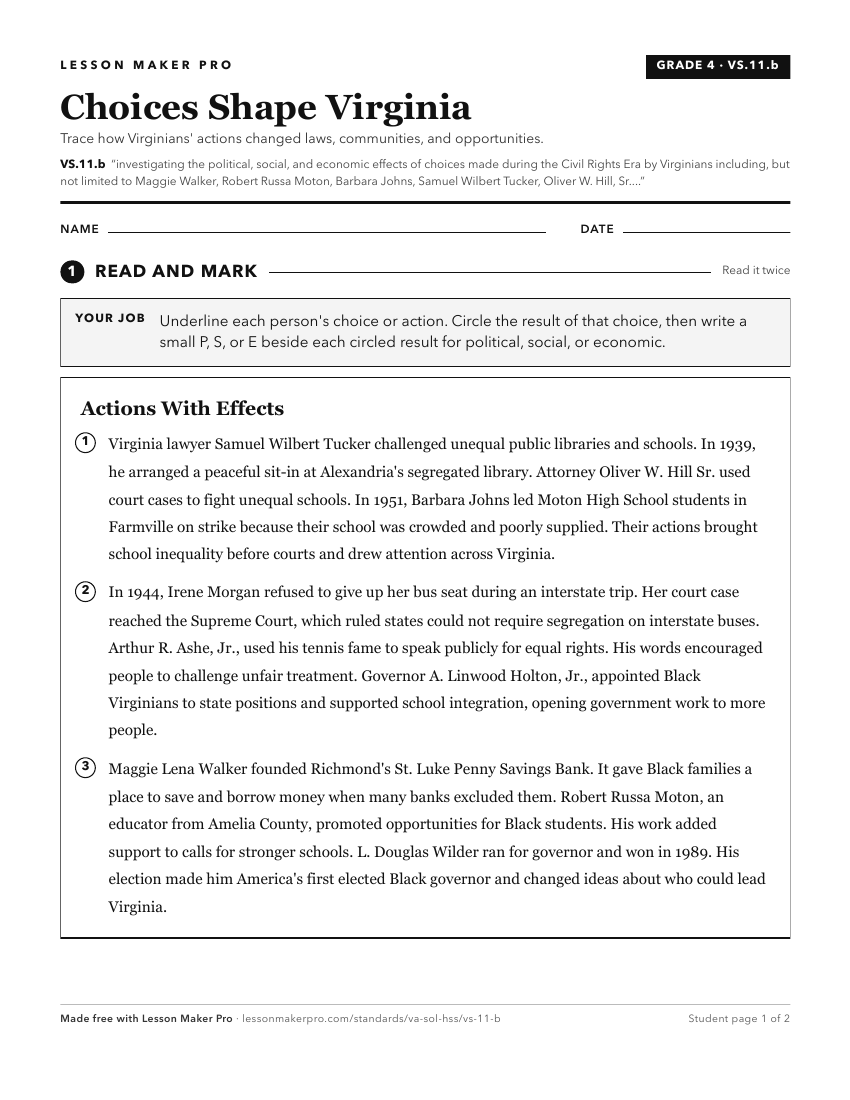
A ready-to-print activity worksheet aligned to VS.11.b, with an answer key for the teacher on its own page. No account needed.
PDF, US Letter, prints cleanly in black and white.
Download the worksheetKeep exploring
Related Standards
- USII.8.a
examining the contributions of key leaders and events during the Civil Rights Era including, but not limited to Robert Kennedy, Dr. Martin Luther King, Jr., Mal...
- VS.11.a
explaining the social and political events connected to disenfranchisement of African American voters in Virginia in the early 20th century, desegregation, cour...
- VS.11
The student will apply history and social science skills to understand the Civil Rights Movement in Virginia by
- VS.5.b
examining the important contributions, leadership, and experiences of Virginians during the war including, but not limited to George Washington, Thomas Jefferso...
Turn this exact standard into a lesson
Grade, subject, topic, and the complete standard are prefilled. Create one free, no account needed.
Also for this standard:Make a WorksheetMake a QuizMake a Sub Lesson