Virginia SOL USII.8.b
The Standard
- USII.8
- The student will apply history and social science skills to analyze the key changing patterns of society during the second half of the 20th and early 21st centuries by
explaining the significance of urban renewal plans including, but not limited to Jackson Ward in Richmond and Vinegar Hill in Charlottesville
Virginia Standards of Learning for History and Social Science
Teacher's field guide
What This Standard Means
What Students Need to Do
- Students explain how city redevelopment plans changed Jackson Ward and Vinegar Hill. They identify who was displaced, what community spaces were lost, and how roads and demolition affected Black residents and businesses.
What Mastery Looks Like
- Students compare both neighborhoods using details from maps, photographs, or accounts. They explain that urban renewal brought physical changes while also causing displacement, business loss, and lasting racial inequities.
Common Misconceptions
- Students may assume urban renewal improved life for everyone or that residents chose to leave. They may also confuse rebuilding neglected areas with clearing established homes, businesses, churches, and social networks.
How to Assess It
- Exit ticket: Name one change caused by urban renewal in either neighborhood, then explain one lasting effect on residents or businesses.
Lesson moves
Ways to Teach It
Give pairs printed maps from before and after clearance, then have them mark lost homes, businesses, roads, and community spaces.
Write a response to this prompt: Who gained and who lost when Jackson Ward or Vinegar Hill was redeveloped?
Students sort evidence cards into plan, action, and consequence columns for Jackson Ward and Vinegar Hill, then check a partner’s sort.
Use a current city map to locate each neighborhood, then identify one visible feature linked to redevelopment, such as a highway or vacant block.
Free download
Printable USII.8.b Worksheet
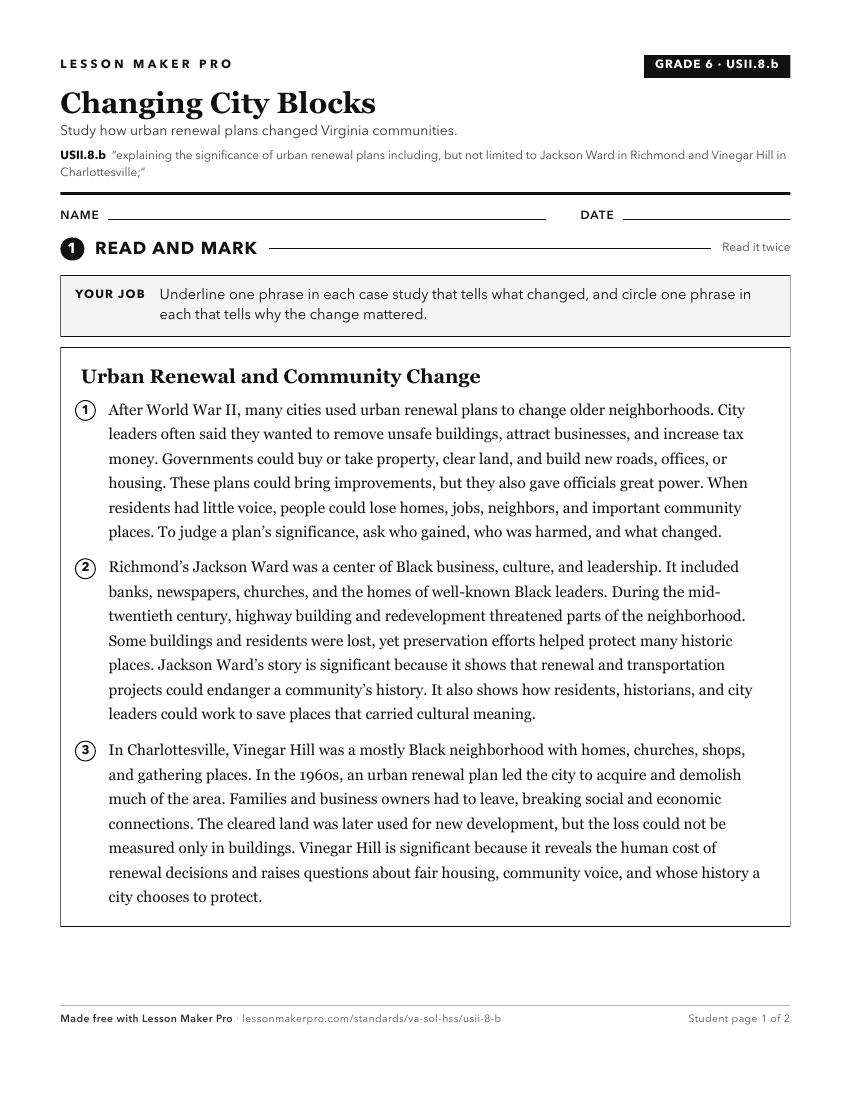
A ready-to-print activity worksheet aligned to USII.8.b, with an answer key for the teacher on its own page. No account needed.
PDF, US Letter, prints cleanly in black and white.
Download the worksheetKeep exploring
Related Standards
- VS.5.c
identifying the reasons for the relocation of Virginia’s capital from Williamsburg to Richmond
- VS.4.e
explaining the reasons for the relocation of Virginia’s capital from Jamestown to Williamsburg
- VS.8.b
examining the effects of Reconstruction on life in Virginia
- VS.9.a
explaining the importance of railroads, waterways, new industries, and the growth of cities to Virginia’s economic development in the late 1800s
Turn this exact standard into a lesson
Grade, subject, topic, and the complete standard are prefilled. Create one free, no account needed.
Also for this standard:Make a WorksheetMake a QuizMake a Sub Lesson