Virginia SOL VS.5.c
The Standard
- VS.5
- The student will apply history and social science skills to explain Virginia and Virginians’ role during the American Revolution by
identifying the reasons for the relocation of Virginia’s capital from Williamsburg to Richmond
Virginia Standards of Learning for History and Social Science
Teacher's field guide
What This Standard Means
What Students Need to Do
- Students explain why Virginia leaders chose Richmond instead of Williamsburg as the capital. They connect the move to westward population growth, a more central location, and protection from British attack.
What Mastery Looks Like
- Students name at least two reasons for the move and explain each one. They use a map to show why Richmond was more central and safer from coastal attack.
Common Misconceptions
- Students may confuse this move with the earlier change from Jamestown to Williamsburg. They may also think Richmond was chosen only because it was larger or already the capital.
How to Assess It
- Exit ticket: Give two reasons Virginia leaders chose Richmond over Williamsburg, and explain how Richmond's location addressed each concern.
Lesson moves
Ways to Teach It
Use a Virginia map, yarn, and population markers to compare Williamsburg and Richmond for central location, western settlement, and distance from the coast.
Ask students to write: Why was Richmond a better capital site during the Revolution and as settlement shifted west?
Play a reason-or-not card sort with central location, inland safety, western population growth, tobacco prices, and harbor access.
Have students choose a new location for a town hall, using maps to defend their choices based on access and safety.
Free download
Printable VS.5.c Worksheet
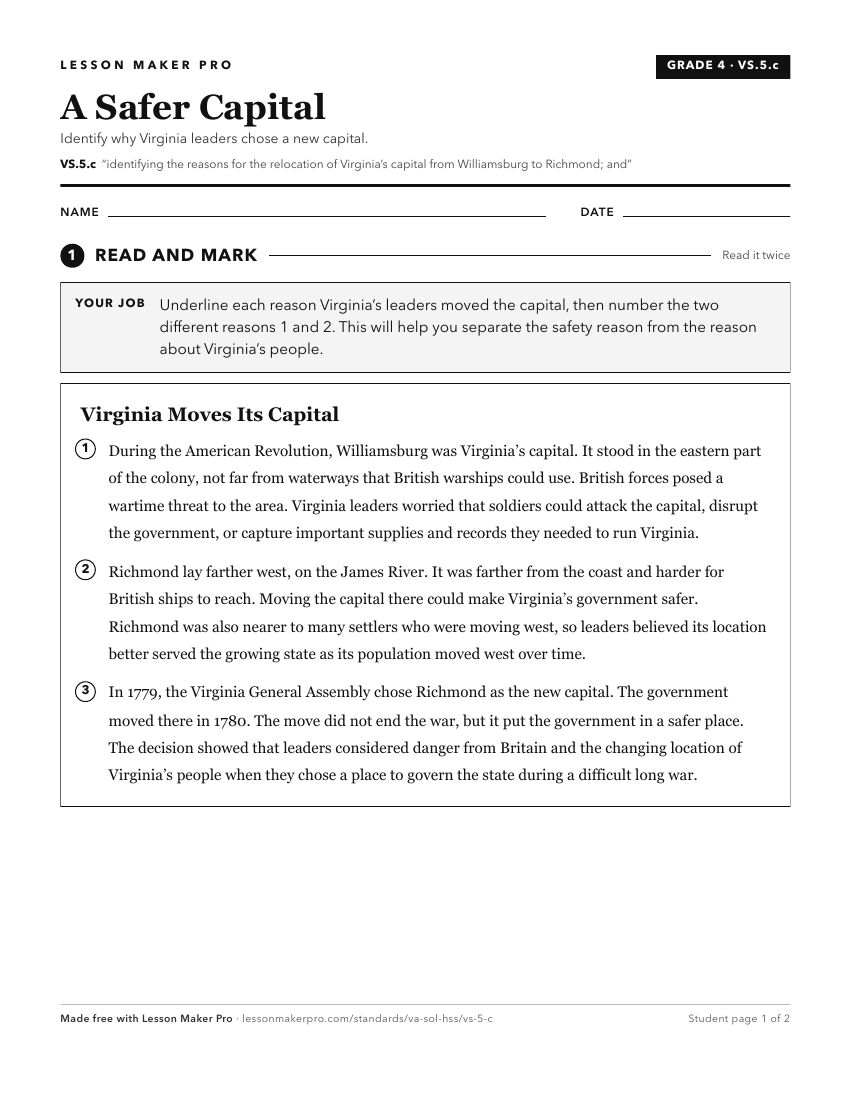
A ready-to-print activity worksheet aligned to VS.5.c, with an answer key for the teacher on its own page. No account needed.
PDF, US Letter, prints cleanly in black and white.
Download the worksheetKeep exploring
Related Standards
- VS.4.e
explaining the reasons for the relocation of Virginia’s capital from Jamestown to Williamsburg
- 1.7.c
locating the site of the Jamestown colony
- 2.9.a
recognizing the reasons for moving the nation’s capital from Philadelphia to Washington, D.C. and the importance of the nation’s capital
- VS.9.a
explaining the importance of railroads, waterways, new industries, and the growth of cities to Virginia’s economic development in the late 1800s
Turn this exact standard into a lesson
Grade, subject, topic, and the complete standard are prefilled. Create one free, no account needed.
Also for this standard:Make a WorksheetMake a QuizMake a Sub Lesson