Virginia SOL USII.5
SOL Standard (Skills Cluster)
The student will apply history and social science skills to understand the social, political, economic, and technological changes of the early 20th century by explaining how capitalism and free markets helped foster developments in factory and labor productivity, transportation, and communication and how rural electrification changed American life and the standard of living; examining how the rise of communism affected America including, but not limited to the first Red Scare; describing the reasons for and impact of the Great Migration; describing the events and leaders that lead to prohibition, the Women’s Suffrage Movement, and the passage of the Nineteenth Amendment including, but not limited to Susan B. Anthony, Lucy Burns, Elizabeth Cady Stanton, Carrie Chapman Catt, Ida B. Wells-Barnett, and Sojourner Truth; examining the art, literature, and music of the 1920s and 1930s including, but not limited to the Roaring Twenties and the Harlem Renaissance; analyzing the causes of the Great Depression and the impact of the Dust Bowl on the lives of Americans; describing the features, effects, programs, and lasting institutions of Franklin D. Roosevelt’s New Deal; describing racial segregation, housing discrimination via redlining, the rise of “Jim Crow” laws, Black Codes, and threats of violence including, but not limited to intimidation, lynchings, armed conflicts, suppressed voting rights, and limits on political participation faced by African Americans and other people during post-Reconstruction; and analyzing events and impacts of African American leaders in response to “Jim Crow” including, but not limited to the formation of the National Association for the Advancement of Colored People (NAACP), strikes, protests, the role of historically black colleges and universities (HBCUs), and the work of leaders like Booker T. Washington, W.E.B. DuBois, Mary White Ovington, and Ida B. Wells-Barnett.
Virginia Standards of Learning for History and Social Science
Cluster contents
Skills in This Standard
USII.5 is a Standards of Learning history and social science standard. These are the skills expectations under it.
- USII.5.a
explaining how capitalism and free markets helped foster developments in factory and labor productivity, transportation, and communication and how rural electri...
- USII.5.b
examining how the rise of communism affected America including, but not limited to the first Red Scare
- USII.5.c
describing the reasons for and impact of the Great Migration
- USII.5.d
describing the events and leaders that lead to prohibition, the Women’s Suffrage Movement, and the passage of the Nineteenth Amendment including, but not limite...
- USII.5.e
examining the art, literature, and music of the 1920s and 1930s including, but not limited to the Roaring Twenties and the Harlem Renaissance
- USII.5.f
analyzing the causes of the Great Depression and the impact of the Dust Bowl on the lives of Americans
- USII.5.g
describing the features, effects, programs, and lasting institutions of Franklin D. Roosevelt’s New Deal
- USII.5.h
describing racial segregation, housing discrimination via redlining, the rise of “Jim Crow” laws, Black Codes, and threats of violence including, but not limite...
- USII.5.i
analyzing events and impacts of African American leaders in response to “Jim Crow” including, but not limited to the formation of the National Association for t...
Teacher's field guide
What This Cluster Means
What Students Need to Do
- Students connect capitalism, competition, inventions, transportation, communication, and rural electricity to changes in work and daily life. They explain causes and effects of the Red Scare, Great Migration, suffrage, Prohibition, cultural movements, Great Depression, Dust Bowl, and New Deal. They analyze discrimination and explain how Black leaders, HBCUs, and the NAACP responded.
What Mastery Looks Like
- A student can place major developments in order and build cause and effect chains using specific evidence. The student can match key leaders and organizations to their goals, methods, and results. The student can compare economic progress with unequal access to rights, jobs, housing, and political power.
Common Misconceptions
- Students may treat the Great Migration as immigration from another country. They often assume the Nineteenth Amendment gave every woman equal voting access and that Jim Crow existed only in the South. They may claim the New Deal ended the Great Depression or view the Harlem Renaissance as only music.
How to Assess It
- Give students six terms: rural electrification, Great Migration, Nineteenth Amendment, Harlem Renaissance, redlining, and New Deal. For any three, have them write one cause, one effect, and one supporting fact.
Lesson moves
Ways to Teach It
Give pairs event, leader, cause, and effect cards, then have them build and defend four accurate chains on a desk.
Ask students to write: Which change most improved American life, and who was excluded from its benefits?
Run a timeline relay where teams place dated cards, then earn a point by explaining each card’s connection to another.
Compare a 1930s appliance advertisement with a current ad, then list how electricity changed household work and expectations.
Free download
Printable USII.5 Worksheet
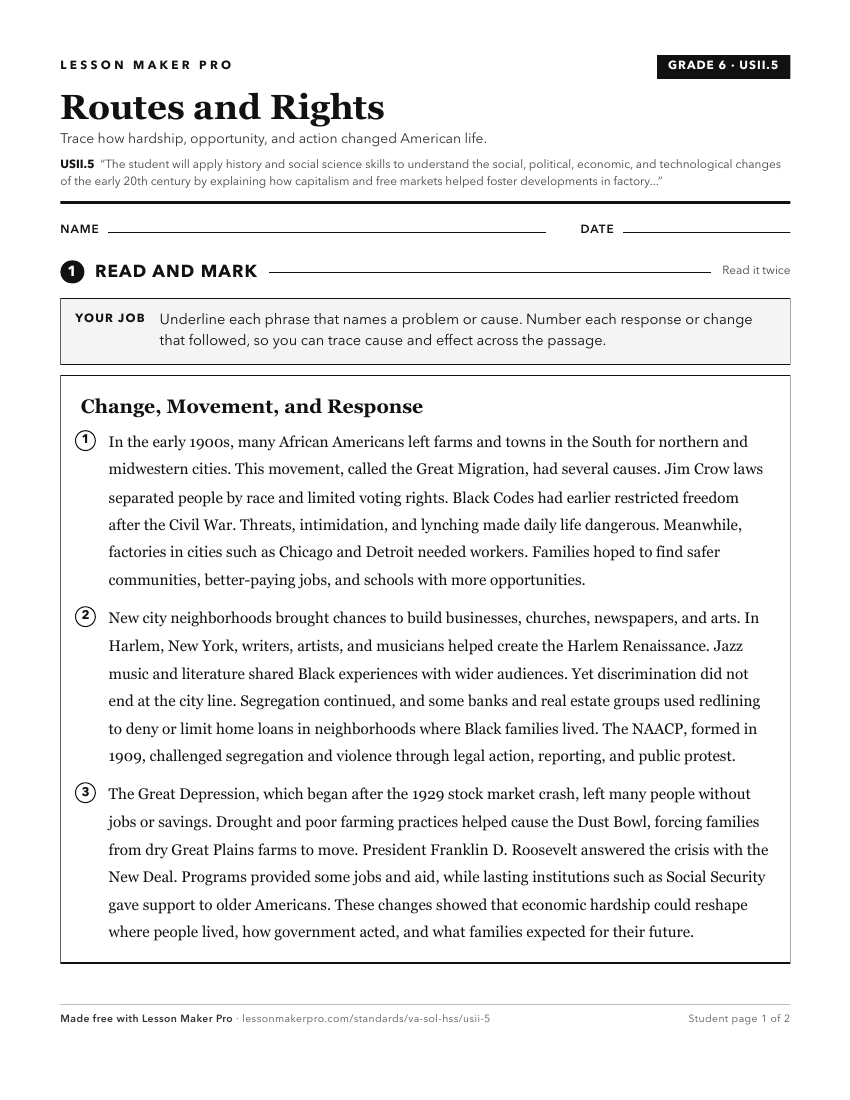
A ready-to-print activity worksheet aligned to USII.5, with an answer key for the teacher on its own page. No account needed.
PDF, US Letter, prints cleanly in black and white.
Download the worksheetKeep exploring
Related Standards
- USII.8
The student will apply history and social science skills to analyze the key changing patterns of society during the second half of the 20th and early 21st centu...
- USII.3
The student will apply history and social science skills to understand how industrialization changed life in rural and urban America after the Civil War by
- USII.9
The student will apply history and social science skills by
- USII.4
The student will apply history and social science skills to explain the changing role of the United States from the late 19th century through World War I by
Turn this cluster into a lesson
Grade, subject, topic, and the complete cluster are prefilled. Create one free, no account needed.
Also for this cluster:Make a WorksheetMake a QuizMake a Sub Lesson