Virginia SOL USII.5.g
The Standard
- USII.5
- The student will apply history and social science skills to understand the social, political, economic, and technological changes of the early 20th century by
describing the features, effects, programs, and lasting institutions of Franklin D. Roosevelt’s New Deal
Virginia Standards of Learning for History and Social Science
Teacher's field guide
What This Standard Means
What Students Need to Do
- Students explain why the federal government created new programs during the Great Depression. They sort programs by relief, recovery, or reform and describe how several changed daily life. They identify institutions that still operate, including Social Security, the FDIC, and the SEC.
What Mastery Looks Like
- Students can connect programs such as the CCC, WPA, FDIC, and Social Security to the problems they addressed. They can separate temporary job programs from lasting institutions and explain how the New Deal expanded the federal government’s role.
Common Misconceptions
- Students may claim the New Deal alone ended the Great Depression or assume every program became permanent. They often confuse the roles of Social Security, the FDIC, and the SEC. Some overlook that benefits were not shared equally across racial and social groups.
How to Assess It
- Give students CCC, WPA, FDIC, and Social Security. For each, have them name its purpose, classify it, and circle whether its work continues today.
Lesson moves
Ways to Teach It
Give pairs program cards and problem cards; students match them, label relief, recovery, or reform, then defend one match.
Ask students to write: Which New Deal program most changed the federal government’s role, and what evidence supports your choice?
Play clue bingo with CCC, WPA, TVA, FDIC, SEC, and Social Security, requiring students to explain each winning match.
Show an FDIC sign and a sample pay stub; students trace how New Deal institutions still affect savings and wages.
Free download
Printable USII.5.g Worksheet
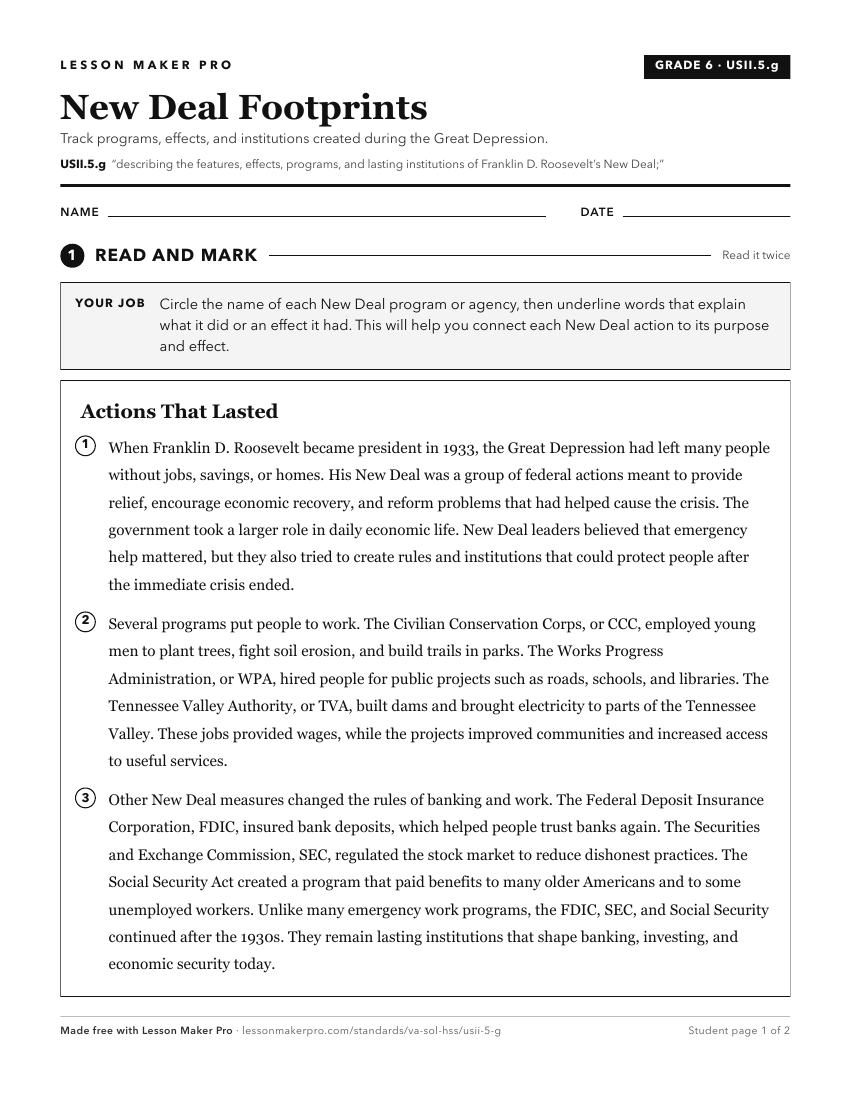
A ready-to-print activity worksheet aligned to USII.5.g, with an answer key for the teacher on its own page. No account needed.
PDF, US Letter, prints cleanly in black and white.
Download the worksheetKeep exploring
Related Standards
- USII.7.b
describing the Marshall Plan’s objectives for rebuilding Europe, the occupation and reconstruction of Japan, and the emergence of the United States and the Sovi...
- USII.4.a
explaining the legacy of Theodore Roosevelt including, but not limited to conservation contributions, progressivism, the building of the Panama Canal, and his r...
- USII.9.b
describing the changes in American culture related to music, art, media, and communication, as well as advancements in American economics related to banking, bu...
- USII.6.i
describing the events that led to the surrender of the Axis powers and America’s role in the Allied victory including, but not limited to the Manhattan Project,...
Turn this exact standard into a lesson
Grade, subject, topic, and the complete standard are prefilled. Create one free, no account needed.
Also for this standard:Make a WorksheetMake a QuizMake a Sub Lesson