Virginia SOL USII.3
SOL Standard (Skills Cluster)
The student will apply history and social science skills to understand how industrialization changed life in rural and urban America after the Civil War by explaining relationships among natural resources, transportation, and industrial development from 1865; explaining the impact of new inventions, the rise of big business, the growth of industry, and the changes to life on American farms in response to industrialization; evaluating and explaining the impact of the Progressive Movement on child labor, working conditions, the rise of organized labor, support for eugenics as a social policy, immigration policy, women’s suffrage, and the temperance movement; explaining the events, factors, and motivations that caused individuals and groups to migrate to the United States towards the end of the 19th century; examining the cause-and-effect relationship between rapid population growth and city government services and infrastructure; explaining how governmental actions including, but not limited to the Chinese Exclusion Act of 1882, caused harm to Chinese Americans and other immigrants; explaining how various groups worked to alleviate the issues facing new immigrants and how immigrants advocated for themselves; and describing the technological advances and the broader impact of the 1893 Chicago World's Fair on America’s rise as a world leader in innovation, business, and trade.
Virginia Standards of Learning for History and Social Science
Cluster contents
Skills in This Standard
USII.3 is a Standards of Learning history and social science standard. These are the skills expectations under it.
- USII.3.a
explaining relationships among natural resources, transportation, and industrial development from 1865
- USII.3.b
explaining the impact of new inventions, the rise of big business, the growth of industry, and the changes to life on American farms in response to industrializ...
- USII.3.c
evaluating and explaining the impact of the Progressive Movement on child labor, working conditions, the rise of organized labor, support for eugenics as a soci...
- USII.3.d
explaining the events, factors, and motivations that caused individuals and groups to migrate to the United States towards the end of the 19th century
- USII.3.e
examining the cause-and-effect relationship between rapid population growth and city government services and infrastructure
- USII.3.f
explaining how governmental actions including, but not limited to the Chinese Exclusion Act of 1882, caused harm to Chinese Americans and other immigrants
- USII.3.g
explaining how various groups worked to alleviate the issues facing new immigrants and how immigrants advocated for themselves
- USII.3.h
describing the technological advances and the broader impact of the 1893 Chicago World's Fair on America’s rise as a world leader in innovation, business, and t...
Teacher's field guide
What This Cluster Means
What Students Need to Do
- Students explain how resources and transportation shaped factories, farms, cities, and big business after the Civil War. They trace how inventions and industrial growth affected workers, immigrants, women, children, and city services. They evaluate reforms and harmful policies, including eugenics and immigration restrictions, and explain how the Chicago fair displayed American innovation and trade.
What Mastery Looks Like
- Students can use a map, image, law, or short account to build a clear cause and effect explanation. They can compare benefits and harms, cite evidence, and explain how labor unions, immigrant groups, reformers, and government actions changed conditions. They can connect the Chicago fair's exhibits to growth in technology, business, and global trade.
Common Misconceptions
- Students may assume industrial growth helped everyone equally, that all immigrants came for the same reason, or that crowded cities failed only because leaders did not care. They may treat all Progressive ideas as helpful, overlooking eugenics, exclusion laws, discrimination, and limits on who benefited. They may also credit inventions alone, missing the roles of resources, rail networks, labor, government, and community action.
How to Assess It
- Exit ticket: Choose one chain, resources to railroads to industry, migration to population growth to city services, or industrial harm to reform. Explain each link with two specific facts, then name one group that benefited and one that was harmed.
Lesson moves
Ways to Teach It
Groups connect coal, iron, railroads, factories, farms, and cities with string, then label each link with a cause and effect.
Read a child labor reform excerpt and a eugenics argument, then write how Progressive ideas could help and harm.
Run a card sort matching inventions, business growth, farm changes, immigration, city services, labor unions, and government policies to effects.
Compare a local transit or sanitation map with an 1890s city map, then identify how population growth shapes public services.
Free download
Printable USII.3 Worksheet
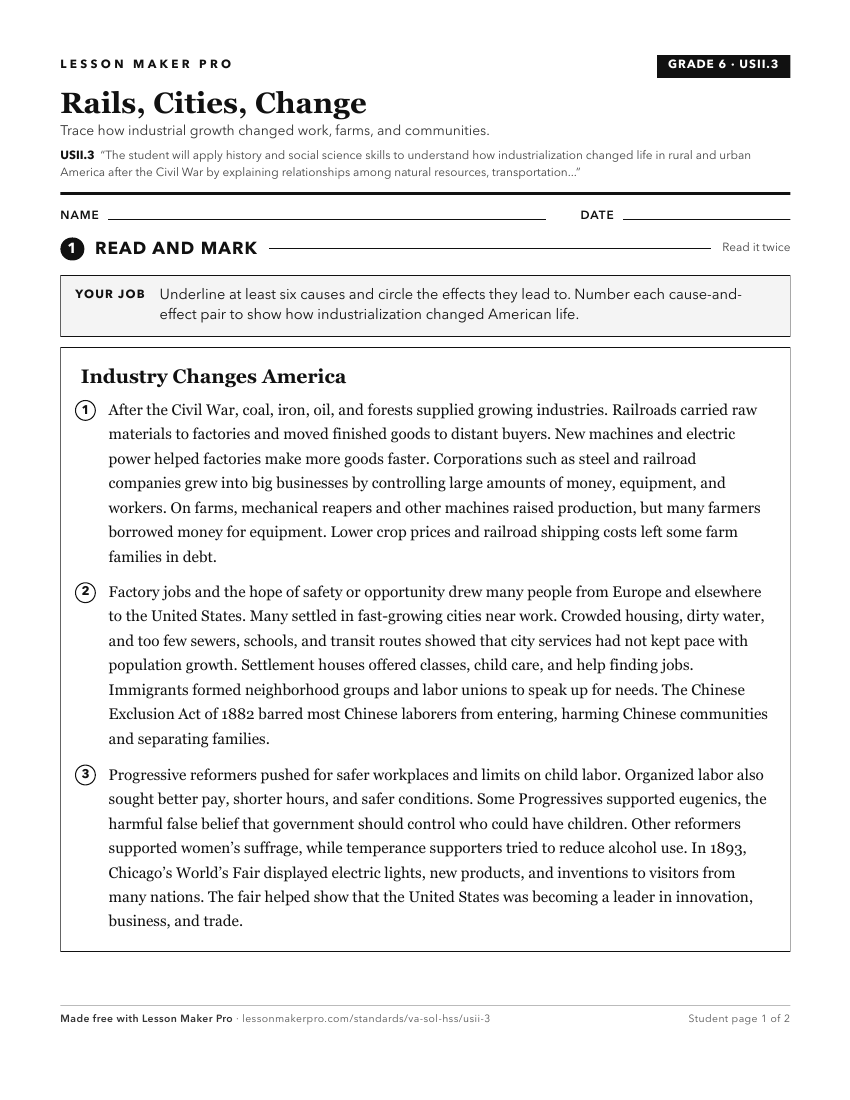
A ready-to-print activity worksheet aligned to USII.3, with an answer key for the teacher on its own page. No account needed.
PDF, US Letter, prints cleanly in black and white.
Download the worksheetKeep exploring
Related Standards
- USII.2
The student will apply history and social science skills to understand the ongoing effects of Reconstruction on American life after the mid-19th century by
- WG.15
The student will apply history and social science skills to analyze the patterns of rural and urban migration and development by
- USII.5
The student will apply history and social science skills to understand the social, political, economic, and technological changes of the early 20th century by
- USII.4
The student will apply history and social science skills to explain the changing role of the United States from the late 19th century through World War I by
Turn this cluster into a lesson
Grade, subject, topic, and the complete cluster are prefilled. Create one free, no account needed.
Also for this cluster:Make a WorksheetMake a QuizMake a Sub Lesson