Virginia SOL USII.2
SOL Standard (Skills Cluster)
The student will apply history and social science skills to understand the ongoing effects of Reconstruction on American life after the mid-19th century by describing the impact of the assassination of Abraham Lincoln and the political aftermath of the Civil War; analyzing the goals and effects of the Reconstruction Amendments, the Freedmen’s Bureau, and civil rights policies that changed the meaning of citizenship in the United States; describing the legacies of Abraham Lincoln and the Gettysburg Address, Ulysses S. Grant, Robert E. Lee, Hiram Revels, and Frederick Douglass; describing the role of Congress and the Supreme Court in specific plans and policies including, but not limited to Lincoln’s Ten Percent Plan; describing the role and motivations of individuals who sought to gain from Reconstruction including, but not limited to formerly enslaved people elected to office during the years right after the Civil War; and explaining how the 1876 presidential election led to the end of Reconstruction.
Virginia Standards of Learning for History and Social Science
Cluster contents
Skills in This Standard
USII.2 is a Standards of Learning history and social science standard. These are the skills expectations under it.
- USII.2.a
describing the impact of the assassination of Abraham Lincoln and the political aftermath of the Civil War
- USII.2.b
analyzing the goals and effects of the Reconstruction Amendments, the Freedmen’s Bureau, and civil rights policies that changed the meaning of citizenship in th...
- USII.2.c
describing the legacies of Abraham Lincoln and the Gettysburg Address, Ulysses S. Grant, Robert E. Lee, Hiram Revels, and Frederick Douglass
- USII.2.d
describing the role of Congress and the Supreme Court in specific plans and policies including, but not limited to Lincoln’s Ten Percent Plan
- USII.2.e
describing the role and motivations of individuals who sought to gain from Reconstruction including, but not limited to formerly enslaved people elected to offi...
- USII.2.f
explaining how the 1876 presidential election led to the end of Reconstruction
Teacher's field guide
What This Cluster Means
What Students Need to Do
- Students trace how Lincoln’s assassination changed postwar leadership and intensified conflict over rebuilding the nation. They explain how amendments, federal programs, government branches, public figures, and the 1876 election changed citizenship and civil rights.
What Mastery Looks Like
- Students can build a cause and effect account from the Civil War’s end through the end of Reconstruction. They compare policy goals with actual results and support claims with accurate examples involving people, laws, elections, and government actions.
Common Misconceptions
- Students may think Reconstruction only repaired damaged buildings or that new amendments immediately created equal rights. They may also assume Lincoln directed the whole period, all leaders had the same goals, or the 1876 election ended Reconstruction automatically.
How to Assess It
- Give an exit ticket: Explain how one Reconstruction policy changed citizenship, then connect the 1876 election to the end of Reconstruction. Require two specific facts.
Lesson moves
Ways to Teach It
Give pairs event, policy, person, and effect cards to build a Reconstruction timeline, then require written cause and effect links.
Ask: Which action most changed citizenship, an amendment, the Freedmen’s Bureau, or a government policy? Defend your answer with two facts.
Run a government branch sorting game using Lincoln’s plan, congressional laws, amendments, and Supreme Court decisions, then have students correct misplaced cards.
Have students compare a Reconstruction voting rights source with a current voter registration form and list one continuity and one change.
Free download
Printable USII.2 Worksheet
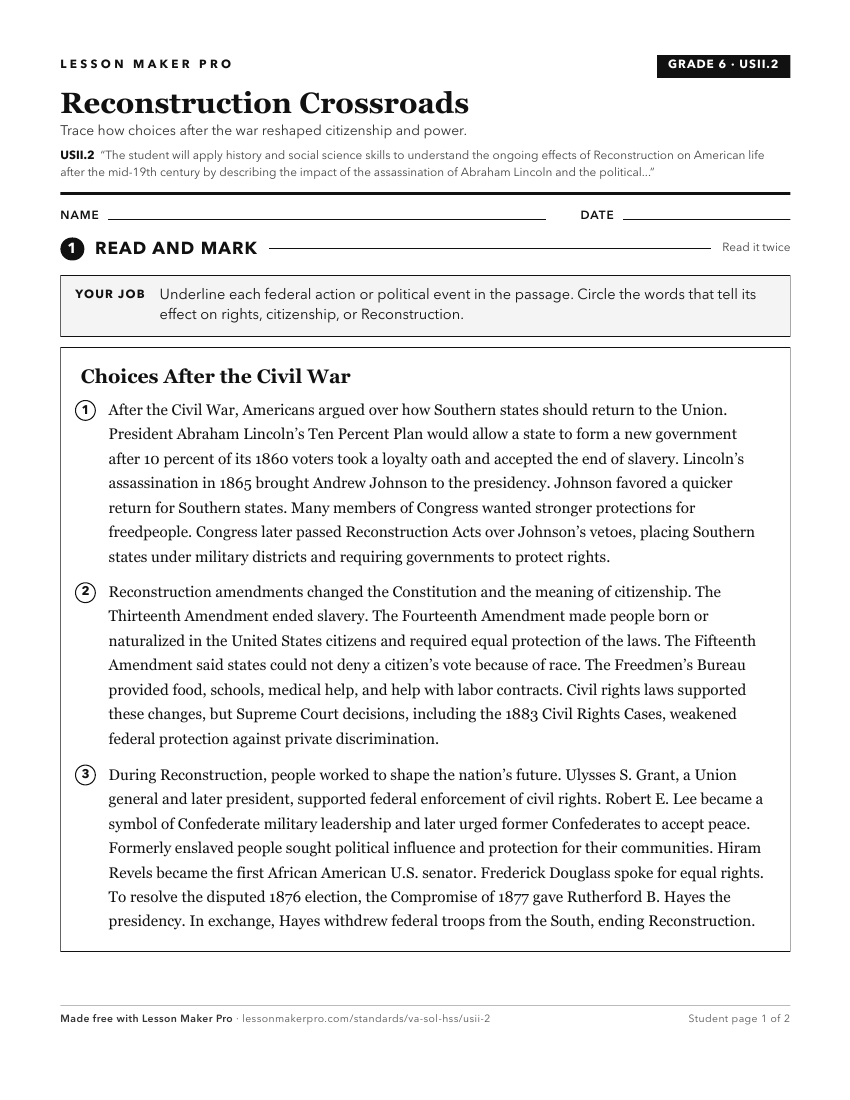
A ready-to-print activity worksheet aligned to USII.2, with an answer key for the teacher on its own page. No account needed.
PDF, US Letter, prints cleanly in black and white.
Download the worksheetKeep exploring
Related Standards
- USI.9
The student will apply history and social science skills to understand the cause, major events, and effects of the Civil War by
- VS.8
The student will apply history and social science skills to explain the reconstruction of Virginia following the Civil War by
- USII.3
The student will apply history and social science skills to understand how industrialization changed life in rural and urban America after the Civil War by
- USII.4
The student will apply history and social science skills to explain the changing role of the United States from the late 19th century through World War I by
Turn this cluster into a lesson
Grade, subject, topic, and the complete cluster are prefilled. Create one free, no account needed.
Also for this cluster:Make a WorksheetMake a QuizMake a Sub Lesson