Virginia SOL USII.2.c
The Standard
- USII.2
- The student will apply history and social science skills to understand the ongoing effects of Reconstruction on American life after the mid-19th century by
describing the legacies of Abraham Lincoln and the Gettysburg Address, Ulysses S. Grant, Robert E. Lee, Hiram Revels, and Frederick Douglass
Virginia Standards of Learning for History and Social Science
Teacher's field guide
What This Standard Means
What Students Need to Do
- Students identify each leader and explain what that person said or did during the Civil War and Reconstruction era. They connect those actions to reunion, citizenship, equality, or national memory.
What Mastery Looks Like
- Students match each person to accurate actions and explain the lasting effect. They distinguish military leadership from later work involving reconciliation, education, political representation, and civil rights.
Common Misconceptions
- Students may confuse Grant and Lee, or assume both supported the same Reconstruction policies. They may mistake Hiram Revels for an abolitionist or overlook Douglass's work for voting rights after slavery ended.
How to Assess It
- Give students five names and five legacy statements to match. Then ask them to explain which person most affected civil rights, using one specific fact.
Lesson moves
Ways to Teach It
Give groups portrait cards and action strips to sort by person, then place the matched sets on a Civil War and Reconstruction timeline.
Ask students to write which person's legacy had the greatest effect on national unity or equality, citing two facts.
Play a five-round Who Am I game using clues about military service, public office, speeches, education, and civil rights work.
Have students examine a monument, stamp, or government portrait and write what part of the person's legacy it presents or leaves out.
Free download
Printable USII.2.c Worksheet
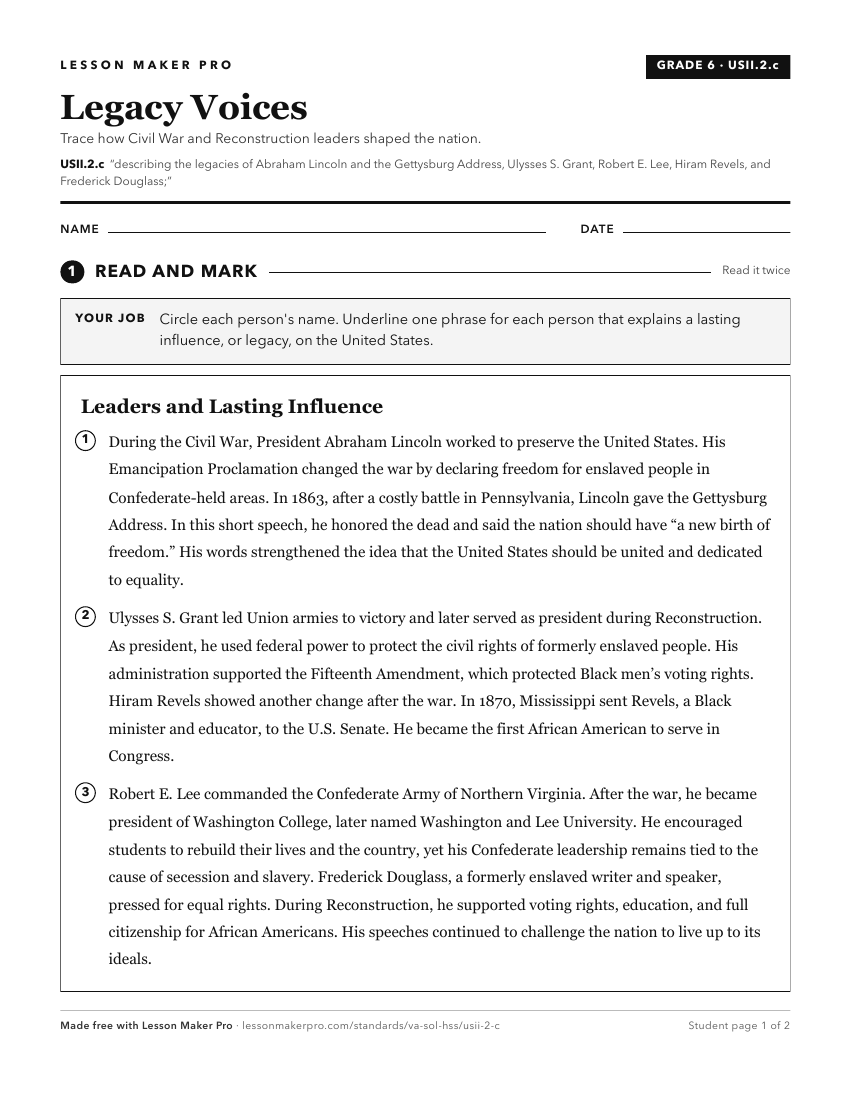
A ready-to-print activity worksheet aligned to USII.2.c, with an answer key for the teacher on its own page. No account needed.
PDF, US Letter, prints cleanly in black and white.
Download the worksheetKeep exploring
Related Standards
- USI.9.c
evaluating the leadership and impact of Abraham Lincoln during the Civil War
- USI.9.e
describing major political texts during the war including, but not limited to Lincoln’s Inaugural Address, the Emancipation Proclamation, the Gettysburg Address...
- USII.2.a
describing the impact of the assassination of Abraham Lincoln and the political aftermath of the Civil War
- USI.9.d
describing how individuals influenced the course of the Civil War including, but not limited to Jefferson Davis, Ulysses S. Grant, Robert E. Lee, William Tecums...
Turn this exact standard into a lesson
Grade, subject, topic, and the complete standard are prefilled. Create one free, no account needed.
Also for this standard:Make a WorksheetMake a QuizMake a Sub Lesson