Virginia SOL USI.9.c
The Standard
- USI.9
- The student will apply history and social science skills to understand the cause, major events, and effects of the Civil War by
evaluating the leadership and impact of Abraham Lincoln during the Civil War
Virginia Standards of Learning for History and Social Science
Teacher's field guide
What This Standard Means
What Students Need to Do
- Students explain how Lincoln’s major decisions shaped the war, slavery, and the nation. They use evidence to judge his leadership, including his efforts to preserve the Union and issue the Emancipation Proclamation.
What Mastery Looks Like
- Students connect a Lincoln decision or speech to a specific result. They support an evaluation of his leadership with two accurate facts and explain why those facts matter.
Common Misconceptions
- Students may think the Emancipation Proclamation immediately freed every enslaved person. They may also think Lincoln entered the war only to end slavery or made wartime decisions without Congress, advisers, soldiers, and citizens.
How to Assess It
- Give students this exit prompt: “Was Lincoln an effective wartime leader? State your judgment and support it with two specific actions and their effects.”
Lesson moves
Ways to Teach It
Give pairs Lincoln decision cards and impact cards, then have them match each decision to its result on a classroom timeline.
Ask students to write: “Which Lincoln action had the greatest impact during the war, and what evidence supports your choice?”
Play a matching game using Lincoln’s actions, goals, and outcomes, with students earning points only when they explain each match.
Have students create three criteria for effective leadership, then use those criteria to rate Lincoln and a familiar school or community leader.
Free download
Printable USI.9.c Worksheet
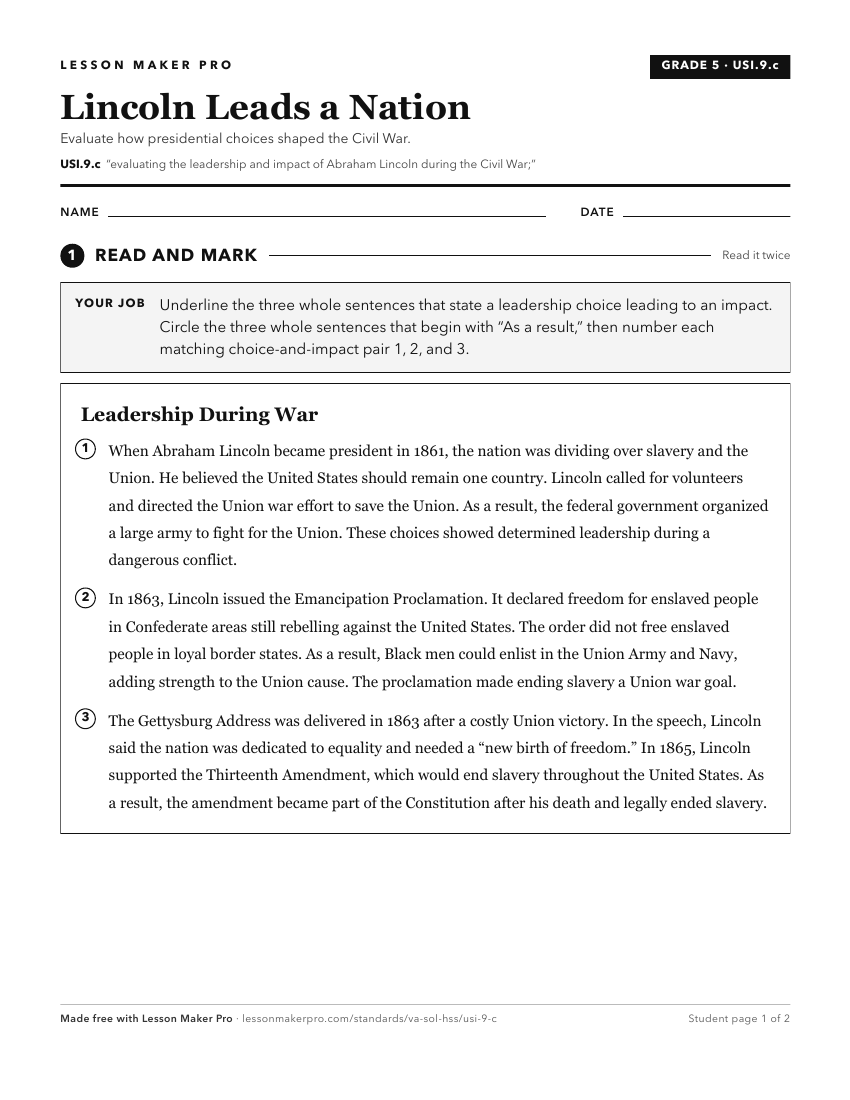
A ready-to-print activity worksheet aligned to USI.9.c, with an answer key for the teacher on its own page. No account needed.
PDF, US Letter, prints cleanly in black and white.
Download the worksheetKeep exploring
Related Standards
- USII.2.c
describing the legacies of Abraham Lincoln and the Gettysburg Address, Ulysses S. Grant, Robert E. Lee, Hiram Revels, and Frederick Douglass
- USI.9.e
describing major political texts during the war including, but not limited to Lincoln’s Inaugural Address, the Emancipation Proclamation, the Gettysburg Address...
- USII.2.a
describing the impact of the assassination of Abraham Lincoln and the political aftermath of the Civil War
- USI.9.d
describing how individuals influenced the course of the Civil War including, but not limited to Jefferson Davis, Ulysses S. Grant, Robert E. Lee, William Tecums...
Turn this exact standard into a lesson
Grade, subject, topic, and the complete standard are prefilled. Create one free, no account needed.
Also for this standard:Make a WorksheetMake a QuizMake a Sub Lesson