Virginia SOL USII.3.a
The Standard
- USII.3
- The student will apply history and social science skills to understand how industrialization changed life in rural and urban America after the Civil War by
explaining relationships among natural resources, transportation, and industrial development from 1865
Virginia Standards of Learning for History and Social Science
Teacher's field guide
What This Standard Means
What Students Need to Do
- Students connect coal, iron ore, oil, timber, and waterways to the places where factories and cities grew after the Civil War. They explain how railroads and canals carried raw materials to factories and finished goods to markets.
What Mastery Looks Like
- Given a resource and transportation map, students can predict likely industrial centers and support each choice with map evidence. They can build a cause-and-effect chain, such as coal and rail access leading to steel production and urban growth.
Common Misconceptions
- Students may treat resources, transportation, and factories as separate facts, or assume factories had to sit directly on a resource site. They may confuse raw materials with finished goods and overlook how railroads carried both supplies and products.
How to Assess It
- Give students a map showing coal fields, iron ore, rivers, and railroad lines. Ask: “Which labeled city is best placed for a steel mill, and what two map features support your choice?”
Lesson moves
Ways to Teach It
Give groups resource, city, factory, and transportation cards, then have them build three supply chains and explain each connection.
Write: Why did Pittsburgh become a steel center? Use coal, iron ore, rivers, and railroads in a four-sentence explanation.
Play Map Match: students pair resource regions with transportation routes and industrial cities, earning a point only when they explain the link.
Trace a local product from raw material to factory to store, then compare its route with an 1800s industrial supply chain.
Free download
Printable USII.3.a Worksheet
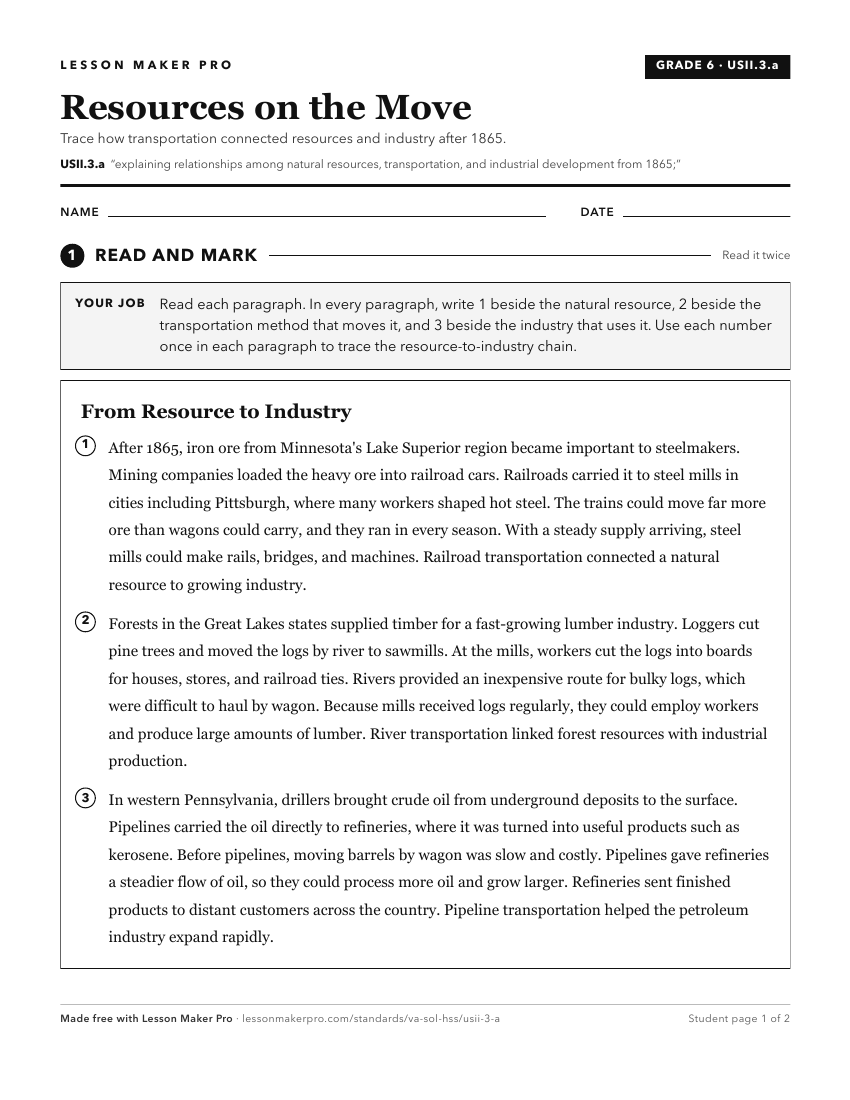
A ready-to-print activity worksheet aligned to USII.3.a, with an answer key for the teacher on its own page. No account needed.
PDF, US Letter, prints cleanly in black and white.
Download the worksheetKeep exploring
Related Standards
- WG.2.b
showing the influence of resources on patterns of economic activity and land use
- USII.5.a
explaining how capitalism and free markets helped foster developments in factory and labor productivity, transportation, and communication and how rural electri...
- VS.9.a
explaining the importance of railroads, waterways, new industries, and the growth of cities to Virginia’s economic development in the late 1800s
- USII.3.b
explaining the impact of new inventions, the rise of big business, the growth of industry, and the changes to life on American farms in response to industrializ...
Turn this exact standard into a lesson
Grade, subject, topic, and the complete standard are prefilled. Create one free, no account needed.
Also for this standard:Make a WorksheetMake a QuizMake a Sub Lesson