Virginia SOL USII.5.d
The Standard
- USII.5
- The student will apply history and social science skills to understand the social, political, economic, and technological changes of the early 20th century by
describing the events and leaders that lead to prohibition, the Women’s Suffrage Movement, and the passage of the Nineteenth Amendment including, but not limited to Susan B. Anthony, Lucy Burns, Elizabeth Cady Stanton, Carrie Chapman Catt, Ida B. Wells-Barnett, and Sojourner Truth
Virginia Standards of Learning for History and Social Science
Teacher's field guide
What This Standard Means
What Students Need to Do
- Students explain why temperance and women’s voting rights gained support. They sequence major events and constitutional changes. They connect each leader to specific actions, groups, and campaign methods.
What Mastery Looks Like
- Students can compare Carrie Chapman Catt’s lobbying with Lucy Burns’s protests and explain how both advanced voting rights. They can describe the Eighteenth and Nineteenth Amendments and identify limits faced by Black women voters.
Common Misconceptions
- Students may confuse the Eighteenth Amendment with the Nineteenth Amendment. They may think voting access became equal for all women in 1920. They may also assume every leader worked together during the same period.
How to Assess It
- On an exit ticket, place Seneca Falls, White House picketing, the Eighteenth Amendment, and the Nineteenth Amendment in order. Explain one leader’s contribution.
Lesson moves
Ways to Teach It
Have pairs sort leader, event, strategy, and amendment cards into a class timeline, then defend two placements with evidence.
Ask students to compare Lucy Burns and Carrie Chapman Catt: Which methods did each use, and why might both approaches matter?
Play Who Am I using clue cards for Anthony, Burns, Stanton, Catt, Wells-Barnett, Truth, and major movement events.
Compare suffrage campaign tools, including petitions, marches, speeches, and newspaper articles, with methods used by a current local campaign.
Free download
Printable USII.5.d Worksheet
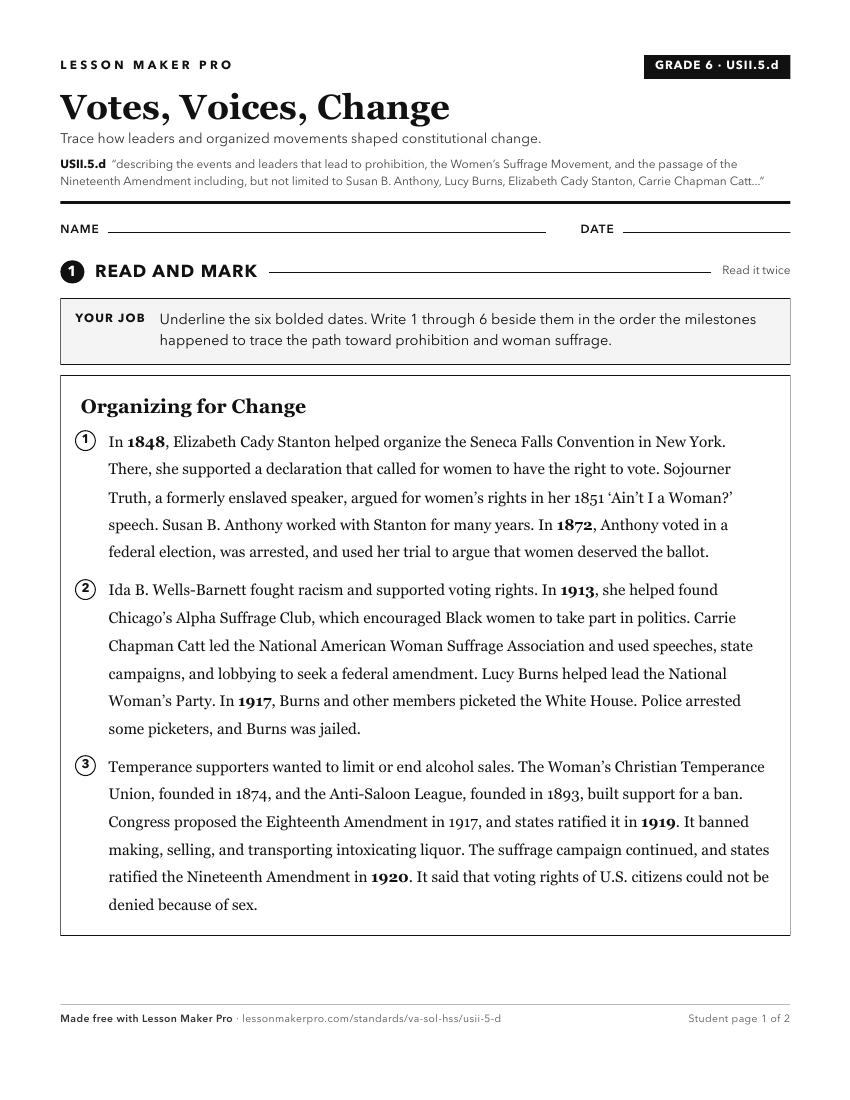
A ready-to-print activity worksheet aligned to USII.5.d, with an answer key for the teacher on its own page. No account needed.
PDF, US Letter, prints cleanly in black and white.
Download the worksheetKeep exploring
Related Standards
- USI.8.g
explaining how the expansion of U.S. territory led to increased momentum for the abolitionist and women’s suffrage movements
- USI.8.f
describing major developments in the abolitionist and women’s suffrage movements
- USII.8.f
describing the similarities and differences between the objectives of the women’s movement of the early and mid-20th century
- USII.3.c
evaluating and explaining the impact of the Progressive Movement on child labor, working conditions, the rise of organized labor, support for eugenics as a soci...
Turn this exact standard into a lesson
Grade, subject, topic, and the complete standard are prefilled. Create one free, no account needed.
Also for this standard:Make a WorksheetMake a QuizMake a Sub Lesson