Virginia SOL USI.8.f
The Standard
- USI.8
- The student will apply history and social science skills to explain westward expansion and reform in America from 1801 to 1861 by
describing major developments in the abolitionist and women’s suffrage movements
Virginia Standards of Learning for History and Social Science
Teacher's field guide
What This Standard Means
What Students Need to Do
- Students identify key leaders, events, goals, and methods in the abolitionist and women’s suffrage movements. They explain how each movement challenged unequal laws and practices.
What Mastery Looks Like
- Students can explain the roles of Frederick Douglass, Harriet Tubman, Elizabeth Cady Stanton, and Susan B. Anthony. They can describe the Underground Railroad and Seneca Falls Convention and compare the movements’ goals and methods.
Common Misconceptions
- Students may think the Underground Railroad used trains or that abolition ended slavery immediately. They may also think women gained voting rights at Seneca Falls or that all reformers used the same methods.
How to Assess It
- Exit ticket: Explain what abolitionists wanted, what suffragists wanted, and how one named reformer worked toward change.
Lesson moves
Ways to Teach It
Give pairs leader and event cards to sort by movement, place in time order, and connect with yarn.
Write a response to this prompt: Which reform method, speeches, newspapers, petitions, or secret escape routes, was most effective, and why?
Play a matching game with leader, action, event, and movement cards, requiring students to explain each completed set.
Compare a Seneca Falls grievance with a student petition, then identify the problem, requested change, and method used to gain support.
Free download
Printable USI.8.f Worksheet
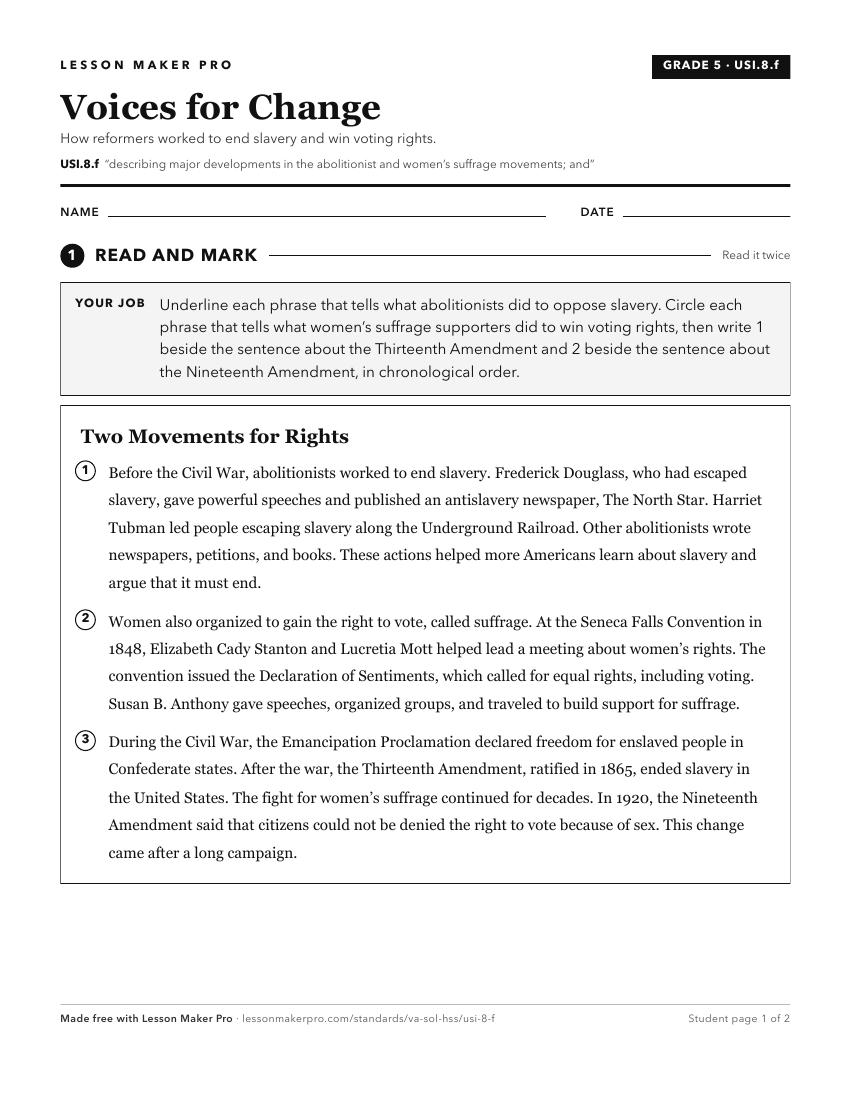
A ready-to-print activity worksheet aligned to USI.8.f, with an answer key for the teacher on its own page. No account needed.
PDF, US Letter, prints cleanly in black and white.
Download the worksheetKeep exploring
Related Standards
- USI.8.g
explaining how the expansion of U.S. territory led to increased momentum for the abolitionist and women’s suffrage movements
- USII.8.f
describing the similarities and differences between the objectives of the women’s movement of the early and mid-20th century
- USII.3.c
evaluating and explaining the impact of the Progressive Movement on child labor, working conditions, the rise of organized labor, support for eugenics as a soci...
- USII.5.d
describing the events and leaders that lead to prohibition, the Women’s Suffrage Movement, and the passage of the Nineteenth Amendment including, but not limite...
Turn this exact standard into a lesson
Grade, subject, topic, and the complete standard are prefilled. Create one free, no account needed.
Also for this standard:Make a WorksheetMake a QuizMake a Sub Lesson