Virginia SOL USI.8.g
The Standard
- USI.8
- The student will apply history and social science skills to explain westward expansion and reform in America from 1801 to 1861 by
explaining how the expansion of U.S. territory led to increased momentum for the abolitionist and women’s suffrage movements.
Virginia Standards of Learning for History and Social Science
Teacher's field guide
What This Standard Means
What Students Need to Do
- Students explain why new western lands reopened arguments over whether slavery could spread. They also connect antislavery organizing to the growing campaign for women’s voting rights.
What Mastery Looks Like
- Students use a map and key events to build a clear cause-and-effect explanation. They cite examples such as free-state and slave-state debates, Seneca Falls, or activists working in both movements.
Common Misconceptions
- Students may think expansion ended slavery or that every new territory allowed it. They may also confuse abolition and suffrage, or assume women had no role in antislavery work.
How to Assess It
- Use this exit ticket: “How did adding western territory strengthen abolitionism and women’s suffrage? Include one event or activist in your answer.”
Lesson moves
Ways to Teach It
Give pairs a territory map and event cards, then have them place each event and draw arrows showing causes and effects.
Ask students to write: “Why might an antislavery activist also support women’s voting rights?” Use two historical examples.
Play a cause-and-effect matching game with cards about territorial growth, slavery debates, abolitionist action, Seneca Falls, and suffrage demands.
Compare a reform-era petition with a current community petition, then identify the demand, audience, evidence, and methods used to gain support.
Free download
Printable USI.8.g Worksheet
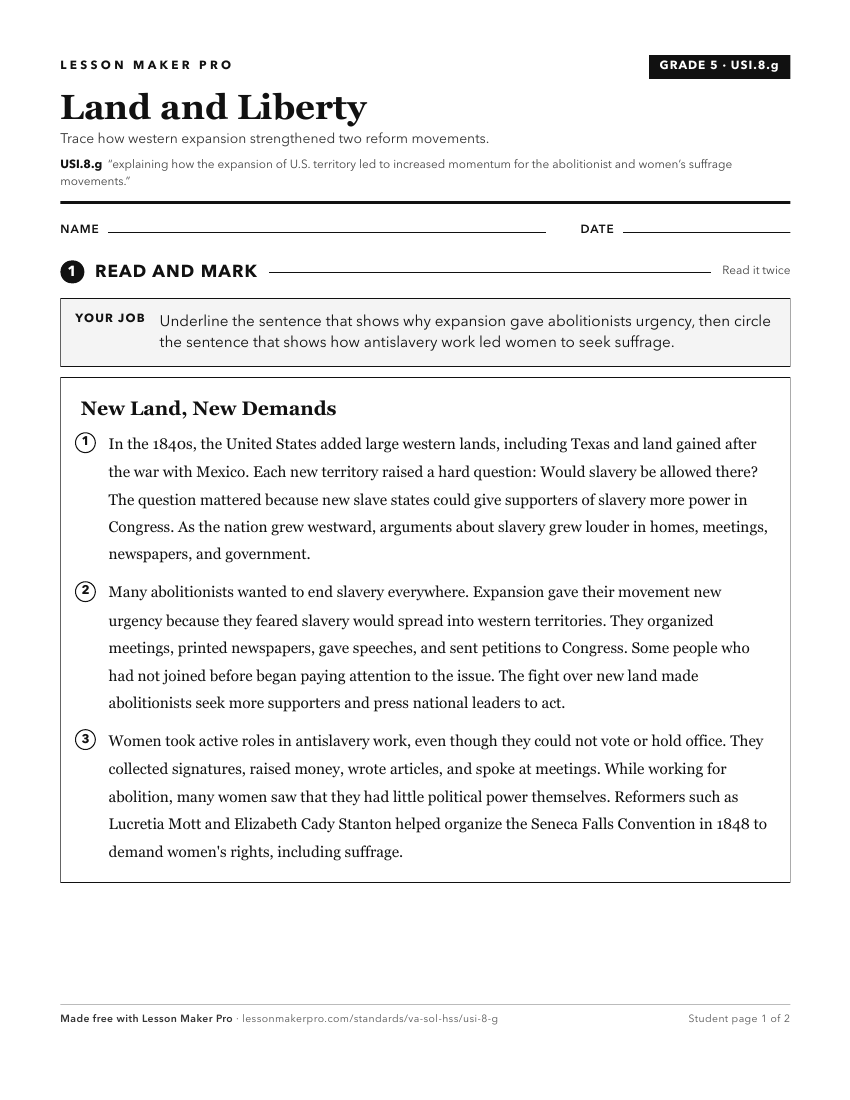
A ready-to-print activity worksheet aligned to USI.8.g, with an answer key for the teacher on its own page. No account needed.
PDF, US Letter, prints cleanly in black and white.
Download the worksheetKeep exploring
Related Standards
- USII.4.e
explaining how the war was a catalyst for the United States gaining international power and expanding its sphere of international influence
- USII.3.d
explaining the events, factors, and motivations that caused individuals and groups to migrate to the United States towards the end of the 19th century
- USI.8.f
describing major developments in the abolitionist and women’s suffrage movements
- USI.8.a
describing how territorial expansion affected the political map of the United States including, but not limited to the Louisiana Purchase, the Lewis and Clark E...
Turn this exact standard into a lesson
Grade, subject, topic, and the complete standard are prefilled. Create one free, no account needed.
Also for this standard:Make a WorksheetMake a QuizMake a Sub Lesson