Virginia SOL USII.8.f
The Standard
- USII.8
- The student will apply history and social science skills to analyze the key changing patterns of society during the second half of the 20th and early 21st centuries by
describing the similarities and differences between the objectives of the women’s movement of the early and mid-20th century
Virginia Standards of Learning for History and Social Science
Teacher's field guide
What This Standard Means
What Students Need to Do
- Students compare goals pursued by women’s rights activists in different parts of the 20th century. They identify shared aims, such as equal citizenship, and changing priorities, such as voting rights, workplace equality, and education.
What Mastery Looks Like
- Students can sort movement goals by time period and support each choice with historical evidence. They can name at least one similarity and one difference between the periods.
Common Misconceptions
- Students may treat the women’s movement as one event with unchanged goals. They may also think voting rights ended sex discrimination or that all women gained equal access at the same time.
How to Assess It
- Give students four goals: voting rights, equal pay, equal education, and access to jobs. Ask them to place each by period, then explain one similarity and one difference.
Lesson moves
Ways to Teach It
Give pairs goal cards and dated source excerpts, then have them build a two-column timeline and defend where each card belongs.
Ask students to write: How did winning voting rights change, but not finish, the fight for equality?
Play Goal Match, where teams connect leaders, laws, slogans, and demands to the early or mid-20th-century movement.
Use a school handbook or job advertisement to discuss how rules about education and work can create or remove barriers for women.
Free download
Printable USII.8.f Worksheet
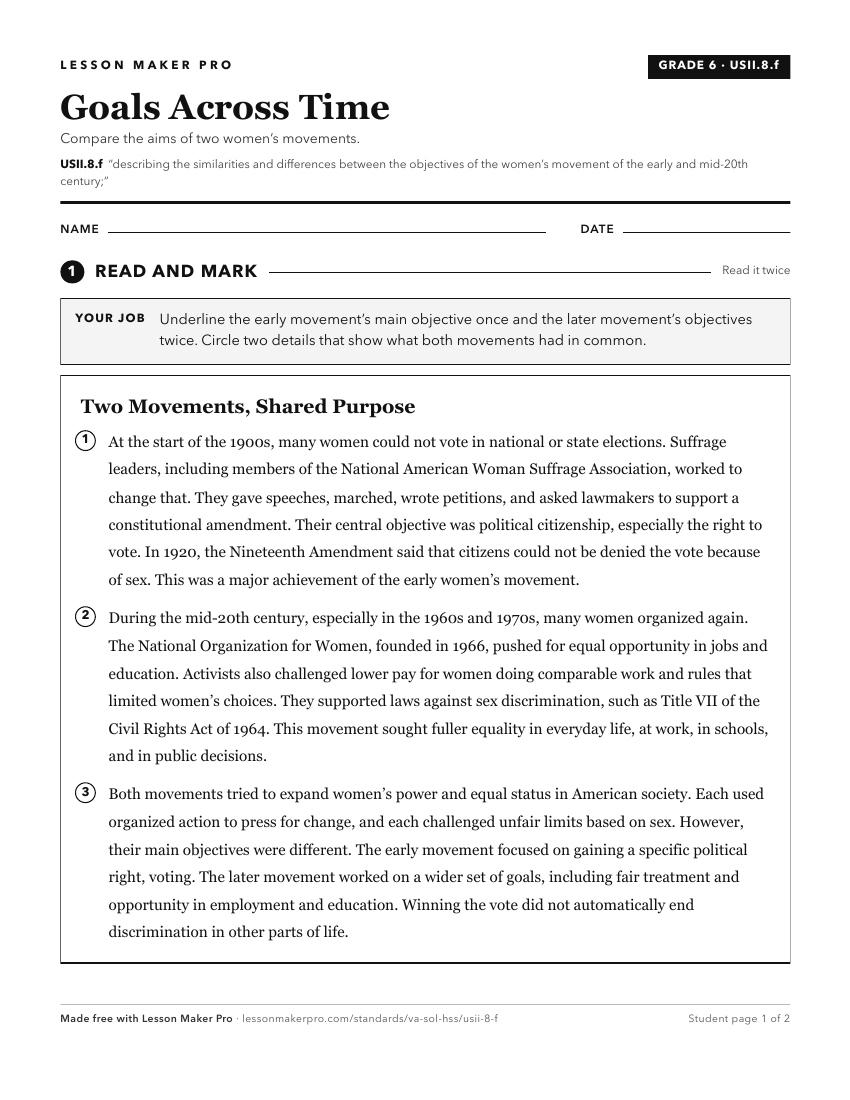
A ready-to-print activity worksheet aligned to USII.8.f, with an answer key for the teacher on its own page. No account needed.
PDF, US Letter, prints cleanly in black and white.
Download the worksheetKeep exploring
Related Standards
- USI.8.f
describing major developments in the abolitionist and women’s suffrage movements
- USII.3.c
evaluating and explaining the impact of the Progressive Movement on child labor, working conditions, the rise of organized labor, support for eugenics as a soci...
- USII.5.d
describing the events and leaders that lead to prohibition, the Women’s Suffrage Movement, and the passage of the Nineteenth Amendment including, but not limite...
- USI.6.c
comparing and contrasting the political ideas and principles that shaped the revolutionary movement
Turn this exact standard into a lesson
Grade, subject, topic, and the complete standard are prefilled. Create one free, no account needed.
Also for this standard:Make a WorksheetMake a QuizMake a Sub Lesson