Virginia SOL CE.13
SOL Standard (Skills Cluster)
The student will apply history and social science skills to analyze the role of government in the United States economy by examining the effect of competition in the marketplace; explaining how and why government provides certain public goods and services; describing how local, state, and federal governments allocate their budgets and collect taxes to pay for goods and services; explaining the structure and main function of the Federal Reserve System and how it acts as the nation’s central bank; explaining the role of government currency and analyzing the purpose of a money economy; describing how governments regulate commerce to protect consumers, the environment, competition in the marketplace, and property rights; and evaluating how and why governments regulate industry, labor, competition, and monopolies in the marketplace.
Virginia Standards of Learning for History and Social Science
Cluster contents
Skills in This Standard
CE.13 is a Standards of Learning history and social science standard. These are the skills expectations under it.
- CE.13.a
examining the effect of competition in the marketplace
- CE.13.b
explaining how and why government provides certain public goods and services
- CE.13.c
describing how local, state, and federal governments allocate their budgets and collect taxes to pay for goods and services
- CE.13.d
explaining the structure and main function of the Federal Reserve System and how it acts as the nation’s central bank
- CE.13.e
explaining the role of government currency and analyzing the purpose of a money economy
- CE.13.f
describing how governments regulate commerce to protect consumers, the environment, competition in the marketplace, and property rights
- CE.13.g
evaluating how and why governments regulate industry, labor, competition, and monopolies in the marketplace.
Teacher's field guide
What This Cluster Means
What Students Need to Do
- Students explain why governments tax, spend, issue currency, provide public goods, and regulate markets. They analyze how competition, the Federal Reserve, and government rules affect prices, choices, workers, consumers, property, and the environment.
What Mastery Looks Like
- A student can examine an economic scenario, identify the government action, and explain its likely costs and benefits. The student can distinguish government levels, connect taxes to services, and describe how the Federal Reserve manages money and banking.
Common Misconceptions
- Students often think every public service is free, all taxes are federal, or any large business is a monopoly. They may confuse the Federal Reserve with a commercial bank and assume regulation always raises prices or always protects everyone.
How to Assess It
- Give students four cases: a city funds buses, Congress passes product safety rules, one company buys every competitor, and the Federal Reserve raises interest rates. Ask them to name the government role in each case and explain one likely effect.
Lesson moves
Ways to Teach It
Give groups $100 in budget cards to divide among schools, roads, police, and parks, then require a tax plan that covers the spending.
Ask, “Should one company be allowed to own every grocery store in town?” Students write a claim supported by two economic effects.
Play a scenario sorting game with cards labeled public good, tax, consumer protection, environmental rule, competition, monopoly, currency, and Federal Reserve.
Use a current city budget page to trace one local service from tax revenue to spending, then identify who benefits and who pays.
Free download
Printable CE.13 Worksheet
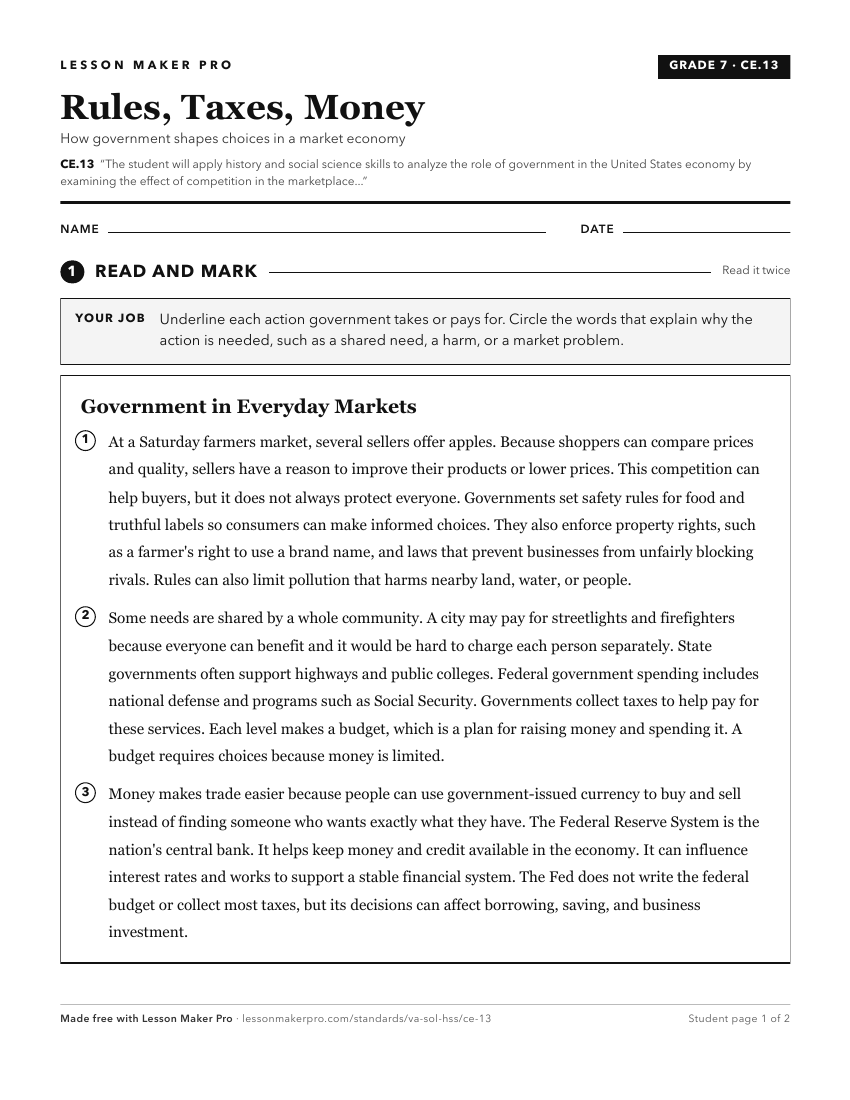
A ready-to-print activity worksheet aligned to CE.13, with an answer key for the teacher on its own page. No account needed.
PDF, US Letter, prints cleanly in black and white.
Download the worksheetKeep exploring
Related Standards
- 3.10
The student will apply history and social science skills to explain basic economic principles by
- CE.12
The student will apply history and social science skills to describe the United States economy by
- 3.9
The student will apply history and social science skills to explain the basic structure of the United States government by
- CE.11
The student will apply history and social science skills to analyze how economic decisions are made in the marketplace and in daily life by
Turn this cluster into a lesson
Grade, subject, topic, and the complete cluster are prefilled. Create one free, no account needed.
Also for this cluster:Make a WorksheetMake a QuizMake a Sub Lesson