Virginia SOL CE.12
SOL Standard (Skills Cluster)
The student will apply history and social science skills to describe the United States economy by evaluating the shared fundamental principles and connection of free enterprise and democracy; describing the critical components of the United States economy, such as limited government, private property, markets, consumer sovereignty, and competition; explaining the concept of inflation and the effect of supply and demand on consumer prices in a market economy; describing the types of business organizations and the role of entrepreneurship; explaining the role of consumers, producers, and government interactions on the economy; explaining how financial institutions are critical to creating capital to fuel economic growth for individuals and the larger economy by channeling funds from savers to borrowers through lending; and analyzing the role of Virginia in the United States and global economies, with an emphasis on the effect of technological innovations.
Virginia Standards of Learning for History and Social Science
Cluster contents
Skills in This Standard
CE.12 is a Standards of Learning history and social science standard. These are the skills expectations under it.
- CE.12.a
evaluating the shared fundamental principles and connection of free enterprise and democracy
- CE.12.b
describing the critical components of the United States economy, such as limited government, private property, markets, consumer sovereignty, and competition
- CE.12.c
explaining the concept of inflation and the effect of supply and demand on consumer prices in a market economy
- CE.12.d
describing the types of business organizations and the role of entrepreneurship
- CE.12.e
explaining the role of consumers, producers, and government interactions on the economy
- CE.12.f
explaining how financial institutions are critical to creating capital to fuel economic growth for individuals and the larger economy by channeling funds from s...
- CE.12.g
analyzing the role of Virginia in the United States and global economies, with an emphasis on the effect of technological innovations.
Teacher's field guide
What This Cluster Means
What Students Need to Do
- Students explain how free enterprise, democratic choice, private property, competition, and limited government work together. They analyze prices, inflation, business ownership, entrepreneurship, economic roles, bank lending, and Virginia’s place in national and global markets.
What Mastery Looks Like
- Students can read an economic scenario, identify the people and principles involved, and predict how changing supply or demand will affect prices. They can explain how savings become loans for growth and use a Virginia technology example to show global connections.
Common Misconceptions
- Students may think free enterprise means government has no economic role, or that inflation means one product became more expensive. They often reverse supply and demand effects, confuse revenue with profit, and assume banks simply store deposited money.
How to Assess It
- Give students this prompt: “Demand for Virginia-made computer chips rises, and a bank lends money to a new factory. Explain the likely price change, the bank’s role, and two economic principles shown.”
Lesson moves
Ways to Teach It
Run a classroom market with tokens and product cards, changing supply or demand each round while students record and graph prices.
Ask students to write whether government rules support or limit free enterprise, using one example involving workers, consumers, or businesses.
Play a scenario card sort matching examples to consumers, producers, government, entrepreneurs, business types, and economic principles.
Research one Virginia technology company and map its links to workers, banks, suppliers, consumers, and international markets.
Free download
Printable CE.12 Worksheet
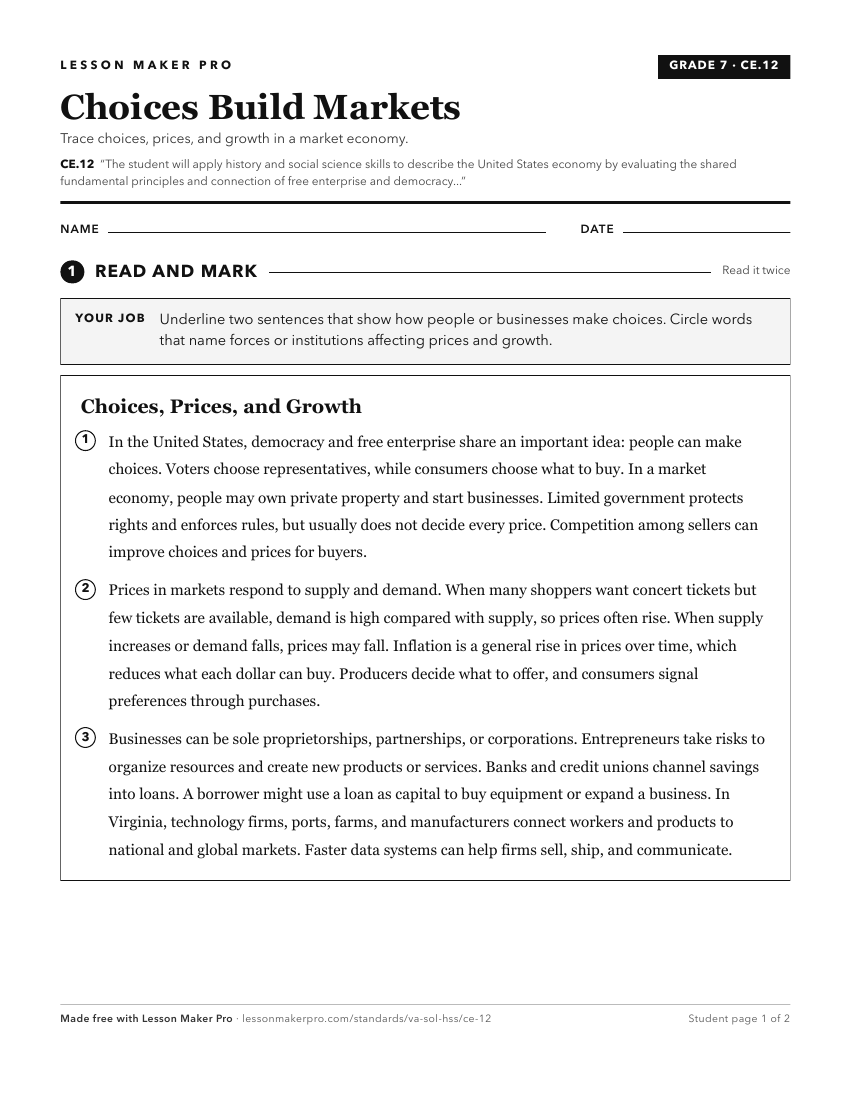
A ready-to-print activity worksheet aligned to CE.12, with an answer key for the teacher on its own page. No account needed.
PDF, US Letter, prints cleanly in black and white.
Download the worksheetKeep exploring
Related Standards
- 3.10
The student will apply history and social science skills to explain basic economic principles by
- CE.13
The student will apply history and social science skills to analyze the role of government in the United States economy by
- 2.13
The student will apply history and social science skills to understand basic economic principles by
- CE.11
The student will apply history and social science skills to analyze how economic decisions are made in the marketplace and in daily life by
Turn this cluster into a lesson
Grade, subject, topic, and the complete cluster are prefilled. Create one free, no account needed.
Also for this cluster:Make a WorksheetMake a QuizMake a Sub Lesson