Virginia SOL CE.12.d
The Standard
- CE.12
- The student will apply history and social science skills to describe the United States economy by
describing the types of business organizations and the role of entrepreneurship
Virginia Standards of Learning for History and Social Science · The student will apply history and social science skills to describe the United States economy by
Teacher's field guide
What This Standard Means
What Students Need to Do
- Students compare sole proprietorships, partnerships, and corporations. They explain how entrepreneurs take risks, organize resources, and create goods, services, and jobs.
What Mastery Looks Like
- Students can identify a business type from a short scenario and support their choice with evidence. They can explain tradeoffs involving control, profit, liability, and access to money.
Common Misconceptions
- Students may think corporations are always large or that entrepreneurs simply invent products. They may also confuse business ownership with management and overlook personal liability for debts.
How to Assess It
- Give students three business scenarios. Ask them to label each organization type and explain one advantage or disadvantage for the owner.
Lesson moves
Ways to Teach It
Give groups owner, money, debt, and decision cards, then have them build models of three business structures.
Ask students to write which structure they would choose for a neighborhood bakery and defend their choice with two tradeoffs.
Play a scenario sorting game where teams match business descriptions to sole proprietorship, partnership, or corporation.
Examine three local businesses, research their ownership structures, and discuss how each entrepreneur meets a community need.
Free download
Printable CE.12.d Worksheet
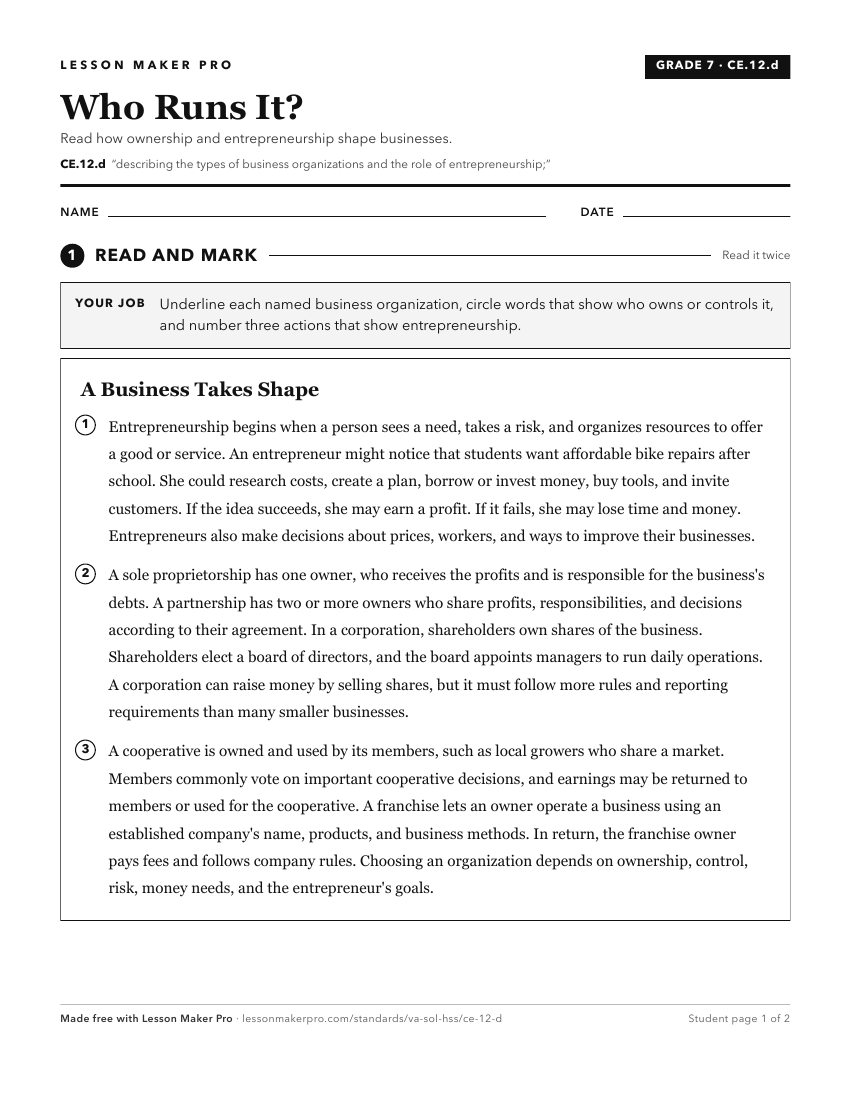
A ready-to-print activity worksheet aligned to CE.12.d, with an answer key for the teacher on its own page. No account needed.
PDF, US Letter, prints cleanly in black and white.
Download the worksheetKeep exploring
Related Standards
- CE.12.a
evaluating the shared fundamental principles and connection of free enterprise and democracy
- CE.13.f
describing how governments regulate commerce to protect consumers, the environment, competition in the marketplace, and property rights
- CE.12.b
describing the critical components of the United States economy, such as limited government, private property, markets, consumer sovereignty, and competition
- CE.11.b
explaining the importance of innovation and productivity, including the freedom to choose occupations, the role of technology, and the development of human capi...
Turn this exact standard into a lesson
Grade, subject, topic, and the complete standard are prefilled. Create one free, no account needed.
Also for this standard:Make a WorksheetMake a QuizMake a Sub Lesson