Virginia SOL CE.13.f
The Standard
- CE.13
- The student will apply history and social science skills to analyze the role of government in the United States economy by
describing how governments regulate commerce to protect consumers, the environment, competition in the marketplace, and property rights
Virginia Standards of Learning for History and Social Science · The student will apply history and social science skills to analyze the role of government in the United States economy by
Teacher's field guide
What This Standard Means
What Students Need to Do
- Students examine government rules and enforcement actions, then explain the problem each is meant to address. They connect examples to consumer safety, environmental harm, fair competition, or ownership and contract rights.
What Mastery Looks Like
- A student can identify who or what a rule protects, using examples such as food labels or emissions limits. They can explain how antitrust laws support competition and how patents, contracts, and courts protect ownership.
Common Misconceptions
- Students often assume every business rule comes from the federal government or that regulation always means banning a product. They may confuse consumer protection with competition policy, or treat property rights as permission to use property without limits.
How to Assess It
- Exit ticket: Match each action to its main purpose and explain one match: nutrition labels, factory discharge limits, blocking a monopoly merger, and patent protection.
Lesson moves
Ways to Teach It
Give pairs regulation and outcome cards, then have them match food labels, emissions limits, antitrust action, and patents to the protection provided.
Ask students to write: When should protecting the public justify limits on a business, and what evidence supports your rule?
Run a four-corners game labeled Consumers, Environment, Competition, and Property Rights; read government actions and require students to defend each choice.
Have students inspect a cereal box, appliance label, or app terms page and identify one rule that shapes the seller's choices.
Free download
Printable CE.13.f Worksheet
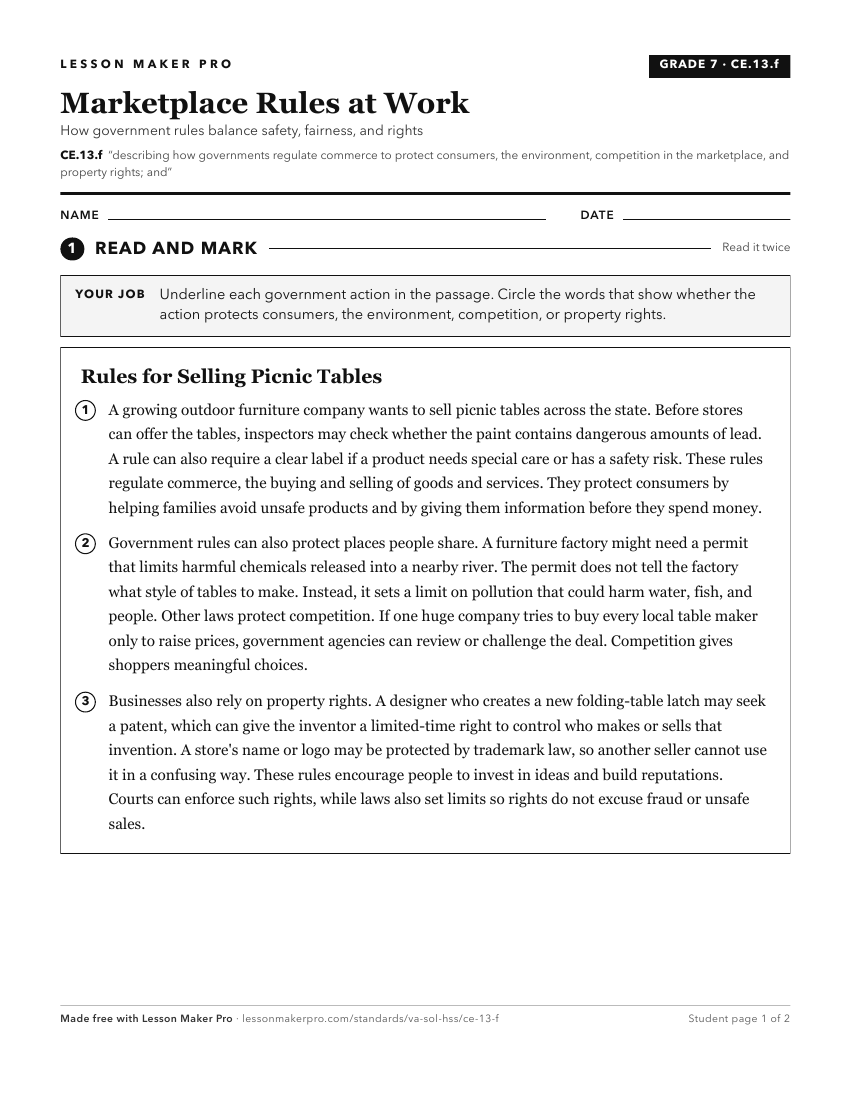
A ready-to-print activity worksheet aligned to CE.13.f, with an answer key for the teacher on its own page. No account needed.
PDF, US Letter, prints cleanly in black and white.
Download the worksheetKeep exploring
Related Standards
- CE.13.g
evaluating how and why governments regulate industry, labor, competition, and monopolies in the marketplace.
- CE.12.e
explaining the role of consumers, producers, and government interactions on the economy
- CE.3.c
describing the roles and powers of the executive branch and regulatory boards as they affect states
- CE.12.b
describing the critical components of the United States economy, such as limited government, private property, markets, consumer sovereignty, and competition
Turn this exact standard into a lesson
Grade, subject, topic, and the complete standard are prefilled. Create one free, no account needed.
Also for this standard:Make a WorksheetMake a QuizMake a Sub Lesson