Virginia SOL CE.12.a
The Standard
- CE.12
- The student will apply history and social science skills to describe the United States economy by
evaluating the shared fundamental principles and connection of free enterprise and democracy
Virginia Standards of Learning for History and Social Science · The student will apply history and social science skills to describe the United States economy by
Teacher's field guide
What This Standard Means
What Students Need to Do
- Students identify shared ideas such as individual liberty, choice, competition, property rights, equality under law, and limits on government. They explain how voters shape market rules and how laws protect ownership, contracts, consumers, and competition. They also judge when public rules support or limit economic freedom.
What Mastery Looks Like
- Given a policy or business case, a student names the principles involved and supports a judgment with details from the case. The student explains that elected government sets market rules, while citizens also act as owners, workers, and consumers. The student does not treat freedom as the absence of all laws.
Common Misconceptions
- Students often think free enterprise means government never acts in the economy. They may equate buying a product with casting a ballot, or assume majority rule can override property and individual rights. Some confuse equal rights and opportunity with equal income or equal business success.
How to Assess It
- Exit ticket: A city council passes a restaurant safety rule after a public hearing. Name one democratic principle and one economic principle involved, then explain whether the rule supports or limits economic freedom.
Lesson moves
Ways to Teach It
Sort cards labeled choice, private property, voting, competition, rule of law, and consumer protection into democracy, free enterprise, or both, then defend two choices.
Write a claim: When should voters, through government, limit business choices? Use one principle from each system as evidence.
Play a scenario match game, pairing cases such as price competition or licensing rules with individual freedom, competition, rights, or rule of law.
Read a local business license rule, then explain how elected officials, owners, workers, and consumers influence or are affected by it.
Free download
Printable CE.12.a Worksheet
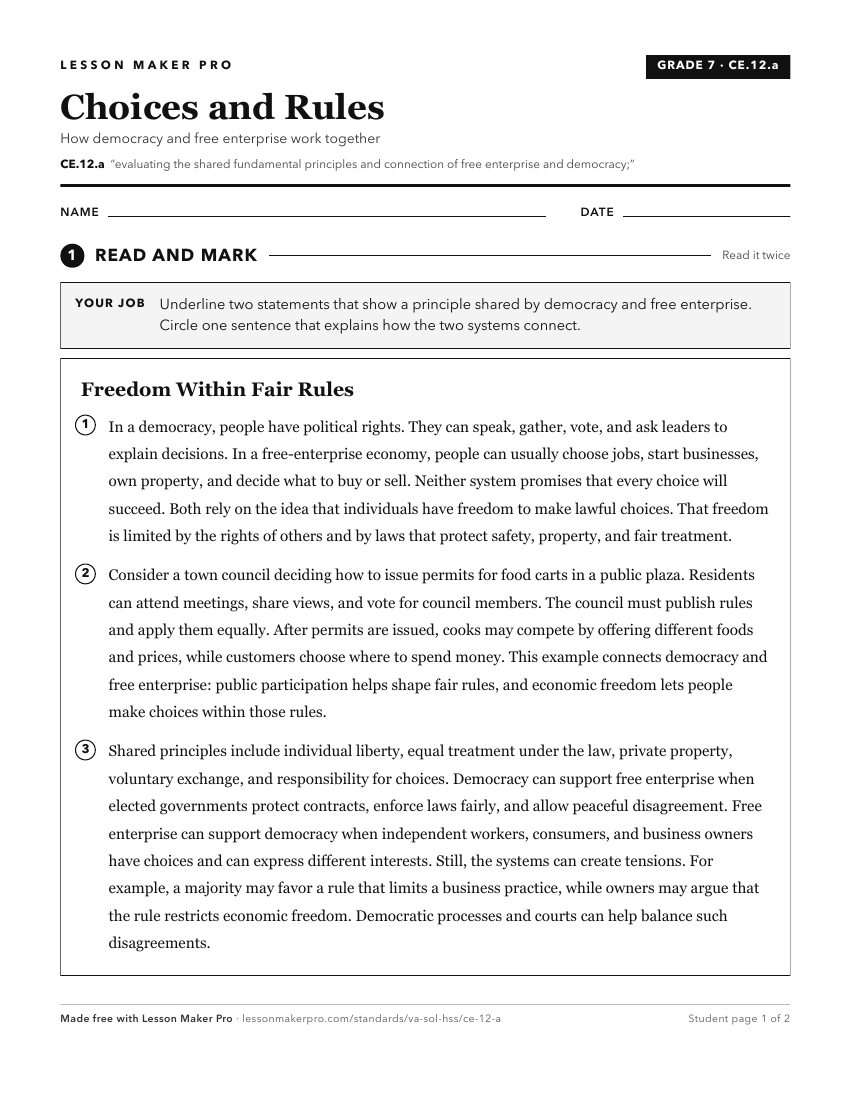
A ready-to-print activity worksheet aligned to CE.12.a, with an answer key for the teacher on its own page. No account needed.
PDF, US Letter, prints cleanly in black and white.
Download the worksheetKeep exploring
Related Standards
- CE.1
The student will apply history and social science skills to explain the foundations of the American constitutional democracy by
- 3.7.c
identifying and explaining representative democracy
- CE.1.a
explaining the fundamental principles of limited government, republicanism, federalism, checks and balances, separation of powers, and popular sovereignty
- CE.12.b
describing the critical components of the United States economy, such as limited government, private property, markets, consumer sovereignty, and competition
Turn this exact standard into a lesson
Grade, subject, topic, and the complete standard are prefilled. Create one free, no account needed.
Also for this standard:Make a WorksheetMake a QuizMake a Sub Lesson