Virginia SOL 2.RI
SOL Standard (Knowledge and Skills Cluster)
The student will use textual evidence to demonstrate and build knowledge from a variety of grade level complex informational texts heard or read.
Virginia Standards of Learning for English
Cluster contents
Knowledge and Skills in This Standard
2.RI is a Standards of Learning standard. These are the knowledge and skills expectations under it.
- 2.RI.1
Key Ideas and Confirming Details
- 2.RI.1.A
Ask and answer literal and inferential questions (who, what, where, when, how, and why) about key details in a text.
- 2.RI.1.B
Retell key details of texts that demonstrate an understanding of the main topics of texts.
- 2.RI.1.C
Differentiate facts from opinions within a text.
- 2.RI.2
Craft and Style
- 2.RI.2.A
Use text features (table of contents, headings, pictures, captions, maps, and charts) to preview, set a purpose for reading and gain information.
- 2.RI.2.B
Identify the main purpose of a text, including what the author wants to answer, explain, or describe.
- 2.RI.3
Integration of Concepts
- 2.RI.3.A
Use prior (experience) and background (content) knowledge as context for new learning.
- 2.RI.3.B
Compare and contrast the most important points presented by two texts on the same topic.
- 2.RI.3.C
Describe the interactions between two individuals, events, ideas, or pieces of information in texts.
Teacher's field guide
What This Cluster Means
What Students Need to Do
- Students read or listen to informational texts, answer literal and inferential questions, and support answers with text details. They retell the main topic and key details, separate facts from opinions, and use headings, captions, maps, pictures, and charts. They identify the author’s purpose, connect new learning to prior knowledge, compare two texts, and explain how people, events, or ideas interact.
What Mastery Looks Like
- Students can name the main topic, retell relevant details, and point to words or features that support an answer. They can distinguish facts from opinions and explain what the author is trying to answer, explain, or describe. After reading two sources, they can state an important similarity and difference and explain a connection between people, events, or ideas.
Common Misconceptions
- Students may guess answers from prior knowledge instead of citing the text. They often confuse the main topic with one detail, treat opinions as facts, or view captions and charts as decoration. They may compare minor details while missing each text’s main points or confuse the topic with the author’s purpose.
How to Assess It
- Give students two short texts about the same animal, including a heading and caption. Ask them to name the main topic, cite one supporting detail, answer one why question, label one statement as fact or opinion, and state one similarity.
Lesson moves
Ways to Teach It
Give pairs a cut-up article; students match headings, pictures, captions, and paragraphs, then explain how each feature helps them predict or learn.
Read a short science article and ask, “Why did this happen, and which sentence supports your answer?”
Play Fact, Opinion, or Evidence: teams sort statement cards, label each one, and point to text that confirms their choices.
Use a school lunch menu and nutrition chart; students identify the author’s purpose, compare two meals, and explain which facts guide their choice.
Free download
Printable 2.RI Worksheet
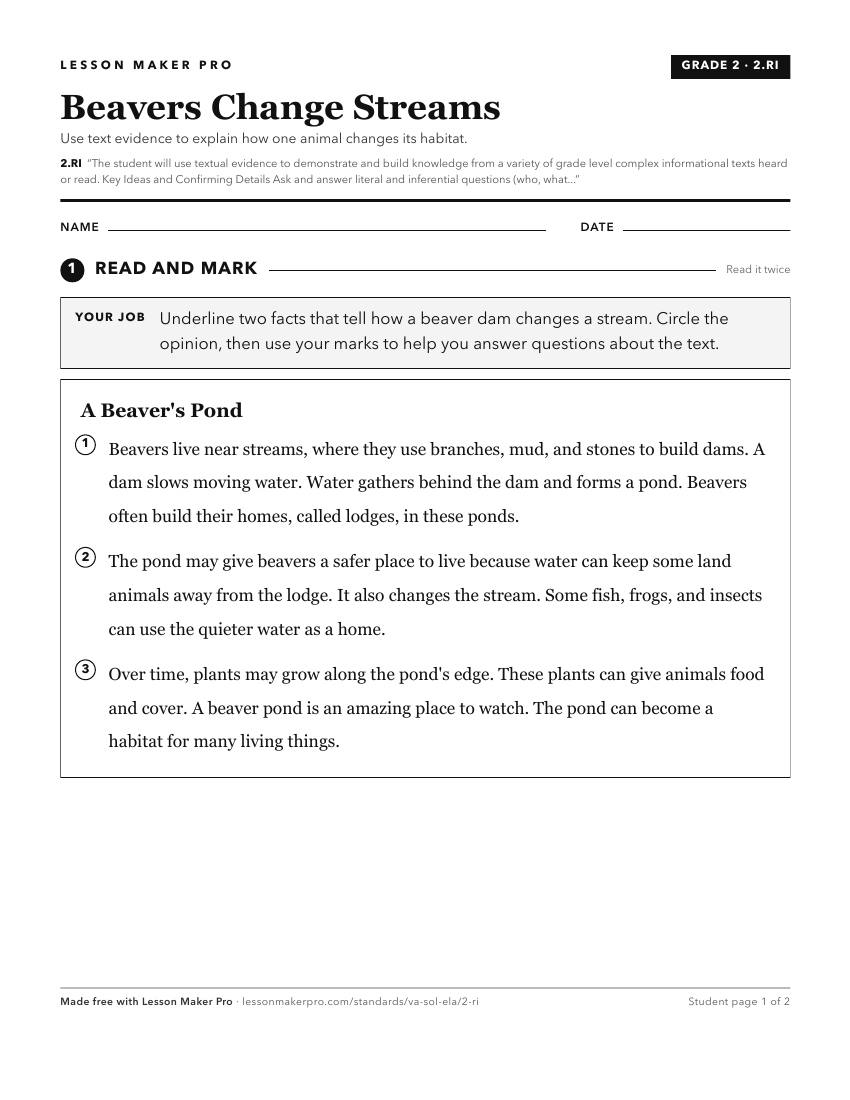
A ready-to-print activity worksheet aligned to 2.RI, with an answer key for the teacher on its own page. No account needed.
PDF, US Letter, prints cleanly in black and white.
Download the worksheetKeep exploring
Related Standards
- 4.RI
The student will use textual evidence to demonstrate comprehension and build knowledge from grade-level complex informational texts read.
- 9.RI
The student will use textual evidence to demonstrate comprehension and build knowledge from grade-level complex informational texts read.
- 3.RI
The student will use textual evidence to demonstrate comprehension and build knowledge from grade-level complex informational texts read.
- 10.RI
The student will use textual evidence to demonstrate comprehension and build knowledge from grade-level complex informational texts read.
Turn this cluster into a lesson
Grade, subject, topic, and the complete cluster are prefilled. Create one free, no account needed.
Also for this cluster:Make a WorksheetMake a QuizMake a Sub Lesson