Virginia SOL 10.RI
SOL Standard (Knowledge and Skills Cluster)
The student will use textual evidence to demonstrate comprehension and build knowledge from grade-level complex informational texts read.
Virginia Standards of Learning for English
Cluster contents
Knowledge and Skills in This Standard
10.RI is a Standards of Learning standard. These are the knowledge and skills expectations under it.
- 10.RI.1
Key Ideas and Confirming Details
- 10.RI.1.A
Explain how authors organize an analysis or series of ideas or events, including the order in which points are made, how they are introduced and developed, and ...
- 10.RI.1.B
Compare characteristics of the information from informational, historical, scientific, and technical texts and interpret the use of data and information in maps...
- 10.RI.1.C
Evaluate the argument and specific claims in texts, examining whether the reasoning is valid, the evidence is relevant, and whether there are any false or unsup...
- 10.RI.2
Craft and Style
- 10.RI.2.A
Analyze how authors use structure to explain relationships among concepts in a text, including how key sentences, paragraphs, and sections of texts contribute t...
- 10.RI.2.B
Analyze key terms (e.g., words and phrases, technical terminology) and ideas of historical, scientific, and technical texts to clarify the relationships and und...
- 10.RI.2.C
Analyze the author’s purpose and impact of literary techniques such as hyperbole, analogy, and paradox as they appear in texts.
- 10.RI.3
Integration of Concepts
- 10.RI.3.A
Evaluate how different authors write about the same topic and shape their presentations or viewpoints of key information using facts, opinions, and reasoning.
- 10.RI.3.B
Analyze multiple texts addressing the same topic to determine how authors reach similar or different conclusions.
Teacher's field guide
What This Cluster Means
What Students Need to Do
- Students cite details from complex nonfiction to explain ideas, claims, and relationships. They analyze organization, text structure, technical terms, data displays, and techniques such as analogy or hyperbole. They evaluate reasoning and compare how authors present the same topic.
What Mastery Looks Like
- Students can trace how an author introduces, orders, and connects claims or ideas. They judge whether evidence and data support the reasoning. They can compare two texts and explain how language, structure, facts, and opinions shape different conclusions.
Common Misconceptions
- Students often treat any quotation or statistic as relevant evidence. They may summarize paragraphs without explaining how the order, structure, or language develops ideas. They may also confuse opinion with false information or assume that charts prove every claim in the text.
How to Assess It
- Give students a 300-word article with one graph. Ask them to identify the main claim, cite relevant evidence, explain how one paragraph or the graph develops it, and flag one unsupported statement.
Lesson moves
Ways to Teach It
Give pairs paragraph strips from an article to arrange, then have them mark transitions and explain why the final order makes sense.
Read two accounts of the same event, then write how each author’s facts, word choices, and reasoning shape the conclusion.
Run an evidence sort where teams label cards relevant, irrelevant, opinion, or unsupported, then defend each label with the text.
Compare a news report and agency infographic about local water quality, checking each claim against the graph or table provided.
Free download
Printable 10.RI Worksheet
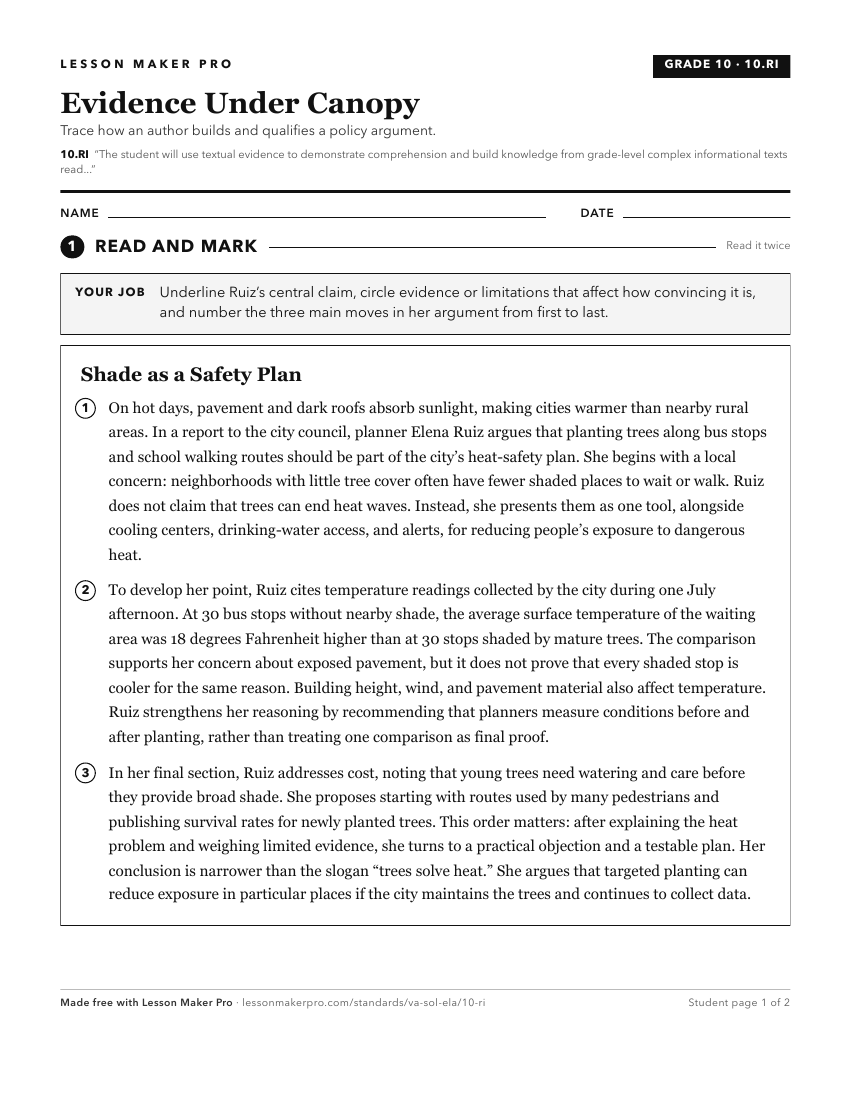
A ready-to-print activity worksheet aligned to 10.RI, with an answer key for the teacher on its own page. No account needed.
PDF, US Letter, prints cleanly in black and white.
Download the worksheetKeep exploring
Related Standards
Turn this cluster into a lesson
Grade, subject, topic, and the complete cluster are prefilled. Create one free, no account needed.
Also for this cluster:Make a WorksheetMake a QuizMake a Sub Lesson