Virginia SOL 10.RI.2.C
The Standard
Analyze the author’s purpose and impact of literary techniques such as hyperbole, analogy, and paradox as they appear in texts.
Virginia Standards of Learning for English · Craft and Style
Teacher's field guide
What This Standard Means
What Students Need to Do
- Students find hyperbole, analogy, and paradox in informational texts. They explain why the author chose each technique and how it shapes meaning, tone, emphasis, or reader response.
What Mastery Looks Like
- Students identify the technique and cite the exact words that create it. They explain its purpose and effect using details from the surrounding text, not vague claims like “it adds interest.”
Common Misconceptions
- Students may read hyperbole literally or call it a lie. They may confuse analogy with any comparison and treat paradox as a mistake rather than a meaningful contradiction.
How to Assess It
- Give students a short paragraph containing one technique. Ask them to name it and explain, in two sentences, why the author used it and how it affects readers.
Lesson moves
Ways to Teach It
Give pairs excerpt cards to sort into hyperbole, analogy, and paradox, then add a note explaining each technique’s effect.
Ask students to rewrite one technique literally, then discuss what meaning, tone, or emphasis disappears in the revised version.
Play technique detective with short passages, awarding points for correct identification and a text-based explanation of purpose and impact.
Examine an advertisement or speech and explain how one exaggerated claim, analogy, or paradox shapes the audience’s response.
Free download
Printable 10.RI.2.C Worksheet
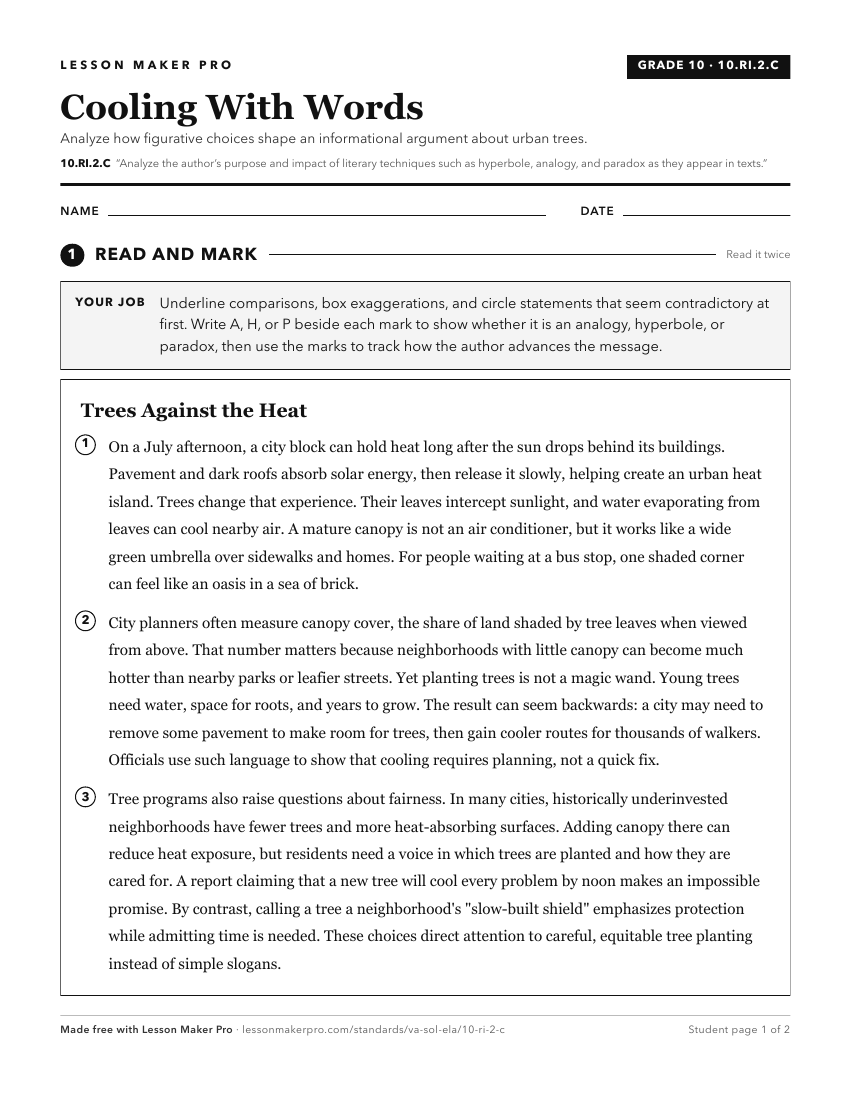
A ready-to-print activity worksheet aligned to 10.RI.2.C, with an answer key for the teacher on its own page. No account needed.
PDF, US Letter, prints cleanly in black and white.
Download the worksheetKeep exploring
Related Standards
- 10.RL.2.B
Analyze how authors use literary devices and figurative language, including allusion, allegory, and paradox to impact the meaning of the text.
- 5.RL.2.B
Analyze the author’s use of language (e.g., synonyms, figurative language, sensory words, dialogue, dialect) and their impact on understanding characters, setti...
- 11.RI.2.C
Recognize and analyze the author’s purpose and impact of ambiguity, contradiction, paradox, oxymoron, irony, sarcasm, overstatement, and understatement in infor...
- 8.RV.1.E
Analyze the construction and meaning of an author’s use of symbols, analogy, and figurative language such as simile, metaphor, personification, hyperbole, and i...
Turn this exact standard into a lesson
Grade, subject, topic, and the complete standard are prefilled. Create one free, no account needed.
Also for this standard:Make a WorksheetMake a QuizMake a Sub Lesson