Virginia SOL 7.RI
SOL Standard (Knowledge and Skills Cluster)
The student will use textual evidence to demonstrate comprehension and build knowledge from grade-level complex informational texts read.
Virginia Standards of Learning for English
Cluster contents
Knowledge and Skills in This Standard
7.RI is a Standards of Learning standard. These are the knowledge and skills expectations under it.
- 7.RI.1
Key Ideas and Confirming Details
- 7.RI.1.A
Create a main idea statement and provide an accurate summary of how key events or ideas develop through the text.
- 7.RI.1.B
Analyze how the author unfolds a perspective or series of ideas or events in historical, scientific, or technical texts, including the order in which the points...
- 7.RI.1.C
Trace the argument and specific claims in texts and assess whether all the evidence presented is relevant and whether irrelevant evidence was introduced.
- 7.RI.2
Craft and Style
- 7.RI.2.A
Analyze how an author uses text features (e.g., boldface and italics; type set in color; underlining; indentation; sidebars; illustrations, graphics and photogr...
- 7.RI.2.B
Analyze how an author’s word choice, organizational pattern, and language structure impact the author’s purpose and support the reader’s comprehension.
- 7.RI.2.C
Analyze how an author’s purpose(s) reflects the author’s perspective (e.g., beliefs, assumptions, biases) and influences the meaning of an informational text.
- 7.RI.3
Integration of Concepts
- 7.RI.3.A
Analyze ideas within and between selections including how specific sentences, paragraphs, or sections contribute to the development and meaning of ideas.
- 7.RI.3.B
Compare and contrast how two or more authors writing about the same topic shape their presentations or viewpoints of key information by emphasizing different fa...
Teacher's field guide
What This Cluster Means
What Students Need to Do
- Students identify a main idea and explain how details, sections, and text features develop it. They trace claims, judge whether evidence is relevant, and analyze how organization, wording, purpose, and perspective shape meaning. They also compare how authors present the same topic.
What Mastery Looks Like
- A student writes an accurate, objective summary and supports the main idea with well-chosen evidence. The student explains how ideas unfold and how wording, organization, purpose, perspective, and text features shape meaning. The student can judge evidence and compare how two authors present the same topic.
Common Misconceptions
- Students often treat the topic as the main idea or copy a sentence instead of forming a complete statement. They may include opinions in summaries, assume every detail supports a claim, or confuse evidence with explanation. They may also identify bias without showing how wording, selected facts, organization, or text features reveal it.
How to Assess It
- Give students a one-page article. Ask them to state the main idea, cite two supporting details, identify one claim and its evidence, and explain how one text feature supports understanding.
Lesson moves
Ways to Teach It
Cut a short article into sections; pairs restore the order, then annotate how each section develops the main idea.
Discuss: How do the author's word choices and selected facts reveal purpose, assumptions, or bias?
Play an evidence sort: teams place detail cards under relevant, irrelevant, or insufficient, then defend each choice with the claim.
Compare two news reports on the same local event, noting which facts, images, and viewpoints each source emphasizes.
Free download
Printable 7.RI Worksheet
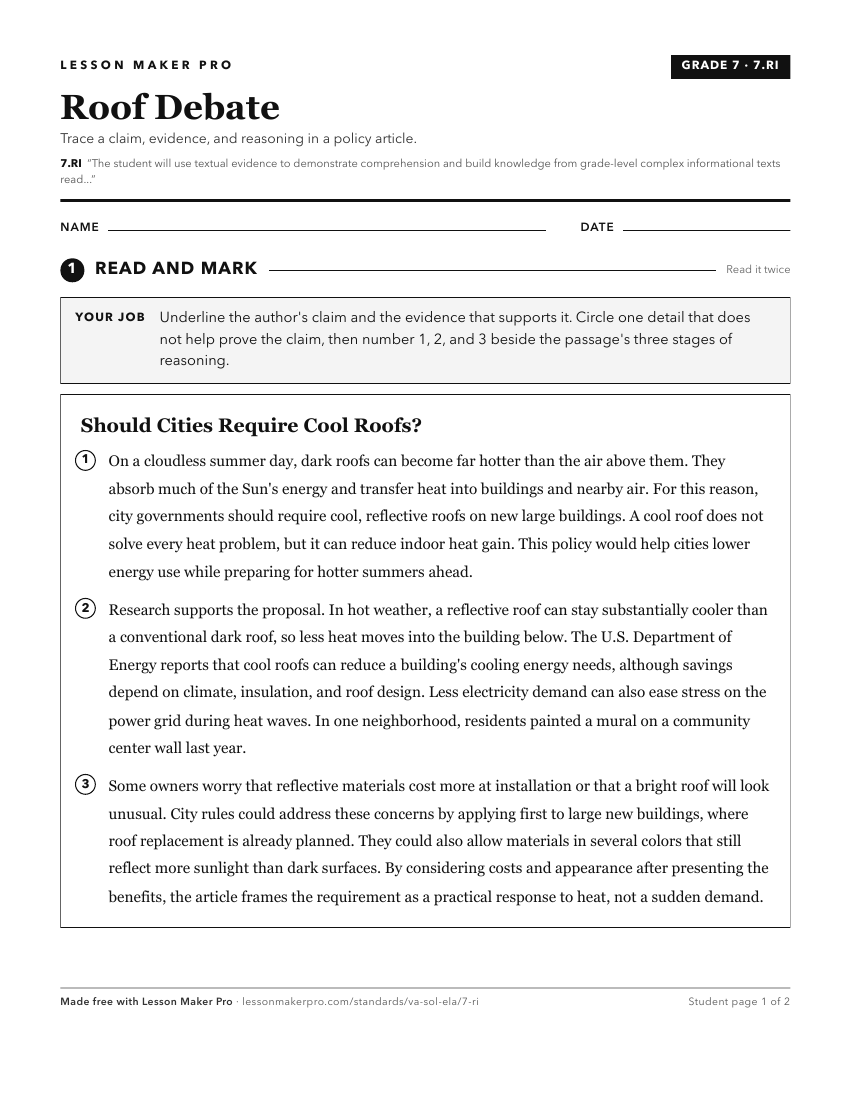
A ready-to-print activity worksheet aligned to 7.RI, with an answer key for the teacher on its own page. No account needed.
PDF, US Letter, prints cleanly in black and white.
Download the worksheetKeep exploring
Related Standards
Turn this cluster into a lesson
Grade, subject, topic, and the complete cluster are prefilled. Create one free, no account needed.
Also for this cluster:Make a WorksheetMake a QuizMake a Sub Lesson