Virginia SOL 10.RI.1.B
The Standard
Compare characteristics of the information from informational, historical, scientific, and technical texts and interpret the use of data and information in maps, charts, graphs, timelines, tables, and diagrams.
Virginia Standards of Learning for English · Key Ideas and Confirming Details
Teacher's field guide
What This Standard Means
What Students Need to Do
- Students compare how different kinds of nonfiction organize ideas and present evidence. They interpret maps, charts, graphs, timelines, tables, and diagrams. They connect visual data to claims or conclusions in the text.
What Mastery Looks Like
- A student can explain how historical accounts, scientific reports, and technical texts present information differently. The student reads visuals accurately and uses specific data to support a comparison or conclusion.
Common Misconceptions
- Students may treat maps, charts, and diagrams as decoration rather than evidence. They may ignore axes, units, legends, scale, or dates. They may also confuse what the data shows with the author's interpretation.
How to Assess It
- Give students a short paragraph and a related graph. Ask: "State one conclusion supported by both sources, cite one detail from each, and explain how their presentations differ."
Lesson moves
Ways to Teach It
Give groups four source cards and matching visuals; students sort them by text type, then annotate the evidence each source emphasizes.
Write: How would a historian, scientist, and technician present the same flood differently, and what evidence would each emphasize?
Run a graph detective relay where teams identify titles, units, trends, and one supported conclusion at each visual data station.
Compare a local weather article, forecast map, data table, and safety instructions to decide which source best answers four practical questions.
Free download
Printable 10.RI.1.B Worksheet
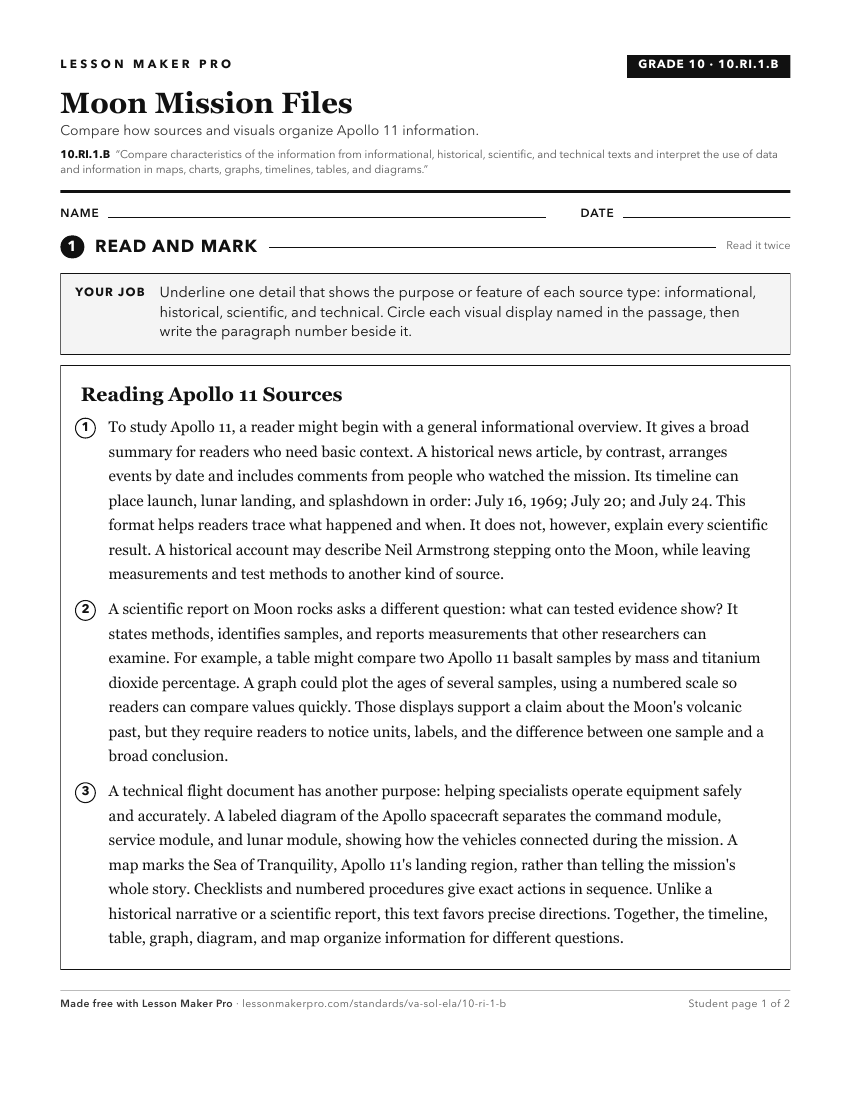
A ready-to-print activity worksheet aligned to 10.RI.1.B, with an answer key for the teacher on its own page. No account needed.
PDF, US Letter, prints cleanly in black and white.
Download the worksheetKeep exploring
Related Standards
- 3.RL.3.B
Compare and contrast details in paired literary and informational nonfiction texts including their treatment of similar themes, topics, and patterns of events.
- 11.RI.1.B
Analyze the hypotheses, data, analysis, and/or conclusions in informational, historical, scientific, or technical texts, verifying the data when possible and co...
- 9.RI.1.B
Explain the purpose and interpret the use of data and information in maps, charts, graphs, timelines, tables, and diagrams in informational, historical, scienti...
- 11.RI.3.B
Compare and contrast informational and technical texts for intent, content, and clarity.
Turn this exact standard into a lesson
Grade, subject, topic, and the complete standard are prefilled. Create one free, no account needed.
Also for this standard:Make a WorksheetMake a QuizMake a Sub Lesson