Virginia SOL 11.RI.1.B
The Standard
Analyze the hypotheses, data, analysis, and/or conclusions in informational, historical, scientific, or technical texts, verifying the data when possible and corroborating or challenging conclusions with other sources of information.
Virginia Standards of Learning for English · Key Ideas and Confirming Details
Teacher's field guide
What This Standard Means
What Students Need to Do
- Students identify a writer’s hypothesis, evidence, reasoning, and conclusion. They judge whether the evidence supports the conclusion. They check key facts or data against other reliable sources.
What Mastery Looks Like
- Students can trace how a writer moves from a question or hypothesis to evidence and a conclusion. They can check data against another reliable source and explain whether the conclusion is supported, limited, or contradicted.
Common Misconceptions
- Students may treat any number or quotation as strong evidence. They may assume a conclusion is valid because it sounds reasonable or appears in a credible publication. Some compare sources without checking whether they use the same definitions, dates, or methods.
How to Assess It
- Give students a short article, its data table, and a second source. Ask: “Does the evidence support the conclusion, and what does the second source confirm or challenge?”
Lesson moves
Ways to Teach It
Give groups an article, data table, and colored notes to label the hypothesis, evidence, analysis, conclusion, and any gaps.
Ask students to write: “Which conclusion is best supported, and what specific evidence makes it stronger than the others?”
Run an evidence sorting race where teams match claims to supporting data, weak data, conflicting data, or irrelevant details.
Compare a health claim from social media with CDC data, then have students explain whether the post’s conclusion holds up.
Free download
Printable 11.RI.1.B Worksheet
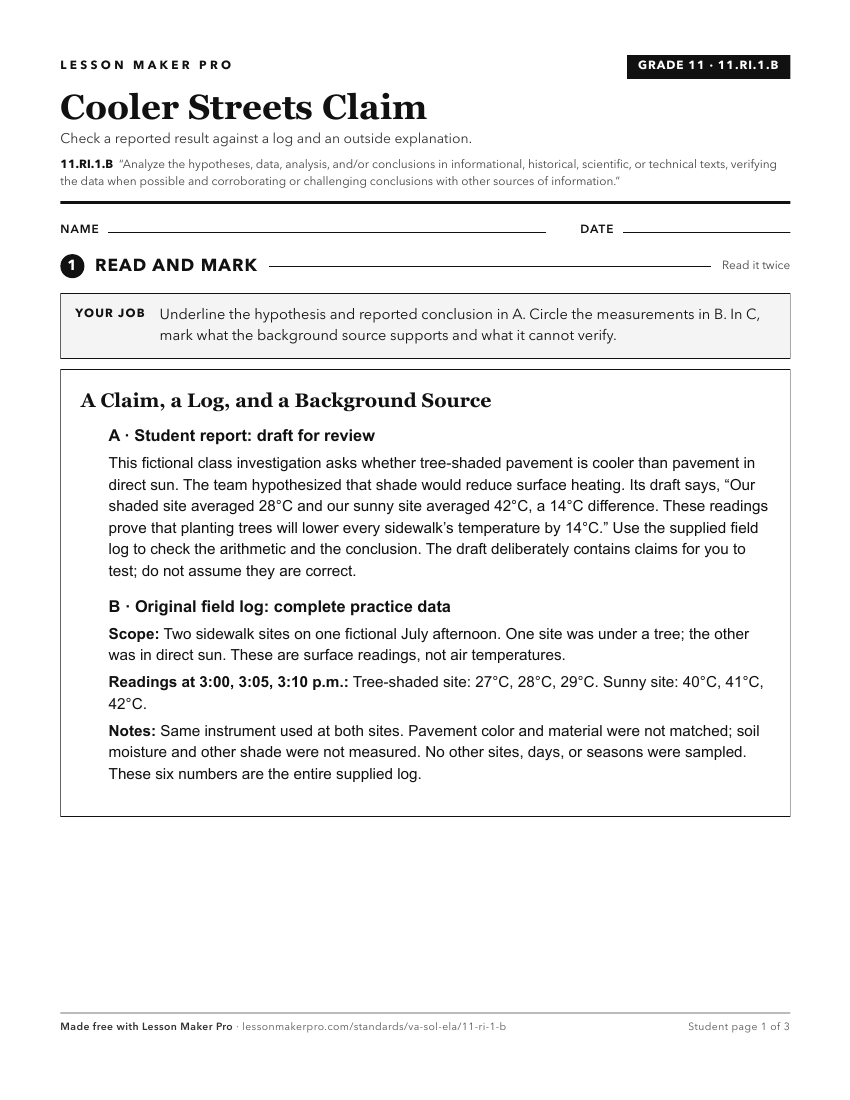
A ready-to-print activity worksheet aligned to 11.RI.1.B, with an answer key for the teacher on its own page. No account needed.
PDF, US Letter, prints cleanly in black and white.
Download the worksheetKeep exploring
Related Standards
- 10.RI.1.B
Compare characteristics of the information from informational, historical, scientific, and technical texts and interpret the use of data and information in maps...
- 11.RI.2.B
Analyze and interpret the key terms (e.g., content-specific words and phrases, technical terminology) and ideas of historical, scientific, technical, and employ...
- 10.RI.2.B
Analyze key terms (e.g., words and phrases, technical terminology) and ideas of historical, scientific, and technical texts to clarify the relationships and und...
- 9.RI.3.B
Evaluate the clarity and accuracy of information found in informational texts, corroborating or challenging conclusions with other sources of information.
Turn this exact standard into a lesson
Grade, subject, topic, and the complete standard are prefilled. Create one free, no account needed.
Also for this standard:Make a WorksheetMake a QuizMake a Sub Lesson