Virginia SOL 9.RI.3.B
The Standard
Evaluate the clarity and accuracy of information found in informational texts, corroborating or challenging conclusions with other sources of information.
Virginia Standards of Learning for English · Integration of Concepts
Teacher's field guide
What This Standard Means
What Students Need to Do
- Students judge whether a text explains its ideas clearly and supports its claims with accurate evidence. They compare its conclusions with reliable sources, then explain where the sources agree or conflict.
What Mastery Looks Like
- A student can flag vague wording, unsupported claims, and factual errors in a passage. The student can use independent sources to confirm or dispute the author’s conclusion and cite exact evidence from each.
Common Misconceptions
- Students may assume polished wording, charts, or precise numbers make a source accurate. They may call two sources corroborating when one merely repeats the other. They may reject an entire text because one detail is unclear or wrong.
How to Assess It
- Give students a short article about later school start times and a district attendance table. Ask whether the table confirms or challenges the article’s conclusion, then have students identify one unclear or inaccurate sentence and cite both sources.
Lesson moves
Ways to Teach It
Give pairs claim cards and three printed sources, then have them sort each claim into confirmed, challenged, or unresolved piles.
Ask students to write: Which conclusion is best supported, and what wording or evidence makes another conclusion less trustworthy?
Run a corroboration relay where teams race to match claims with supporting or conflicting evidence, then justify one match aloud.
Compare a viral health post with a public health fact sheet, then identify which claims a reader should accept, question, or reject.
Free download
Printable 9.RI.3.B Worksheet
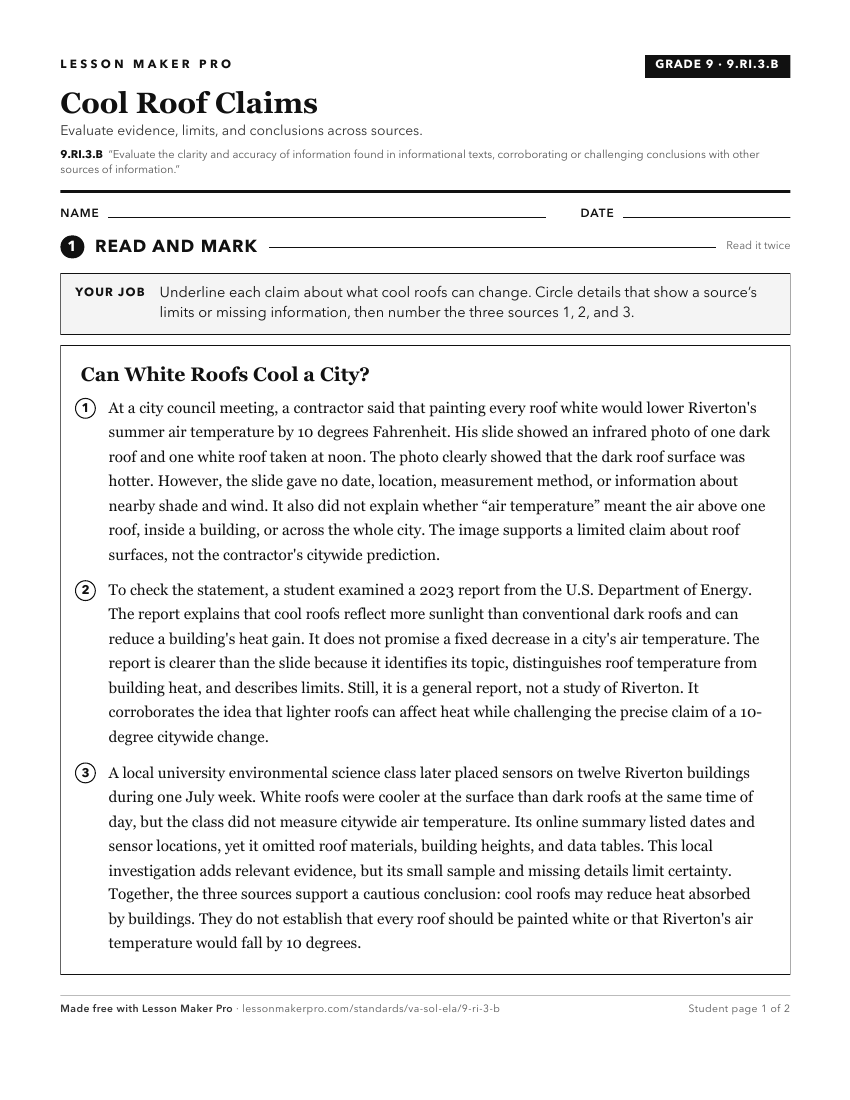
A ready-to-print activity worksheet aligned to 9.RI.3.B, with an answer key for the teacher on its own page. No account needed.
PDF, US Letter, prints cleanly in black and white.
Download the worksheetKeep exploring
Related Standards
- 8.R.1.C
Evaluate and analyze the relevance, validity, and credibility of sources (primary, secondary, digital, and print) identifying main and supporting ideas, conflic...
- 11.R.1.C
Objectively evaluate primary and secondary sources for their credibility, reliability, accuracy, usefulness, and limitations. That includes identifying their ma...
- 11.RI.1.B
Analyze the hypotheses, data, analysis, and/or conclusions in informational, historical, scientific, or technical texts, verifying the data when possible and co...
- 11.RI.1.C
Evaluate the relevance and quality of an author’s premises, claims, counterclaims, and evidence by corroborating or challenging them with other information.
Turn this exact standard into a lesson
Grade, subject, topic, and the complete standard are prefilled. Create one free, no account needed.
Also for this standard:Make a WorksheetMake a QuizMake a Sub Lesson